

Key takeaways on healing from porn addiction
-
Healing from porn addiction requires removing triggers, interrupting habit loops, and retraining the brain’s reward system over time.
-
The process starts by identifying patterns—such as stress, boredom, or loneliness—that drive porn use.
-
Breaking the cycle involves creating friction and disrupting automatic behaviors before they escalate.
-
Replacing porn with healthier activities like exercise or social interaction helps restore natural reward pathways.
-
Accountability through friends, support groups, or structured programs increases consistency and reduces relapse risk.
-
Long-term recovery comes from consistent behavior change rather than relying on willpower alone.
-
Cravings weaken over time as habit loops lose reinforcement and the brain adapts to new patterns.
-
Sustainable healing focuses on building a lifestyle that supports control, connection, and real-world reward.
Frequently asked questions about healing from porn addiction
How to heal from porn addiction?
Healing from porn addiction involves removing triggers, replacing the habit with healthier behaviors, and retraining your brain’s reward system.
Start by identifying when and why you watch porn—such as stress, boredom, or loneliness—then create a plan to interrupt those patterns. Build accountability through friends, support groups, or structured programs, and replace porn with activities that provide real rewards, like exercise or social connection.
Over time, these consistent changes weaken cravings and help restore control.
Can your brain heal from porn?
Yes, your brain can heal from porn through a process called neuroplasticity, which allows it to rewire and adapt over time.
Frequent porn use can desensitize your brain’s reward system by overstimulating dopamine pathways, but when you stop, those pathways gradually return to normal function.
As healing occurs, you may notice improved focus, stronger motivation, and a greater ability to enjoy everyday activities without needing artificial stimulation.
How long does it take to heal from porn addiction?
Healing from porn addiction typically takes several weeks to a few months, depending on how long and how often you’ve been using it.
Many people experience withdrawal symptoms like cravings, anxiety, or low mood in the first 1–2 weeks, followed by gradual improvement over 30–90 days.
Deeper recovery—such as stable mood, reduced urges, and normalized dopamine response—can take several months or longer with consistent effort and healthy habits.
What happens when you heal from porn addiction?
When you heal from porn addiction, your brain’s reward system begins to function normally again, making real-life experiences more satisfying and engaging.
Cravings become less frequent and less intense, emotional regulation improves, and your ability to focus increases.
Many people also experience better relationships, stronger confidence, and a renewed sense of control over their thoughts and behaviors.
What are the signs I’m healing from porn addiction?
Signs you’re healing from porn addiction include fewer and weaker urges, improved mood, better concentration, and increased interest in real-life activities and relationships.
You may also notice longer periods without thinking about porn, reduced feelings of guilt or shame, and a greater ability to handle stress without relying on old habits.
These changes often happen gradually and signal that your brain is adapting to healthier patterns.
Relay is a therapist-backed group recovery program for pornography and unwanted sexual behavior, combining daily accountability, real-time urge support, and a private peer community
What to Expect When Healing From Porn Addiction (Timeline)
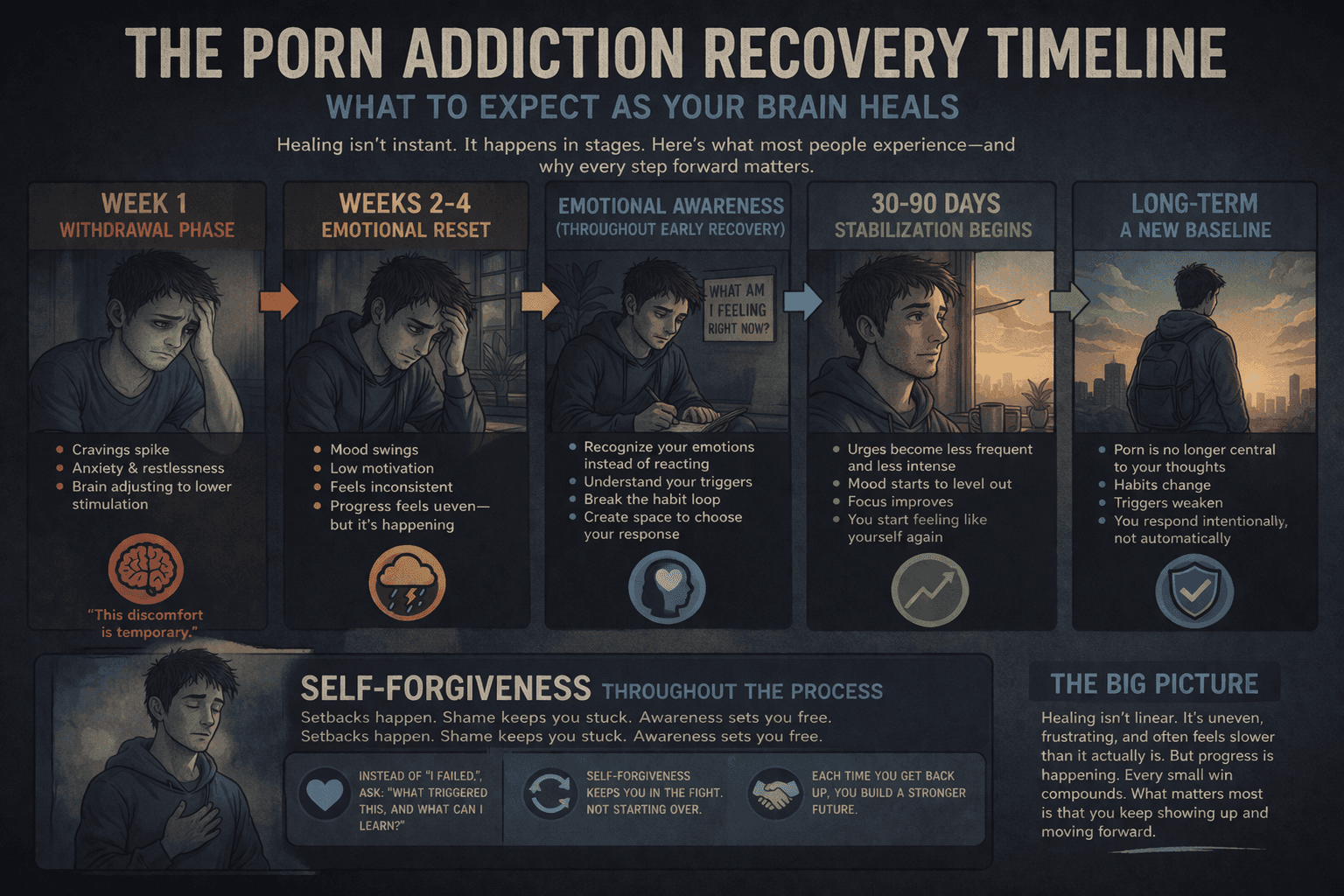
Healing from porn addiction happens in stages. Knowing what to expect can help you stay grounded—especially during periods where it feels like nothing is changing.
Week 1: Cravings, Anxiety, and Restlessness
-
You’ll likely experience a spike in cravings, along with anxiety and restlessness
-
Your brain is reacting to the sudden loss of a familiar source of stimulation
-
This discomfort doesn’t mean you need porn—it means your brain is adjusting
-
Urges may feel intense, but they are temporary and will pass
Weeks 2–4: Mood Swings and Low Motivation
-
Emotions can feel unpredictable—some days better, some worse
-
You may experience low motivation, irritability, or emotional flatness
-
Progress won’t feel linear, which can make this stage frustrating
-
This is a critical point where many people assume they’re failing—but they’re not
Emotional Awareness During Early Recovery
-
Learning to recognize your emotional state is key during this phase
-
Instead of reacting automatically, begin asking: “What am I feeling right now?”
-
Understanding your triggers (stress, boredom, loneliness) helps break the habit loop
-
This awareness creates space between the urge and your response
30–90 Days: Stabilization Begins
-
Urges become less frequent and less intense
-
Everyday activities begin to feel more engaging again
-
You may not feel fully healed, but you’ll notice increased control
Long-Term: A New Baseline
-
Porn becomes less central to your thoughts
-
Your default behaviors begin to change
-
Urges may still occur, but they no longer feel automatic
-
You respond more intentionally rather than reactively
Self-Forgiveness Throughout the Process
-
Setbacks may happen—this is part of recovery, not the end of it
-
Responding with shame reinforces the cycle; responding with awareness breaks it
-
Instead of “I failed,” shift to: “What triggered this, and what can I learn?”
-
Self-forgiveness allows you to stay consistent instead of starting over
The Big Picture
Healing is not linear—it’s uneven, frustrating, and often feels slower than it actually is. There will be moments where it seems like nothing is changing, but progress is still happening beneath the surface. Each time you resist an urge, respond differently to a trigger, or recover more quickly from a setback, you’re reinforcing a new pattern. Over time, these small shifts compound into meaningful change. What matters most isn’t how quickly you heal, but that you keep showing up and moving forward.
Why Has Healing From Porn Addiction Been So Hard?
Porn addiction is a behavioral addiction, similar to being addicted to sex or gambling. Like other addictions, it often doesn’t have one specific cause—there are many underlying factors that can contribute to porn addiction, and it’s not uncommon for people to develop an emotional reliance on pornography before they’re even aware it’s bad.
Unfortunately, time and repetition train the brain to believe it needs porn, and even to experience addiction-like symptoms.
Many people turn to porn as a coping method to deal with stress, anxiety, or depression.
Porn addiction is difficult to overcome because it rewires your brain’s reward system. Each time you watch porn, your brain releases a surge of dopamine, reinforcing the behavior. Over time, this leads to desensitization—meaning you need more stimulation to feel the same effect.
At the same time, your brain begins to associate certain triggers like boredom, stress, or being alone with porn use, making the behavior feel automatic.
Until you understand this, you will always feel like you aren't making progress in your recovery journey.
How to Actually Heal From Porn Addiction (Step-by-Step)
The term “heal” is a literal one in this case.
Months or years of watching too much pornography have changed how your brain reacts to stress and other triggers, but this is not permanent. Your efforts to heal from porn addiction will also rewire your brain in a good and positive way, but the process will not happen overnight.
The best things you can do to heal from porn are to identify the problem and set clear goals, build a support network of safe people, find a recovery program, address any underlying concerns that may be augmenting the issue, and replace the time you spent watching porn with a positive behavior instead.
Most people try to quit porn using willpower alone—and that’s why they fail.
Real recovery comes from changing your environment, understanding your triggers, and building systems that make better behavior easier. The steps below break this process into something practical you can actually follow.
-
Identify the problem
You can’t change a behavior you don’t understand, and you can't solve a problem you've yet to identify.
All healing efforts go further when you at least know how you ended up hurt in the first place.
If you don't understand how you got injured, you're likely to keep injuring yourself, regardless of how much you heal in the interim.
Most people don’t watch porn randomly—it follows a pattern. The key is to figure out when, where, and why it happens.
Ask yourself:
-
What time of day do I usually watch?
-
What am I feeling right before? (bored, stressed, lonely, tired)
-
What situation am I in? (alone, on my phone, late at night)
Over time, you’ll start to see that porn use isn’t the real problem—it’s your response to a trigger.
-
Set clear recovery goals for yourself
Recovery is an ongoing process.
“Quit porn forever” sounds good—but it is neither reasonable nor actionable. What actually works is setting goals you can track and adjust.
The problem with a goal like “never watch porn again” is that there’s no way you can ever feel like you’ve made progress, and that’s not a trivial issue. Setting tough goals for ourselves is how we change, but we also need to have a measurable way to know that we’re getting better.
Vaguely imprecise “forever goals” don’t accomplish this. Instead, pick set goals that have a very clear metric of success. For example:
-
“Go 3 days without watching porn”
-
“Reduce usage by 50% this month”
-
“Replace one urge per day with a different behavior”
The goal isn’t perfection. It's progress and awareness. I don’t want you to take this as an excuse to “fall off the wagon” and feel fine about it. Rather, use it to remind yourself that you don’t need to be perfect. You just need to be better than you were yesterday.
Tracking your behavior (even loosely) helps you:
-
see patterns
-
measure improvement
-
stay motivated
-
This creates consistency, and that’s what’s really needed to heal.
-
Build a support network
Porn addiction thrives in isolation and weakens in connection.
Research shows this same pattern in all addictions. The problem with pornography is that by the nature of how and why it's used, it further exacerbates this sense of loneliness.
The only way to reverse this is to find someone to talk to. Ideally, you’d find a porn addiction support group.
You don’t have to tell everyone everything. But you do need at least one person who knows what you’re dealing with.
This could be:
-
a friend
-
a mentor
-
a support group
-
an online community
The goal isn’t just accountability after you mess up—it’s support before you do.
Reach out when:
-
you feel urges
-
you’re stressed
-
you’re slipping into old patterns
Connection reduces the emotional pressure that drives the behavior in the first place. Half of dealing with difficult problems, like porn addiction, is preventing them before they happen.
Building supporting connections in your life and nurturing them is one of the single most powerful ways to accomplish this.
-
Find a recovery program
The fastest way to heal from porn is to find a structured porn recovery program and get involved.
Relay is a recovery program created for people struggling with pornography by people who have been in their shoes. Instead of just being a habit tracker, Relay combines the proven science of support groups with powerful curriculum from behavioral psychologists who specialize in addiction recovery.
Gain a group of new teammates who understand exactly what you’re going through, and work together with them to finally make lasting progress against addiction.
With Relay, you’ll learn to root out addiction at the source, and gain real tools to help you heal from porn and regain control of your life!
-
Address the underlying issues
Often, addiction to pornography is a symptom of other underlying issues. In order to heal from porn long-term, those issues need to be uncovered and addressed. These issues can range from everyday stresses to real mental health issues.
Imagine having a broken bone. Intense physical pain is just a symptom of the underlying fracture.
You can take all the pain medication you want to, but if you leave that broken bone untreated, it will continue to cause problems in your everyday life.
Addiction to pornography is no different — you have to address the underlying issues. If you’re ready to go deeper and heal your pornography issue once and for all, you can find help here.
-
Forgive yourself
This step in recovery is rarely mentioned, but it is perhaps the most important step of all.
If you do not forgive yourself for your past mistakes, you will never be able to move past them and may end up making them again.
If you respond to every slip with shame, you reinforce the cycle. You feel bad, look for relief from that feeling, and end up right back in the behavior. The issue isn’t just the habit—it’s how you respond afterward.
Guilt is normal. It signals that your actions don’t align with your values. But once you’ve learned the lesson, holding onto that guilt turns into self-punishment. You can’t change the past, no matter how much you replay it.
Healing doesn’t require you to hate yourself into doing better. Urges don’t make you weak—they’re conditioned responses. Relapse doesn’t erase progress—it’s information. And change isn’t linear.
Instead of thinking, “I failed again,” ask: What triggered this, and what can I do differently next time? That shift turns setbacks into part of the process.
Self-forgiveness doesn’t mean avoiding responsibility. It means accepting the mistake, learning from it, and letting go of the need to keep punishing yourself. You’re not trying to be perfect—you’re trying to improve.
If you don’t learn how to treat yourself with some level of respect, you’ll stay stuck in the loop.
Forgiving yourself isn’t letting yourself off the hook.
It’s staying in the fight long enough to actually win.
-
Stay consistent
There will be stretches where it feels like nothing is working.
Cravings will be hard, progress will feel slow, and you'll feel like you’re putting in effort without seeing results.
It's not a sign of failure and it's the worst time to even think about giving up.
For a long time, your brain has been trained to expect a certain reward in response to certain triggers. When you remove that pattern, there’s a period where everything feels off.
What matters most during this phase isn’t how you feel but how you respond.
Sticking to the behaviors you’ve committed to is what drives change, even when it doesn’t feel like it in the moment. Consistency builds new patterns, and those patterns eventually become your default.
Progress is always happening, even if you don't notice. Each day, you will be a little more healed. And then eventually, you'll see something has changed—not all at once, but because you kept going when it didn’t feel like it was working.
When you need more to heal
Healing from porn addiction isn’t about willpower—it’s about having a plan and the right support to follow through on it.
You can try the NoFap challenge. It works, but many people require an understanding to really make the changes stick.
Real recovery starts with understanding your patterns. When are you most likely to slip? What are you feeling in those moments—stress, boredom, loneliness, fatigue? Once you recognize those triggers, you can begin to replace the behavior. That means intentionally choosing something else to do when those moments hit—something positive, engaging, and aligned with the person you’re trying to become.
But the part most people miss is this: you don’t do it alone.
Instead of only reaching out after a setback, bring others into the process. Share your recovery plan with people you trust. Let them know what your triggers are, what you’re working on, and when you’re struggling. Use them not just for accountability after the fact, but as support in real time—when it actually matters. That connection is what breaks the isolation that keeps the cycle going.
This is exactly what we focus on inside Relay.
In the Relay program, you don’t just track habits—you build a real recovery system. You learn how to identify your triggers, create practical replacement behaviors, and lean on a group of people who understand exactly what you’re going through. It’s structured, supportive, and designed to help you make lasting change—not just temporary progress.
Healing from porn addiction can feel overwhelming, but it’s absolutely possible. Thousands of people have already done it, and many more are working through it right now—just like you.
You’re not broken. You’re not stuck. And you don’t have to figure this out alone.
If you’re ready to take this seriously and finally make progress, try Relay and start building a system that actually works.