

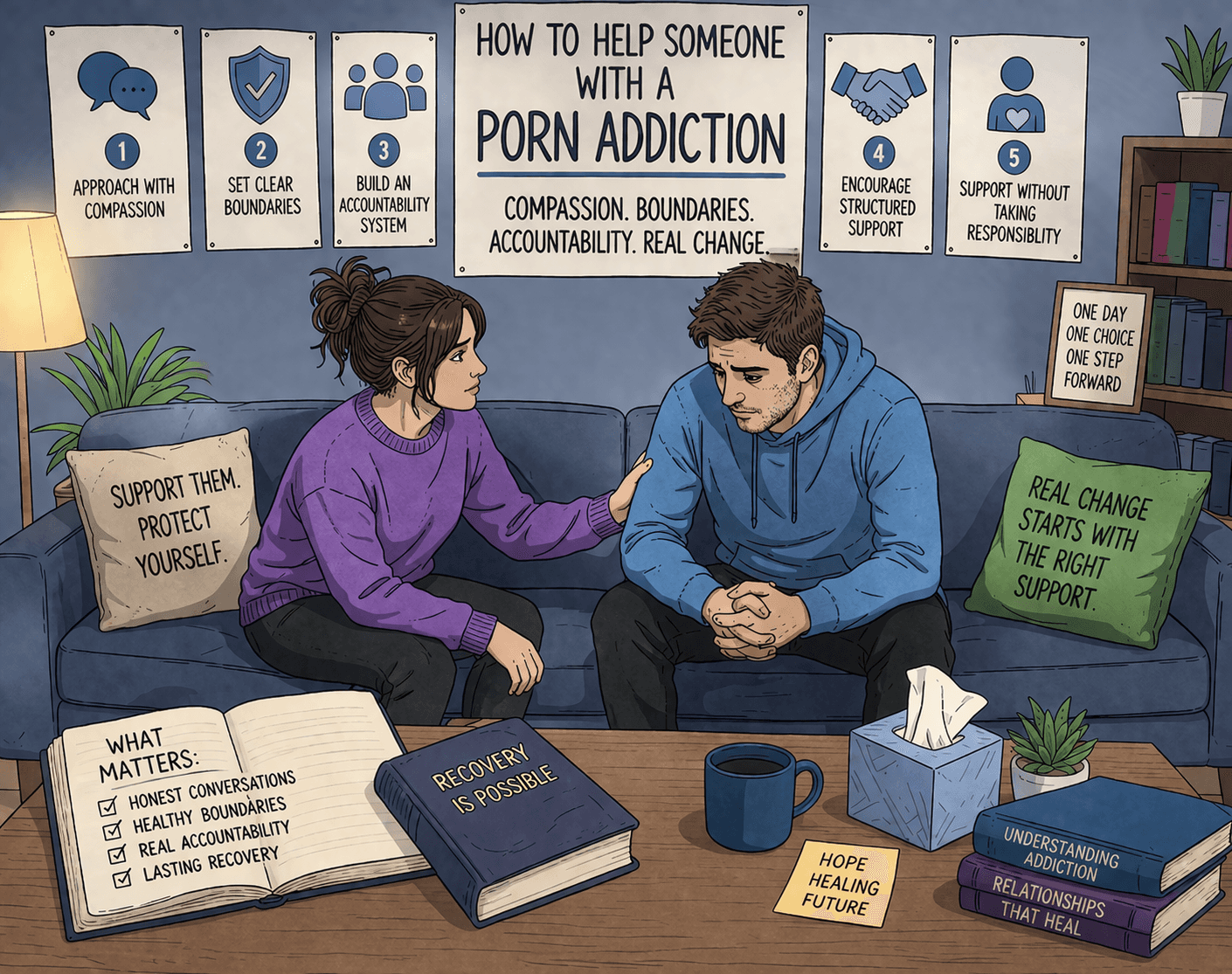
Key takeaways about helping a porn addict
-
Helping someone with a porn addiction requires combining empathy with structure, including clear communication, boundaries, and accountability.
-
You cannot force someone to change—their recovery depends on their willingness to take ownership of the problem.
-
The most effective support avoids shame and focuses on calm, honest conversations that reduce defensiveness.
-
Boundaries are essential and must be clearly defined and enforced to prevent ongoing harm and enable change.
-
Real progress requires structured support systems like therapy, accountability groups, or recovery programs.
-
Focusing on behavior patterns rather than isolated incidents helps you respond strategically instead of emotionally.
-
Trying to control or “fix” someone often leads to burnout and can slow their recovery rather than help it.
-
Protecting your own emotional well-being is just as important as supporting their recovery.
Frequently asked questions about helping a porn addict
What is the best way to help someone with a porn addiction?
The most effective way to help someone with a porn addiction is to combine empathy with structure. This means having honest, calm conversations while also encouraging accountability, professional support, and clear behavioral changes. Support without structure often leads to repeated cycles of relapse.
Can you fix someone’s porn addiction for them?
No, you cannot fix someone else’s addiction. You can support them, but they have to choose to change. Trying to control or rescue them often leads to frustration, burnout, and codependency rather than real progress.
What should you avoid doing when helping someone with a porn addiction?
You should avoid shaming, making threats you won’t enforce, ignoring the problem, or taking responsibility for their recovery. These approaches tend to push the behavior underground and make long-term change less likely.
How do you know if someone is serious about quitting porn?
Someone is serious about quitting porn when their actions change, not just their words. This includes setting up accountability systems, avoiding triggers, seeking help, and being consistent over time. Promises without behavioral change are not reliable indicators of progress.
What should you do if they refuse help?
If someone refuses therapy, accountability, or any structured support, you need to take that seriously. At that point, the issue is not just the addiction, but the refusal to address it. This is where boundaries become decisions about what you are willing to tolerate.
Relay is a therapist-backed group recovery program for pornography and unwanted sexual behavior, combining daily accountability, real-time urge support, and a private peer community.
How to Help Someone With a Porn Addiction
You didn’t go snooping in your spouses or child's electronics. Maybe you were planning a surprise, or you just wanted to look something up, or maybe it was even something as non-invasive as just shutting it down.
And then you saw the porn, and you were shocked. You thought about saying nothing, but then you looked into various pornography stats and realized that you needed to confront them.
Sometimes, the person caught with porn will deny it, and try to gaslight you into thinking you're crazy.
Others have told me that when they confronted a loved one about their pornography use, they blamed a virus or an internet prank. Maybe that could fly in the early 2000s, but now you and everyone else knows better—especially since the page was open in Google Incognito Mode.
And then there's the worst tactic of all. Your loved one blames someone else in the else house. Or they even try to say that you must have been looking it up.
When I was kid, my mom's boyfriend tried this after we received a massive phone bill for calling one of those 1-900 sex lines and he tried to blame 5 year old me. Yes, those 1-900 numbers are a relic of the past, but the response is still directionally the same.
Regardless of the situation plays out when you confront your loved one, you’re stuck in a place no one prepares you for—confused, hurt, and unsure what to do next. Because of how smoothly the confrontation goes—maybe they just outright admit it or they try one of the aforementioned approaches—you probably start wondering if you should have just ignored it.
You don't even know what you expected out of bringing it up and that leads to an even more important question that's more difficult to answer:
Can you even help someone who doesn’t admit they were watching porn or, if they do admit it, they don't even think they have a problem?
Here's the thing a lot of interventions and well-meaning advice misses:
Helping someone with a porn addiction isn’t just about confronting, talking through it, setting boundaries providing support. There is also a delicate but proven way to approach them that requires knowing what actually works, what makes things worse, and how to protect yourself in the process.
This guide will walk you through exactly how to do that.
What Porn Addiction Actually Looks Like
Porn addiction isn’t just “watching too much porn.”
It’s a pattern of behavior where someone continues using pornography despite clear negative consequences on their relationships, mental health, and daily life.
And here’s what makes it difficult to deal with:
Most people struggling with it don’t see it the same way you do.
They might think:
-
“It’s not that serious”
-
“Everyone does it”
-
“I can stop whenever I want”
At the same time, their behavior tells a different story—hiding usage, lying about it, withdrawing emotionally, or losing interest in real-life intimacy.
This gap between what they believe and what’s actually happening is what makes helping them so difficult.
Because before anything changes, they have to recognize the problem—and many don’t.
What Happens When You Try to Help (And Why It Often Fails)
If you’ve already tried to help, you’ve probably run into this:
You bring it up calmly… and they get defensive.
You explain how it’s affecting you… and they minimize it.
They promise to stop…and then go right back to it.
This isn’t random and, as hard as they may be to accept, it's not personal either. With that said, it does affect you personally and it seems like something in their control to stop, so you—understandably so—are hurt.
This path is well-traveled by people who have dealt with loved ones suffering through addiction, irregardless of the vice.
Porn addiction, like any other addiction, often follows a predictable cycle:
-
Use
-
Shame
-
Promise to change
-
Short-term effort
-
Relapse
-
Secrecy
-
Repeat
If you don’t understand this cycle, it’s easy to take their behavior personally—or believe that your approach is the problem.
It’s not.
You’re dealing with a pattern that requires more than just “being supportive.”
It requires something more, and much of that is either not obvious or completely counterintuitive.
The 5-Step Framework to Help Someone With a Porn Addiction
If you want to actually help someone—not just talk about helping them—you need a structured approach.
Here’s what works:
1. Recognize the Pattern (Not Just the Behavior)
Most people focus on the behavior—watching porn.
But the real issue is the pattern around it.
If you’re trying to help someone, look for this:
-
Repeated attempts to quit that fail
-
Secrecy (cleared history, hidden devices, late-night use)
-
Defensiveness when it’s brought up
-
Emotional withdrawal or loss of intimacy
This matters because if you only focus on the behavior, you’ll treat it like a one-time issue.
It’s not.
It’s a loop.
And until you recognize that, you’ll keep expecting permanent change from temporary effort.
Once you see the pattern clearly, you can stop reacting emotionally and start responding strategically.
2. Approach the Conversation Without Triggering Defensiveness
How you bring this up will determine everything that happens next.
If you come in angry, accusing, or emotional, the conversation will shut down immediately—even if you’re right.
Most people instinctively say things like:
-
“You need to stop this”
-
“This is ruining everything”
-
“What’s wrong with you?”
And while those feelings are valid, that approach usually leads to denial, excuses, or withdrawal.
Instead, aim for clarity without attack.
Start with something like:
-
“I’m not here to fight you. I’m worried about what I’m seeing.”
-
“I want to understand what’s going on, not just react to it.”
Your goal isn’t to win an argument.
It’s to open a conversation they don’t feel the need to escape from.
That doesn’t mean being passive—it means being intentional.
Because once they feel attacked, they stop listening. And once they stop listening, nothing changes.
3. Set Boundaries That You Are Willing to Enforce
This is where most people struggle.
They either:
-
Avoid setting boundaries altogether
-
Or set boundaries they don’t enforce
A boundary isn’t about controlling them.
It’s about defining what you will and won’t accept—and what happens if that line is crossed.
For example:
-
“I’m not okay staying in this relationship if this continues without effort to change.”
-
“If there’s continued dishonesty, I will need to take space.”
The key is this:
If you say it, you have to mean it.
Empty threats don’t create change. They create permission to continue.
And without boundaries, the situation often gets worse—not better.
Because there’s no real consequence to staying the same.
Healthy boundaries protect you while also making the reality of the situation clear to them.
4. Help Them Build a Real Accountability System
In fact, one of the biggest mistakes people make is trying to become the entire support system themselves.
That usually leads to:
-
burnout for you
-
pressure for them
-
and eventually, resentment on both sides
Real recovery requires structure.
That can include:
-
therapy with someone experienced in addiction
-
accountability partners
-
tools that limit access or track behavior
The goal is simple:
They need something that exists outside of you.
Because if you are the only line of defense, the relationship becomes the battleground.
And that’s not sustainable.
The more structured and external the system is, the higher the chances of real, lasting change.
5. Support Without Taking Responsibility for Their Recovery
This is the hardest step.
Because if you care about someone, it’s natural to want to fix it.
But you can’t.
You can support them. Encourage them. Be there for them.
But you cannot do the work for them.
If you try, it often turns into:
-
monitoring their behavior
-
constantly checking in
-
feeling responsible for their progress
And over time, that becomes exhausting.
Worse, it can actually slow their recovery—because they rely on you instead of taking ownership themselves.
Real change happens when they decide:
“I’m done living like this.”
Your role is to support that decision—not carry it.
And sometimes, the most supportive thing you can do is step back enough to let them take responsibility for their own actions.
Signs You’re Handling This the Right Way
-
You’re focusing on patterns, not isolated incidents
-
You’re communicating clearly without escalating conflict
-
You’ve set boundaries and are prepared to enforce them
-
You’re encouraging structured support—not doing everything yourself
-
You’re protecting your own emotional well-being
If most of these are true, you’re on the right track.
What If They Don’t Think They Have a Problem?
This is one of the most frustrating situations you can be in.
You see the pattern clearly. The secrecy. The behavior. The impact.
But they don’t.
Or they do—but they downplay it.
They might say:
-
“It’s not that serious”
-
“You’re overreacting”
-
“I can stop whenever I want”
At this point, trying to convince them usually backfires.
Because the more you push, the more they defend.
Instead, shift your focus:
Stop trying to prove that they have a problem—and start focusing on how their behavior affects you.
For example:
-
“Whether you see this as a problem or not, it’s affecting me like this…”
-
“This is what I’m experiencing, and this is what I need moving forward.”
You’re not asking them to agree.
You’re making your position clear.
Because change doesn’t start with them agreeing with you.
It starts with them experiencing the consequences of staying the same.
What If They Keep Lying About It?
Lying is one of the most damaging parts of this situation.
Not just because of the behavior—but because it breaks trust.
And unfortunately, it’s common.
People struggling with porn addiction often lie to:
-
avoid conflict
-
hide shame
-
protect the habit
If this is happening, you need to address the lying directly—not just the porn use.
For example:
-
“The dishonesty is just as damaging as the behavior itself.”
-
“I can’t build trust if I don’t know what’s real.”
Then comes the hard part:
You have to tie honesty to consequences.
Not punishment—but reality.
Something like:
- “If I continue to be lied to, I will need to step back from this relationship.”
Without consequences, the lying continues.
Not because they don’t care—but because nothing is forcing the pattern to change.
What If They Say They’ll Change—But Nothing Happens?
This is one of the most confusing cycles.
They seem sincere, say all the right things, and they make an effort—for a while.
But then everything goes back to how it was.
This usually isn’t about intention. In this situation, they really believe that they're going to go through with everything.
It’s also not about lack of structure.The structure has been handled extremely well and the standards and boundaries have been set.
Sometimes the problem is lack of a proper system. Without a system in place, change depends on:
-
motivation
-
mood
-
willpower
And those are unreliable.
So instead of focusing on what they say, start looking at what they do:
-
Are they taking real steps (therapy, accountability, tools)?
-
Or are they just making promises?
Words don’t create change.
Systems do.
And if there’s no system, you’re likely seeing a temporary reset—not real progress.
How This Affects a Relationship (And What to Do About It)
When this is your partner, it hits differently.
It’s not just about behavior.
It’s about:
-
trust
-
intimacy
-
self-worth
You may start asking yourself:
-
“Am I not enough?”
-
“Why are they choosing this over me?”
-
“Is this relationship even real?”
These thoughts are normal—but they can also be misleading.
Porn addiction isn’t about you being inadequate.
It’s about a pattern they’ve developed—often long before you.
That said, it still affects the relationship.
And it needs to be addressed as such.
That means:
-
open conversations about impact
-
clear boundaries around trust and honesty
-
a shared understanding of what needs to change
If both people are willing to work on it, relationships can recover.
But if one person is doing all the work, the imbalance will eventually break things.
How to Help a Child or Teen Struggling With Porn
This situation requires a different approach.
With a child or teenager, the goal isn’t just stopping behavior—it’s guiding development.
Shame-based reactions often make things worse.
They lead to:
-
secrecy
-
guilt
-
deeper attachment to the behavior
Instead, focus on:
-
education (what porn does to the brain and expectations)
-
open communication (so they don’t feel the need to hide)
-
structure (filters, device limits, accountability)
You’re not just addressing a habit.
You’re shaping how they understand relationships, intimacy, and self-control.
The earlier this is handled correctly, the easier it is to prevent long-term issues.
What If You’re Exhausted From Trying to Help?
At some point, you may realize:
You’re more invested in their recovery than they are.
You’re thinking about it constantly.
Monitoring. Checking. Hoping.
And it’s draining you.
If that’s where you are, you need to pause.
Because helping someone should not come at the cost of losing yourself.
This might mean:
-
stepping back emotionally
-
reinforcing boundaries
-
focusing on your own well-being
Supporting someone is one thing. Carrying their recovery is another.
And if you’re carrying it, it means they aren't, and something needs to change.
For both of you.
What If They Refuse All Help?
If someone refuses therapy, accountability, or any structured support, you need to take that seriously.
Because at that point, the issue isn’t just the addiction.
It’s refusal to address it.
And that changes your role.
You move from: supporting recovery
To: deciding what you are willing to tolerate
This is where boundaries become decisions—not discussions.
The Hard Truths No One Tells You
If you’re trying to help someone with a porn addiction, there are a few things you need to understand—even if they’re uncomfortable.
You cannot force someone to change.
No amount of talking, arguing, or supporting will work if they don’t genuinely want to stop. Pressure can create short-term compliance, but it rarely creates lasting change.
They may lie to you.
Not because they’re trying to hurt you—but because shame, fear, and habit are deeply tied into the behavior. Secrecy is part of the cycle.
Even if they’re serious about quitting. Even if they mean what they say. Recovery is rarely linear.
And finally:
You can’t sacrifice your well-being trying to save someone else.
Helping someone doesn’t mean tolerating behavior that damages your mental health, your relationship, or your sense of self.
The more clearly you understand these realities, the better decisions you’ll make—and the less likely you are to get stuck in a cycle that goes nowhere.
When Support Alone Isn’t Enough
There’s a point where being supportive stops being effective.
If you’re seeing the same pattern over and over—promises, effort, relapse, repeat—it’s not because you’re doing something wrong.
It’s because support without structure rarely works.
At that stage, what’s missing isn’t more encouragement.
It’s a system.
Something that provides:
-
consistent accountability
-
guidance during weak moments
-
reinforcement when motivation fades
Without that, most people fall back into the same habits—not because they don’t care, but because the environment hasn’t changed.
And if nothing changes, nothing changes.
Why Most People Fail—and What Actually Helps
One of the biggest reasons people struggle to quit porn is that they try to do it alone.
Or they rely only on willpower, which can work in certain frameworks, but is often sufficient.
Or they put the entire burden on their partner to keep them accountable.
None of those approaches are sustainable.
What works better is a structured system that combines:
-
accountability (so behavior isn’t hidden)
-
support (so they’re not isolated)
-
guidance (so they know what to do when urges hit)
This is where programs like Relay come in.
Relay is designed specifically for porn addiction recovery, combining behavioral psychology, peer support, and structured guidance into one system.
Instead of relying on you to carry the weight of their recovery, it gives them a framework—and a community—that helps them take ownership of it.
Which allows you to move from being the “police” of their behavior to being a supportive partner in their progress.
What You Should Do Next
If you’re in this situation, you don’t need to have everything figured out right now.
But you do need to take the next step.
Start with this:
-
Have the conversation (even if it’s uncomfortable)
-
Get clear on your boundaries
-
Encourage real support—not just promises
-
Pay attention to patterns, not just words
And if you need deeper guidance, explore these next:
-
our full guide to porn addiction recovery
-
how porn affects relationships
-
the most common relapse patterns and how to break them
Helping someone through this isn’t easy.
But when it’s done the right way—with clarity, structure, and boundaries—it can lead to real change.
For them.
And for you.