
A porn addiction support group is a structured way to get accountability, guidance, and encouragement while quitting pornography. Whether online or in-person, these groups help reduce isolation and increase your chances of long-term success. In this guide, you’ll learn how they work, how to find one, and whether you actually need one to quit porn.
You may have tried to quit porn a thousand times before, but despite your best efforts, it still keeps pulling you back in.
Don't feel bad, because that experience is more common than you think. Many people try to overcome porn addiction with willpower alone, only to find themselves stuck in the same cycle of urges, secrecy, guilt, and relapse.
However, there is some good news.
Struggling on your own does not mean you are incapable of recovery. More often, it means you've been trying to solve the problem without the kind of support that actually works.
Studies show that people attempting recovery tend to have better outcomes when they do it with structured support rather than alone. Now those stats are about drug and alcohol, but the same rule applies to pornography addiction.
But pornography addiction especially insidious in one particularly way that makes support even more important; Porn addiction is not just a bad habit. It is a pattern that leads to isolation that is used an emotional coping device, and it thoroughly hi-jacks the brain.
But do not despair. There is a secret weapon.
If you want to quit porn for good, a support group can give you something willpower cannot: connection, structure, accountability, and a way to change your behavior in real time.
Frequently asked questions
What is a porn addiction support group?
A porn addiction support group is a structured environment where people work together to overcome compulsive pornography use. These groups provide accountability, shared experience, and practical strategies to help members break unhealthy patterns and build healthier habits.
Do porn addiction support groups actually work?
Yes, support groups are one of the most effective tools for addiction recovery. They reduce isolation, increase accountability, and provide support during moments of temptation. People who use structured support tend to have better outcomes than those who rely on willpower alone.
Are porn addiction support groups free?
Many support groups, especially 12-step programs like Porn Addicts Anonymous (PAA) and Sex Addicts Anonymous (SAA), are free to attend. Some online or structured programs may charge for additional features like coaching or accountability systems.
Can I join a porn addiction support group online?
Yes, many support groups offer online meetings or fully digital communities. Online support groups can be especially effective because they provide immediate access to help during moments when urges are strongest.
What is the best porn addiction support group?
The best support group depends on your needs. Some people prefer structured 12-step programs like PAA or SAA, while others benefit from modern, always-available online support systems like Relay that offer real-time accountability and connection.
Best porn addiction support groups (online and in-person)
If you're looking for a porn addiction support group, there are several proven options available. Some follow traditional 12-step models, while others offer modern, online-first approaches with real-time accountability.
Here are some of the most widely used and effective support groups for overcoming porn addiction.
Porn Addicts Anonymous (PAA)
Porn Addicts Anonymous is a 12-step fellowship specifically focused on recovery from pornography addiction. It follows a structure similar to Alcoholics Anonymous, with regular meetings, shared experiences, and a focus on long-term behavioral change.
PAA meetings are typically anonymous and available both in-person and online. For many people, this structure provides consistency and a clear recovery path.
Best for: People who want a structured, 12-step approach specifically focused on porn addiction.
Sex Addicts Anonymous (SAA)
Sex Addicts Anonymous is one of the most established recovery groups for compulsive sexual behaviors, including pornography use. While not exclusively focused on porn, many members join specifically for that reason.
SAA offers a large network of meetings worldwide, making it one of the most accessible options.
Best for: People who want a well-established program with broad availability and community support.
Sex and Porn Addicts Anonymous (SPAA)
SPAA is a variation of traditional 12-step programs with a slightly more modern approach. It focuses on both sex and porn addiction and offers a growing number of online meetings.
Many people prefer SPAA for its updated language and flexible structure compared to older programs.
Best for: People who want a 12-step style program with a more modern tone.
Online porn addiction support groups (including Relay)
Online support groups have become one of the most effective ways to stay consistent in recovery because they are available when you actually need them—not just at scheduled meeting times.
Unlike traditional groups that meet once or twice a week, online support communities allow for real-time check-ins, ongoing accountability, and immediate support during moments of temptation.
Relay is designed specifically for this kind of recovery. Instead of relying on willpower alone, you get access to a structured support system where you can:
check in when urges hit
stay accountable daily
connect with others working toward the same goal
This makes it easier to interrupt the habit loop in real time rather than trying to handle it alone.
Best for: People who want immediate support, daily accountability, and a modern recovery system that fits into their everyday life. You can give Relay a free 7-day trial here.
The reason porn addiction is so hard to overcome on your own
Porn addiction is difficult to break because it usually is not just about porn.
For many people, pornography becomes a way to cope with stress, loneliness, anxiety, boredom, or emotional pain.
Over time, the brain starts to connect stressful feelings and uncertain situations with the expectation of relief. This is one of the primary reasons why urges can feel automatic-because daily life is filled with moments of stress that you may not realize are stressful, but your brain registers them as such.
These stressful moments can be as obvious as a tough day at work or as subtle as trying to finish an assignment that bores you. The subtle nature of stress is why many times, you don't even consciously decide to watch porn. You just feel a trigger, and your brain starts pulling you toward the same behavior that has brought temporary escape before.
This is also why so many people fail when they try to quit to consuming through self-discipline alone.
They focus on stopping the behavior without addressing the deeper patterns that motivate it. Recovery requires more than just removing pornography. You have to replace what porn was doing for you, and that feature-along with with many others-is what makes joining a support group so effective.
Support groups help you interrupt isolation, respond differently to urges, and build new patterns that make recovery sustainable.
Signs you need a support group
Despite how effective they are, not everyone who watches porn needs a support group. In much the same way that not everyone wants to get sober goes to AA, not everyone needs the extra support. However, this does not diminish the effectiveness of such groups.
But if you keep trying to quit and cannot seem to make lasting progress, structured support may be exactly what you need.
It may be time to move beyond self-help if you find yourself:
choosing porn over basic self-care or activities you used to enjoy
viewing content in risky or inappropriate situations
needing more extreme content over time
unable to stop despite repeated attempts
feeling increasingly isolated, ashamed, or emotionally drained
These signs matter because addiction thrives in secrecy. The more isolated you become, the easier it is for the behavior to continue unchecked. A support group changes that. It brings the struggle into the open and gives you people who understand what you're fighting because they are fighting the same demon.
Many men resist the idea of a porn recovery support group because they're worried about being judged, but a properly run group is full of men just like you who are seeking help and don't want to be judged either. So the same courtesy is extended to anyone who takes a risk, opens up, and joins a group.
How porn addiction affects your relationships
Porn addiction rarely affects only one part of life. It often spills into relationships, trust, intimacy, and self-respect.
Shame and isolation tend to become close companions of compulsive porn use. Many people hide the extent of the problem from their partner, family, or friends. That secrecy can erode trust over time, but what doesn't often get discussed enough is what happens if a man comes clean to his parter or even his friends.
Partners may internalize blame, feel betrayed, or struggle to understand why they are not "enough." Meanwhile, porn can distort expectations about sex, connection, and intimacy in ways real relationships cannot match.
And a man's friends might look him differently or judge him, especially if they have daughters. These are not exaggerated risks, and every man who has struggled with pornography addiction and thought about confiding in those closest to him has thought about this.
This is one reason so many people need support beyond private determination. The damage created by porn addiction is often emotional and relational, not just behavioral. Your closest allies mean well and love you, but they may not react to it in a way that improves the relationship, and that disconnection is exactly what someone struggling with porn addiction needs to avoid.
Recovery is much easier when you have a safe place to be honest, rebuild perspective, and learn healthier patterns with other people who understand the process.
Why support groups work for porn addiction
The biggest reason support groups work is simple: they attack the exact conditions that keep porn addiction alive.
Porn addiction feeds on isolation. Support groups replace isolation with connection.
Porn addiction feeds on secrecy. Support groups create a place for honesty.
Porn addiction thrives when you are alone in your own head. Support groups interrupt that cycle with real people, real accountability, and real-time support.
Recovery is not just about saying "no: and forcing yourself to stay the course. "White knuckling" it is a short term solution that only sets you up for failure and disappointment. If you don't fix the wound, you can't stop it from bleeding.
You need to do something different. Porn addiction recovery is about building a new system and attacking the problem in a fresh way. When you are in a healthy support group, you are no longer relying entirely on private willpower in your weakest moments. You are learning to step outside the cycle and let connection do some of the work that isolation used to undo.
That shift in approach turns recovery from a lonely struggle into a shared process.
Connection replaces isolation
One of the most important truths in recovery is that destructive habits grow stronger in isolation.
When you are stuck in a pornography habit, you often retreat inward. You hide what is happening. You avoid talking about it. You tell yourself that next time will be different. But isolation keeps the habit protected in by giving it unfettered space to grow.
Isolation removes friction, erases accountability, and makes it easier for your brain to keep reaching for the same form of escape.
But connection changes that dynamic.
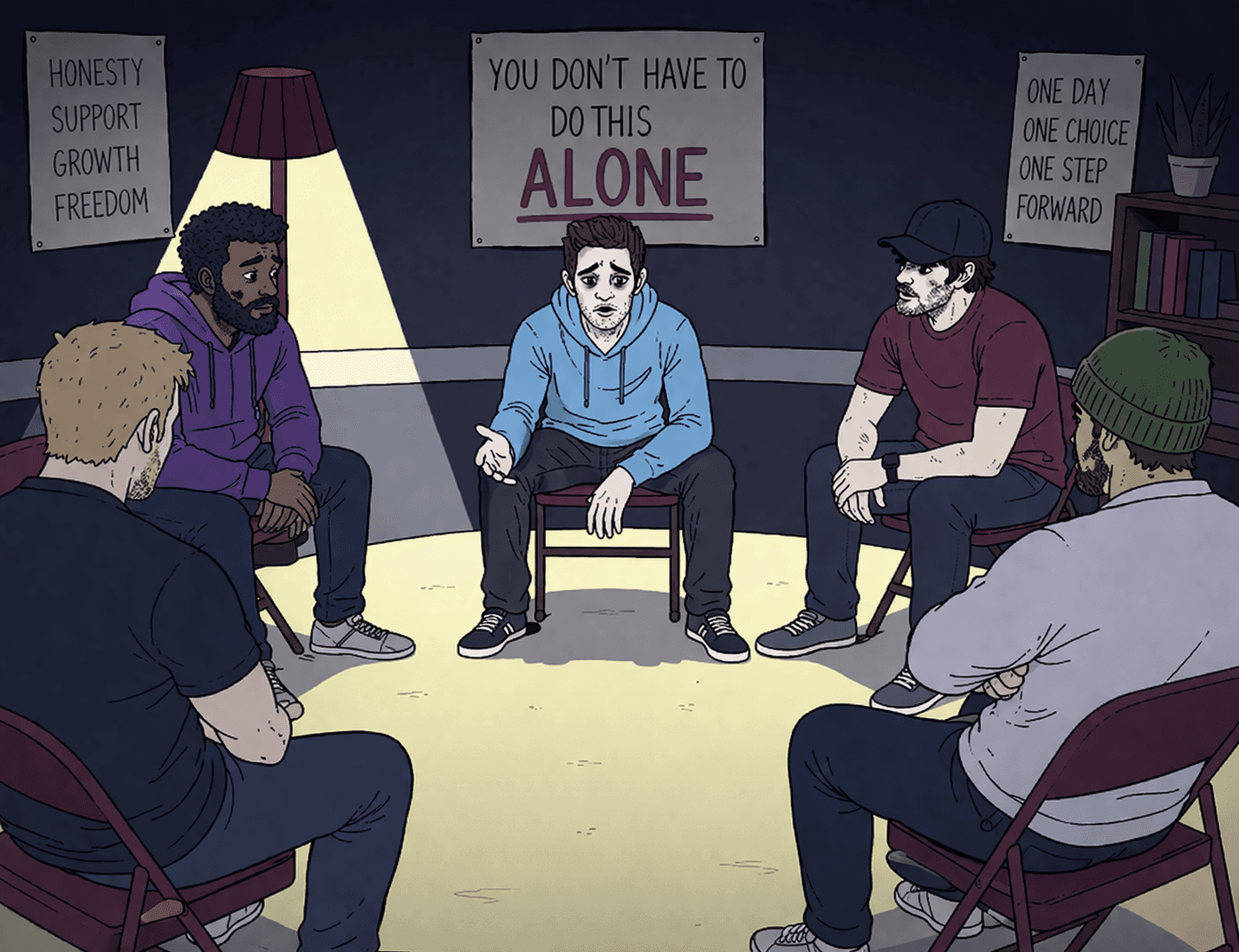
When you have a group of people who know what you are facing, understand the shame that can come with it, and are willing to support you without judgment, you no longer have to fight alone. That does not automatically solve the problem, but it makes change much more possible.
For many people, the first breakthrough in recovery is not a long streak. It is the moment they realize there are other people going through the same thing.
Why peer support matters
Support from anyone is valuable. A spouse, friend, mentor, or therapist can all play an important role. But there is something uniquely powerful about getting help from people who are fighting the same battle.
Peers in the same situation offer a kind of empathy that is hard to replicate. They understand the excuses, the triggers, the shame, the relapse cycle, and the mental gymnastics because they have lived them too. That makes it easier to be honest. It also makes their advice more practical. Instead of generic encouragement, they can offer insight that comes from experience.
This is part of what makes support groups different from simply confessing to someone you trust. In a group of peers, you get empathy, safety, and commitment from people who truly understand the terrain. That kind of support can become a powerful motivator when your own motivation starts to weaken.
Shame-free accountability
Accountability is one of the most important parts of recovery, but many people avoid it because they associate it with embarrassment.
That fear makes sense. If every slip feels humiliating, and every admission feels like a confession that changes how others see you, then staying silent can feel safer. But silence is usually what keeps the addiction going.
Healthy accountability works differently. It is not about punishment or reporting to someone who looks down on you. It is about telling the truth in an environment where honesty is safe and change is still expected.
That is why peer accountability works so well. Imagine you had to send an update after a relapse.
Would you rather send it to someone who has never struggled with porn, or someone who is also trying to overcome it?
Most people would choose the second person. Someone in the same fight is more likely to respond with clarity, compassion, and useful support rather than shock or judgment.
That is the kind of accountability that helps people heal.
Rewiring the habit loop
One of the strongest reasons support groups help is that they give you a new response to your old triggers.
Most compulsive behaviors follow a pattern. Something happens, you feel an urge, and then you act out. Over time, the brain learns this loop so well that it starts to feel automatic.
The goal of recovery is not just to resist the urge harder. It is to interrupt the sequence and replace it with something else.
The old pattern might look like this:
Boredom → urge → porn
A healthier pattern looks like this:
Boredom → urge → reach out → get support → ride it out
That doesn't seem like much, but it is the beginning of retraining your brain. When you repeatedly reach outward instead of acting out, you weaken the old habit pathway and strengthen a new one. A support group gives you people to reach for during that gap between the urge and the behavior.
How to use a support group to overcome urges
When an urge hits, you need a response that is immediate, simple, and easy enough to use under pressure.
This is where many people fail. They assume they will think clearly in the moment, come up with the right words, and reach out for help. But urges usually do not work like that. When you are triggered, even small acts can feel emotionally heavy.
That is why you should decide ahead of time what your outreach will look like.
Keep it simple. It can be as basic as: "I'm struggling right now. Can someone check in?"
The easier you make that first step, the more likely you are to use it. If you are using a recovery app or group chat, have your message ready. If you are not, store a short text in your phone so you can send it quickly when the moment comes.
You do not need a perfect speech. You need a fast interrupt.
What to expect in your first support group meeting
If the idea of joining a support group makes you nervous, that is completely normal.
Many people worry about being judged, pressured to share too much, or made to feel exposed. A healthy support group should do the opposite. It should create safety, not pressure.
In a good support group, you can usually expect:
confidentiality
respect for each person's story
a judgment-free tone
the freedom to share at your own pace
consistency and structure
You do not have to walk into your first meeting ready to say everything.
Often, the first step is just showing up and listening. As trust builds, it usually becomes easier to open up.
Over time, many people find that group meetings give them something they have not felt in a long time: the experience of being honest without being condemned.
That matters more than most people realize.
Why vulnerability helps recovery
Vulnerability is uncomfortable, but it is one of the things that makes support groups so effective.
When you stop hiding, you stop feeding the secrecy that helps the addiction survive. When you speak honestly about what is happening, you create room for support, clarity, and change. You also begin to reduce the shame that keeps so many people stuck.
This does not mean you need to overshare or force yourself to be emotionally raw before you are ready. It simply means being honest enough to let other people help you. That honesty is often where healing begins.
For many people, support groups are the first place they have ever spoken openly about porn without fear of ridicule or rejection. That kind of experience can be deeply stabilizing. It helps replace shame with understanding, which makes long-term change much more realistic.
The role of community in recovery
A strong support group does more than provide sympathy. It gives you a team.
Recovery is hard, and hard things are easier when you are not carrying them alone. A team gives you several things that private struggle does not.
First, it gives you shared wisdom. Every person brings a different story, different triggers, and different lessons. That means you are not limited to your own trial and error. You benefit from the experience of others who have already learned what helps and what hurts.
Second, it gives you an authentic community where you can stop being performative and telling yourself the same story. Many people who struggle with porn addiction become skilled at pretending they are doing better than they really are. That performance keeps them disconnected.
In a healthy support group, you no longer have to fake health in order to belong. You can tell the truth and still be accepted.
Third, it allows you to find strength when you are weak. On some days, your own resolve will feel thin.
In those moments, the encouragement, perspective, and steadiness of other people can help carry you through until your footing returns. Recovery stops being a test of whether you can generate enough willpower alone and starts becoming a shared effort.
What research says about support groups
Support groups are not just emotionally comforting. They also make sense from a recovery standpoint.
Research on group-based recovery consistently points to a few factors that improve outcomes: regular attendance, active participation, peer accountability, structured coping strategies, and ongoing progress monitoring. These elements help people stay engaged long enough to make meaningful behavioral changes.
This is one reason structured support tends to outperform isolated effort.
When people attend regularly, interact honestly, and apply what they are learning between meetings, they are far more likely to build the kind of consistency recovery requires.
The strongest programs usually do more than provide encouragement. They combine peer support with a clear framework for behavior change.
That combination helps people address not just the compulsive behavior itself, but the emotional and behavioral patterns that keep driving it.
How to make a support group actually work for you
Joining a support group is a strong first step, but simply joining is not enough. To get the most out of it, you have to actively use it.
Start by showing up consistently. Recovery depends less on intensity than on consistency. It is better to engage steadily than to go all in for a week and disappear.
Next, focus on building real relationships.
Get to know the people in your group. Talk to them. Encourage them. Let trust build gradually. Recovery works better when the people around you feel like real teammates instead of anonymous names.
Then, participate honestly. Share progress. Ask questions. Let people know when you are struggling. Listen carefully when others speak.
Apply what you learn between meetings instead of treating the group as a place to vent and forget.
The more you engage, the more powerful the group becomes.
Set goals for actions you can control
One of the smartest ways to use a support group is to track inputs, not just outcomes.
A lot of people focus only on streaks, but streaks are not the whole story. If you want to reduce urges and build a healthier life, you need to pay attention to the habits that shape your emotional state and your vulnerability.
That may include things like:
getting enough sleep
exercising consistently
setting a phone curfew
journaling
reducing isolation
spending a few minutes each day checking in with your group
These are actions you can control.
And when you share these goals with your group, accountability becomes much more practical.
Instead of only admitting failure after the fact, you begin strengthening the habits that make success more likely in the first place.
Give support, not just receive it
A good support group is not something you only use when you are in crisis. It is something you contribute to.
One of the best ways to strengthen your own recovery is to support other people in theirs. Check in on someone else. Respond when they are struggling. Encourage them when they are discouraged. Be the person who reaches out first.
This does two important things. It keeps you connected, and it turns your attention outward. That matters because addiction tends to pull your focus inward, toward secrecy, urges, and immediate relief. Giving support helps break that self-enclosed pattern.
It also reinforces your own growth. When you remind someone else to stay strong, you strengthen the same mindset in yourself.
Are online porn addiction support groups effective?
Online support groups have one major advantage: they are available when you actually need them.
Many traditional forms of support are helpful, but limited. Friends may care deeply but not understand the problem. A spouse may want to help but feel hurt by the issue. Therapists and mentors can be valuable, but they are not available at midnight when you are alone and triggered.
An online support group fills that gap. It gives you access to people who understand the struggle and can respond in the moments that matter most. That kind of immediacy can make a huge difference, especially when urges are intense and timing is everything.
An online support group also offers healthy distance. Pornography is addiction is still viewed by many as a type of "perverted" addiction, and many guys are worried about being in proximity to people who they may also run into in the street or know in person. Online groups drastically reduce those odds.
They allow a safe space at a safe distance for you share your struggles and open up.
How long does porn addiction recovery take?
Recovery is possible, but it is rarely instant.
Your brain needs time to adjust to new patterns. Early improvements may begin within a few months, but deeper healing often takes longer. That does not mean you are failing. It means you are in a real process.
This matters because unrealistic expectations can sabotage good progress. If you assume that one relapse means nothing is changing, you may give up too early. But recovery is usually built through repeated small decisions, consistent support, and gradual rewiring over time.
The better question is not, "Why am I not fully healed yet?" The better question is, "Am I moving in the right direction?"
If the answer is yes, keep going.
A better way to approach recovery
A lot of people who have struggled with porn for years quietly ask the same question: "Will I always have this problem?"
That question is understandable, but it is not the most useful one.
A better question is: "What steps do I need to take today?"
That is where support groups shine. They bring recovery down to the level where change actually happens: one urge, one conversation, one check-in, one honest moment, one healthier decision at a time.
You do not have to solve the rest of your life today. You just need a better system for today than the one that has kept you stuck.
Online porn addiction support group (Relay)
If you have been trying to quit porn alone and getting nowhere, that does not mean you are broken. It may simply mean you need support that is built for this kind of struggle.
A good support group can give you connection instead of isolation, accountability instead of secrecy, and a practical path forward instead of another round of private promises. That combination is powerful.
You do not have to keep carrying this by yourself. If you are ready for a recovery process built around support, honesty, and lasting change, Relay can help you take that next step.