Key takeaways to stop jerking off
-
Stopping compulsive masturbation requires breaking a habit loop driven by cues, anticipation, and reward—not relying on willpower alone.
-
The behavior becomes automatic through repetition, making urges feel immediate even when you are not actually aroused.
-
Increasing friction—such as changing environment or limiting access—helps interrupt the automatic habit cycle.
-
Delaying urges and changing physical state can weaken cravings by interrupting the cue–response pattern.
-
Replacing the habit with structured activities is more effective than trying to eliminate urges entirely.
-
Relapses often occur after 2–3 days due to increased anticipation, not lack of discipline.
-
Shame reinforces the cycle by increasing stress and driving further urges rather than preventing them.
-
Long-term change comes from building structure, reducing triggers, and restoring control over behavior through consistency.
Frequently asked questions about jerking off
Why is it so hard to stop jerking off?
It’s difficult because the behavior is reinforced by a habit loop—cue, craving, ritual, reward—that becomes automatic over time. The brain learns to anticipate relief, making urges feel immediate and hard to resist.
Is masturbation bad for you?
For most people, masturbation is not inherently harmful. It becomes a problem when it feels compulsive, interferes with daily life, or replaces more meaningful activities.
Why do I relapse after 2–3 days?
Relapses often happen because the brain expects a regular reward cycle. When that pattern is interrupted, anticipation increases, creating stronger urges that lead to relapse if not managed properly.
What’s the fastest way to stop masturbating?
The most effective approach is to increase friction (reduce access), delay urges, change your environment, and replace the habit with structured activities—rather than relying on willpower alone.
Should I quit completely or learn to moderate?
It depends on control. If the behavior feels automatic and difficult to limit, a period of abstinence can help reset patterns. If it remains a conscious choice, moderation may be possible.
Relay is a therapist-backed group recovery program for pornography and unwanted sexual behavior, combining daily accountability, real-time urge support, and a private peer community
How to Stop Jerking Off (A Step-by-Step Guide That Actually Works)
You told yourself that this was the last time.
You closed out the incognito tabs, fired up your porn block, and even finally signed up for Relay. You are fired up, determined, and tired of feeling like a creepy loser or “gooner.”
But in less than two days, you’re back at it, hungrier than ever. The crazy part is that you’re not even horny.
It was a long day, and you just needed to blow off steam. Before you can even register what’s going on, you’re on your favorite site and halfway done. You don’t even particularly care at this point, but you will, and then the cycle will start all over again.
Because I know what this is like, I know that you’ve gotta be tired of making promises to yourself and giving up at the first feeling of discomfort or crossing paths with your triggers. But your problem is that you can’t find something that works.
Your willpower keeps failing you.
You’ve figured out how to get around all of the porn-blocking software you install.
You even managed to get a girlfriend to have sex with.
But nothing works. You keep jerking off, you know you do it too much, and you’re worried that it’s going to cost you your relationship. Even without that worry, you’re just tired of being a slave to digital women on a screen who don’t even know that you exist—it makes you feel pathetic.
Further reading: Am I Jerking Off Too Much?
Now first, I want to make something clear:
There is nothing inherently bad about masturbation.
For most people, it’s a normal sexual behavior, and there is nothing wrong with it.
The problems arise when masturbation stops feeling like a choice and starts feeling more like a compulsion. You want to stop even though you can’t, and your pleasure becomes a prison.
If you’re here because you feel stuck in that loop, this guide will show you:
-
Why you keep doing it (even when you don’t want to)
-
Why 2–3 day streaks often collapse
-
How to break the habit loop
-
A structured 7-day reset plan
-
What to do when urges hit
-
Whether you should quit completely or learn to moderate
I’m not here to shame you or preach to you. I’m just giving up the game on what’s worked for other men and me. I’ve coached to help them get their masturbation under control and stop jerking off.
If you're trying to break the habit entirely, this complete guide explains how to stop masturbating.
Why You Keep Jerking Off (Even When You Don’t Want To)
I want to reassure you that you aren’t weak. You’re just stuck in a particularly viscous habit loop.
To escape that loop, we have to understand it.
It looks like this:
Cue → Craving → Ritual → Reward → Crash → Repeat
Let’s make it real.
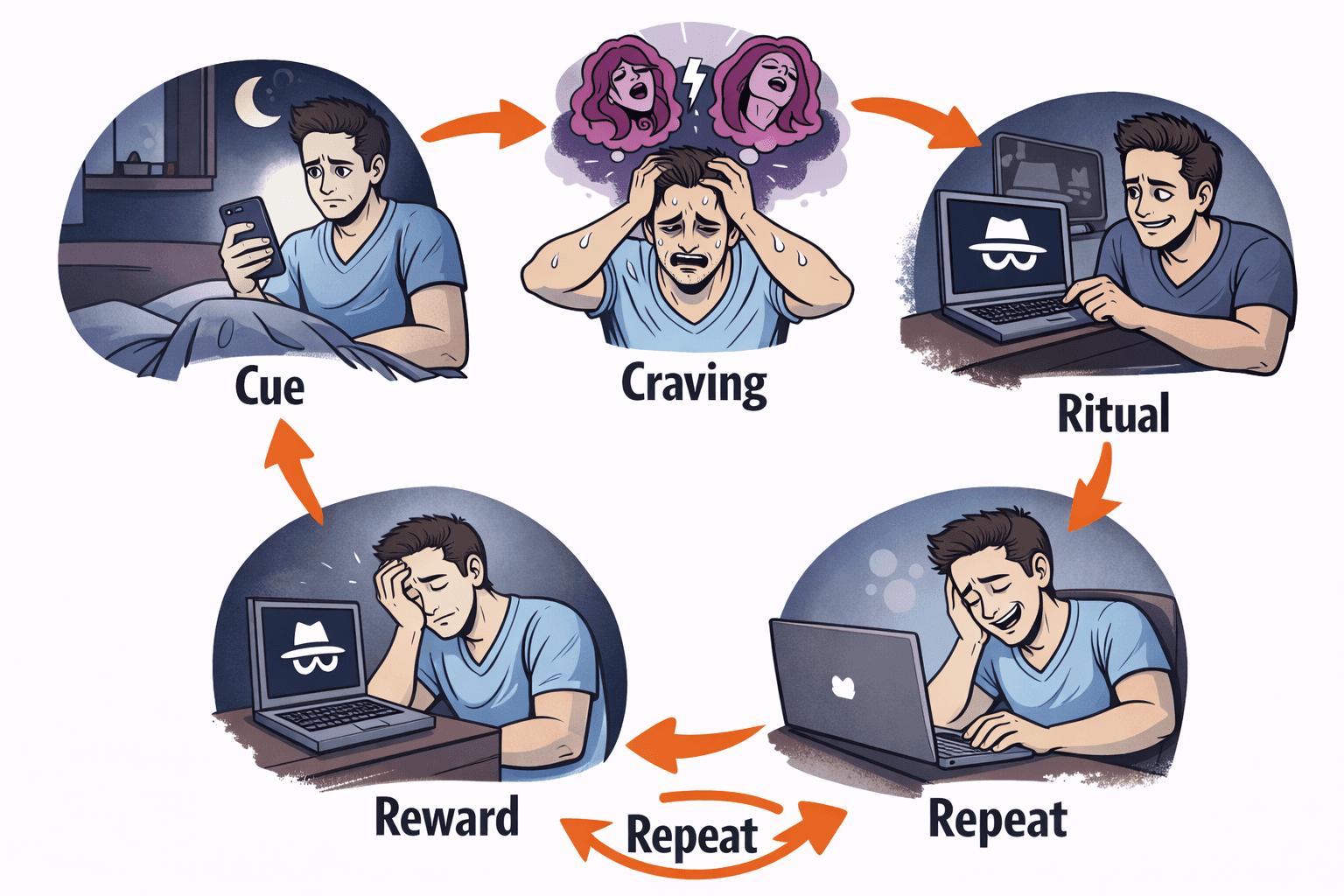
Cue
-
You’re alone in your room.
-
It’s late.
-
You’re stressed.
-
You just finished gaming.
-
You’re lying in bed with your phone.
Craving
You get a subtle urge now that you’ve been cued up—and it’s not always sexual. Sometimes it’s just restlessness or boredom. A lot of guys make themselves horny in order ot masturbate instead of masturbating to deal with horniness.
Ritual
Here’s the wild part. It’s not even the jerking off that’s the most difficult thing to escape from. It’s the ritual. It’s more exciting to open your computer, put Google into Incognito mode, and scroll through your favorite streaming site than it is to actually jerk off. That’s why, even though you tell yourself that’s only going to be a minute, you often end up losing hours to the ritual.
Reward
Find the perfect scene and get down to business. You reach climax, and you feel a temporary sense of relief. You start wondering why you ever thought this was a big deal in the first place. But soon you’ll remember why you were trying to stop masturbating.
Crash
Your energy drops, and you feel regret. You’re sitting there wondering why and what for? Now you’ve gotta make up a story for your girlfriend about why you can’t get it up tonight. Now you feel like a failure again.
If you don’t get in front of this cycle, it’s going to happen all over again.
Further reading: I Can't Quit Masturbating
Dopamine Is About Anticipation, Not Just Pleasure
The most frustrating thing about this cycle is that it does not depend on your level of sexual arousal or “horniness.” So you can’t figure out what the problem is. You just know that not even having an attractive girlfriend is making things any easier, so each relapse makes you even more confused, but here is some clarity.
The addictive nature of masturbation isn’t in the orgasm. It’s in the anticipation.
For example, I used to always wonder how someone could get addicted to gambling. Like, losing money is painful, so the idea of getting addicted to it seemed so crazy to me.
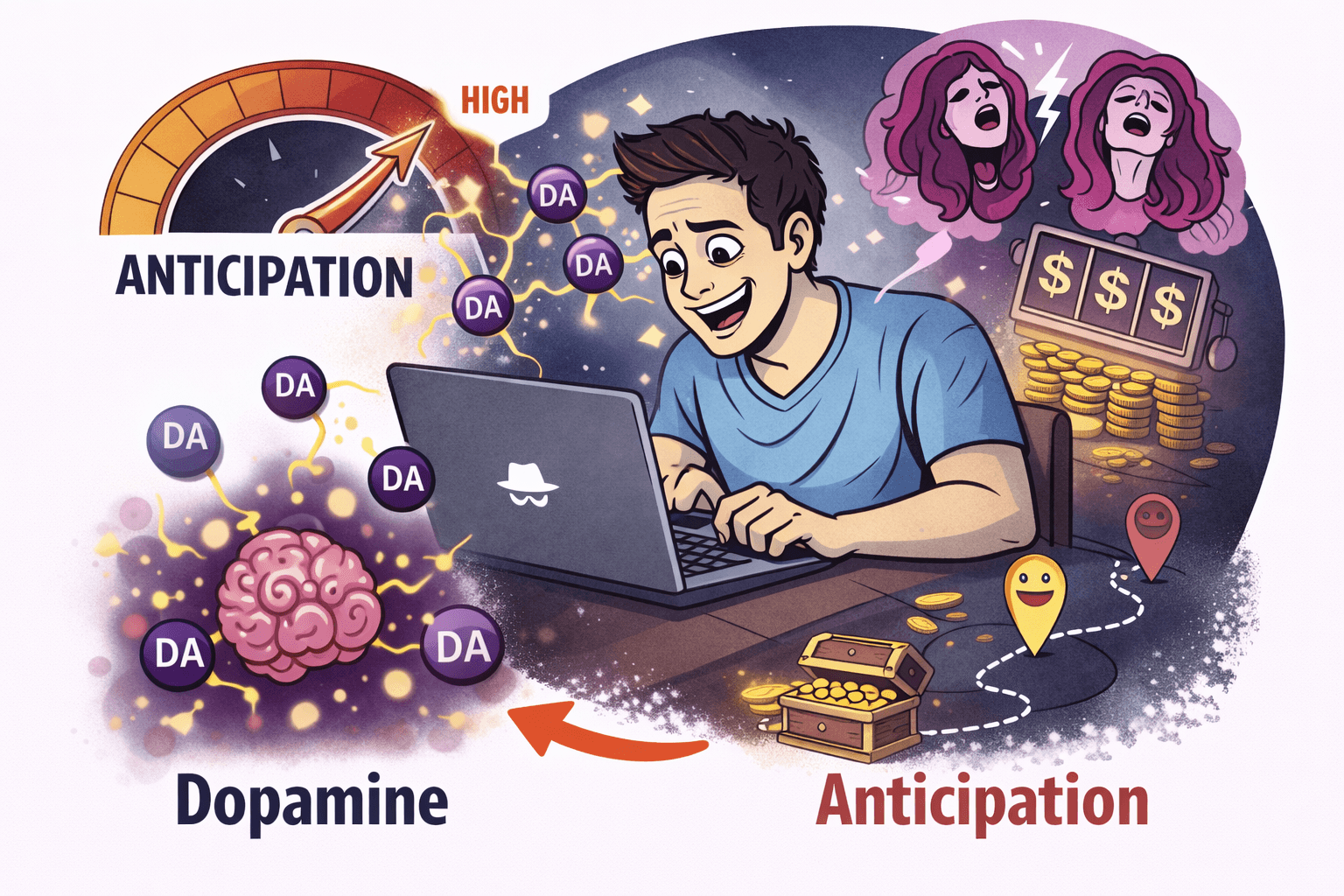
Then I learned that gambling is addictive because there is the anticipation of a payoff (winning money), combined with a ritual (everything from the familiarity of the casino to personal superstitions).
So the real problem we have to solve is how to break the anticipatory loop.
Dopamine often gets labeled as the pleasure chemical, but that’s not accurate. It’s the reward chemical, so what you’re doing is linking the dopamine spike of reward expectation to the pleasure of climax.
The climax itself is not addictive. It’s the anticipation of the climax that you get hooked on.
Why 2–3 Day Streaks Almost Always Collapse
One of the most confusing parts about trying to quit is that you can actually make it a few days. You get through day one. Day two isn’t terrible. By day three, you start thinking that maybe this time is different.
Then, suddenly, you relapse. Because of how abrupt it feels, you assume the problem is a lack of discipline. It isn’t.
When you stop a behavior that your brain has grown accustomed to, the brain does not passively accept the change. It pushes back. Not because you’re defective, but because it has adapted to a predictable reward pattern.
If you’ve been giving yourself a reliable dopamine spike every day or two, your nervous system calibrates around that rhythm. Remove it, and the system doesn’t go quiet. It amplifies the signal.
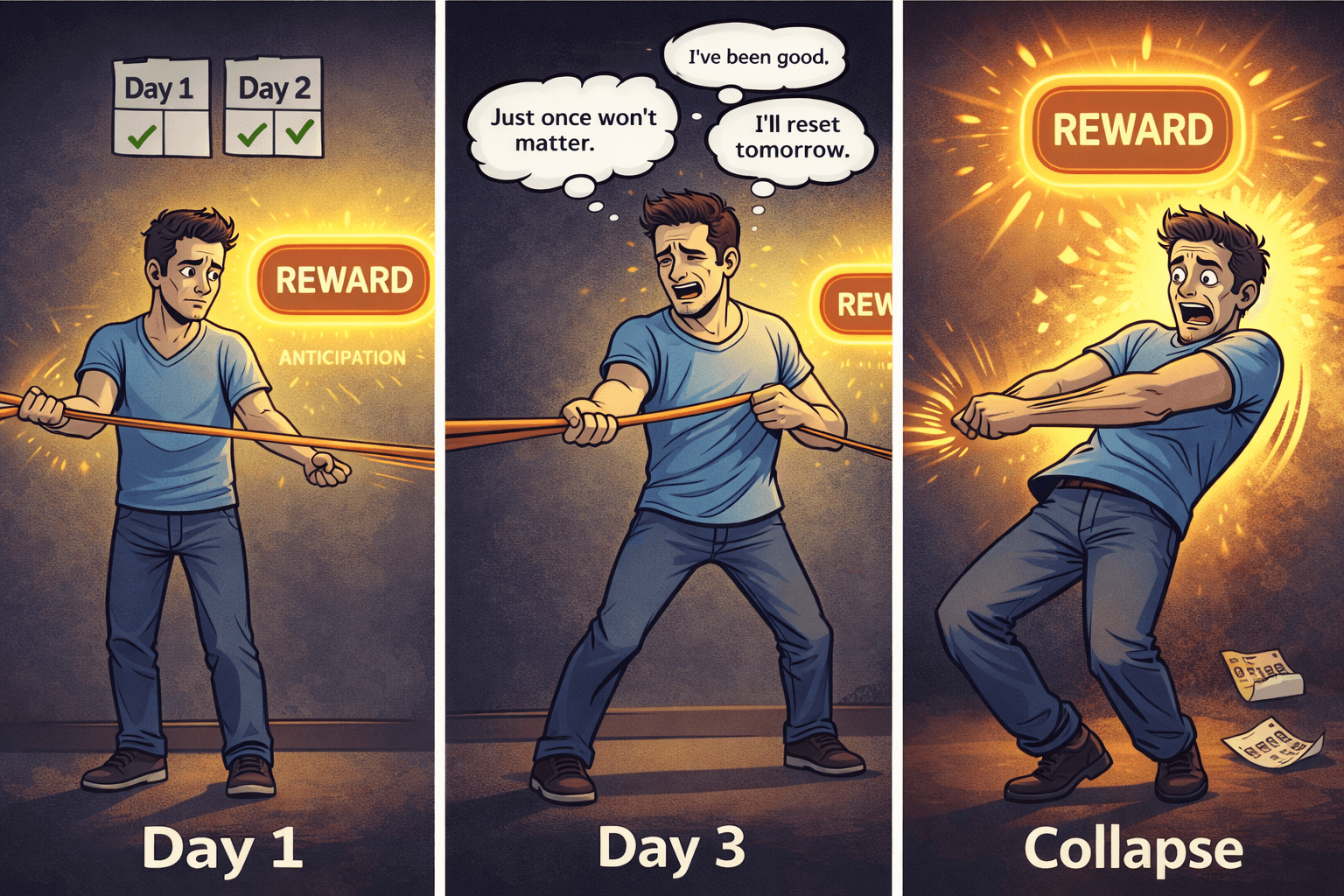
This is where most people misunderstand what’s happening. They think the rising urge means they are becoming “more horny” or losing control. In reality, what they’re experiencing is a surge in anticipation.
The brain has linked certain cues — being alone, being bored, lying in bed with a phone — to an expected payoff. When that payoff doesn’t arrive on schedule, anticipation intensifies.
Your relapse at day two or three works the same way. The orgasm itself is not what your brain is chasing. It’s the expectation of relief, stimulation, and payoff that it has learned to anticipate.
When you remove the behavior without addressing the anticipatory spike, the system compensates by increasing psychological pressure. That pressure often shows up as rationalization.
You’ll notice thoughts like, “I’ve done well,” or “One time won’t matter,” or “I’ll just reset tomorrow.” These aren’t moral failures. They’re predictable byproducts of a brain that has been conditioned to expect a reward and is now trying to restore equilibrium.
If you don’t understand this mechanism, every relapse feels like proof that you lack discipline.
Further reading: Porn Addiction Withdrawals
Shame Makes It Worse
Another part of this cycle that rarely gets explained clearly is the role of shame. Most people think shame is useful. They assume that if they feel bad enough after a relapse, they’ll finally stop. In reality, shame is gasoline on the fire.
The loop often looks like this: stress builds, you masturbate to relieve it, and then shame follows. That shame doesn’t just sit there quietly. It increases internal tension. You start telling yourself that you’re weak, that you lack discipline, that something is wrong with you. Those thoughts create more emotional discomfort.
And what has your brain already learned to use to regulate discomfort?
The same behavior you’re trying to quit.
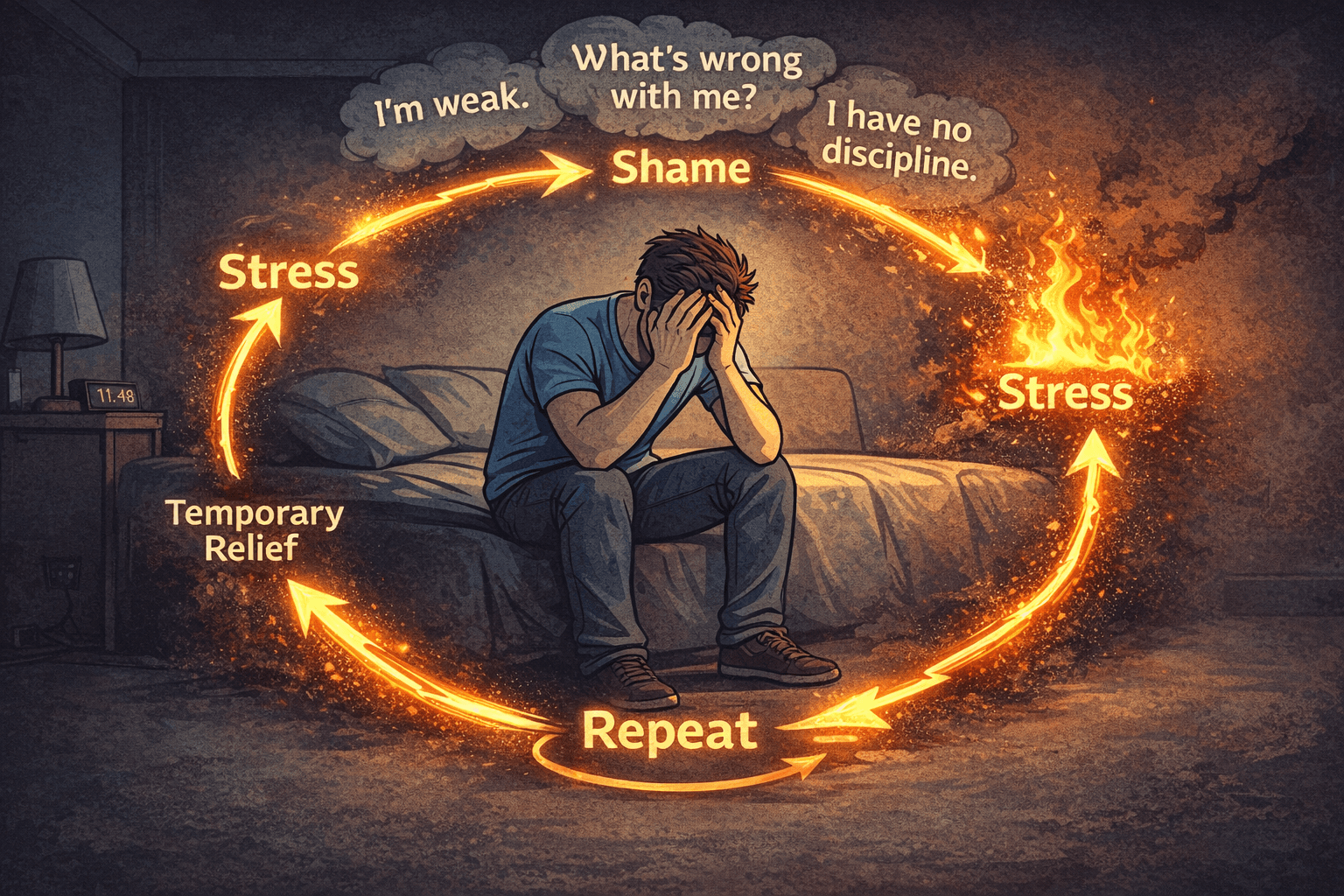
So the pattern becomes self-reinforcing. Stress leads to masturbation. Masturbation leads to shame. Shame leads to more stress. More stress pushes you back toward the same coping mechanism. The relapse isn’t just a break in discipline; it becomes the trigger for the next one.
This is why beating yourself up rarely works long-term.
The 7-Day Reset Plan
Understanding the loop is useful, but understanding alone doesn’t break it. You need a short-term reset that interrupts the pattern long enough for your brain to stop expecting an immediate payoff.
This is not about perfection. It’s about creating just enough friction and stability to weaken the anticipatory cycle we talked about earlier.
The goal of this 7-day reset is simple: reduce automatic behavior by changing the conditions that normally make it easy.
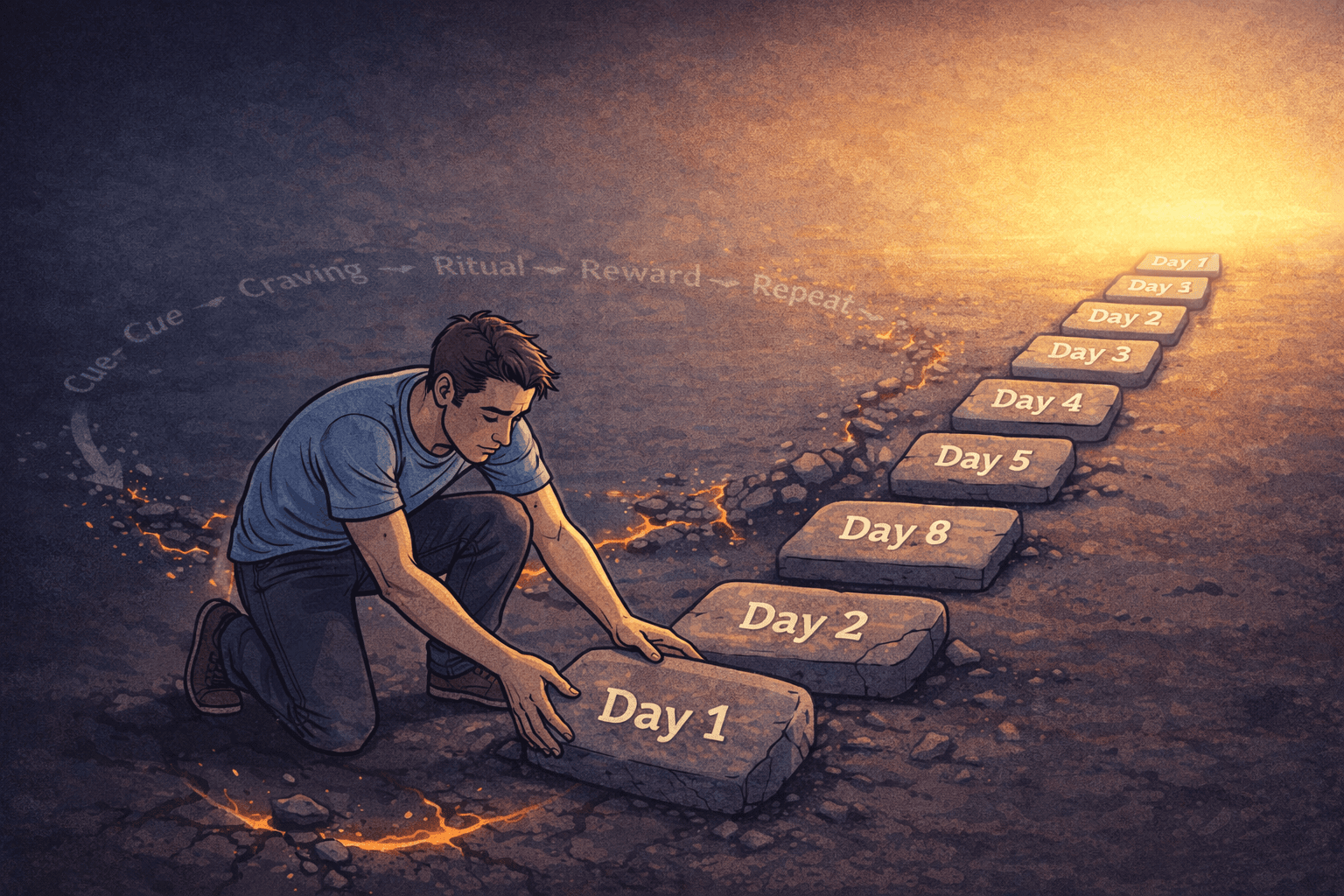
Days 1–2: Increase Friction
Most compulsive masturbation happens because access is effortless. The behavior doesn’t require planning. It requires proximity.
If you’re alone, tired, and sitting on your computer alone in the dark, the barrier between urge and action is almost nonexistent.
So the first step is not willpower. It’s friction.
Move your phone charger outside the bedroom. If the device isn’t within reach when you’re lying down, you eliminate one of the most common late-night cues.
Consider adding blockers to your devices, not because they’re impossible to bypass, but because the extra steps buy you time. Even a small delay can interrupt the automatic progression from urge to ritual.
If you tend to relapse in predictable environments, change those environments. One of the most powerful things that worked for me was to never use my computer in a private space. That meant either with my doors open while someone else was home or in a coffee shop.
Rearrange your evening routine. Avoid extended isolation during your highest-risk windows. The objective here is not abstinence through force, but disruption through inconvenience.
You’re making the loop harder to run.
Days 3–4: Train Your Response to Urges
Once friction is in place, the next step is to learn how to respond when urges arise. You’re not trying to eliminate urges entirely. That’s unrealistic. You’re trying to avoid immediate compliance.
Introduce a delay rule. When the urge hits, wait ten minutes before acting. Most urges crest and decline quickly if you don’t feed them. That delay creates a separation between impulse and behavior.
Physical interruption helps as well. Changing posture, leaving the room, or briefly engaging in movement shifts your nervous system state. It doesn’t have to be dramatic. A short walk, a cold splash of water, or even standing up and resetting your environment can weaken the urge enough to pass.
I was a big fan of having guys in my program do push-ups, as you get the added bonus of physical activity. If you can hit a gym, that’s even better, honestly.
The key is not arguing with the urge. Treat it as a temporary signal that will eventually pass.
Days 5–6: Replace the Boredom Window
Many relapses occur not during intense stress but during periods of empty time. Evenings are particularly risky because structure fades and stimulation becomes self-directed.
Use these days to intentionally fill the windows where the behavior usually occurs. That doesn’t mean overwhelming yourself with obligations. It means choosing low-effort alternatives that occupy attention without requiring high motivation.
Plan your evenings instead of drifting through them. Exercise, social interaction, creative work, or even passive but non-triggering activities can serve as substitutes. Pick up new hobbies, go see friends, volunteer, or make that gym habit a real staple of your life.
The goal is to reduce the amount of unstructured time where anticipation can build unchecked. If you use this time correctly, you will legitimately improve your life and all aspects of it.
You’re not just removing a habit. You’re replacing a function and, ideally, building a valuable skill with it.
Day 7: Reframe Identity
By the end of the week, you will have the building blocks for a new, masturbation-free identity.
The question is no longer “How long can I go without doing this?” It becomes “What kind of person am I trying to be?”
Streaks create pressure, but identity creates direction.
Take a few minutes to reflect on what control actually means for you. Not control as punishment, but control as agency. The ability to decide, rather than react.
The reset doesn’t make urges disappear. What it does is weaken the automatic loop and give you enough space to choose your response.
Further reading: How to stop masturbating
How to Handle Urges in the Moment
Now, despite having a new identity, an urge is going to hit hard.
You will seriously contemplate whether it’s worth it. You’ll say things like, “One time won’t hurt. I’ve been good for so long.” That is a trap.
Realize that you can never eliminate urges entirely. Urges are biological and psychological signals. Do not think that because you have urges means that you’ve failed.
You only fail when you give in to them, no matter how tempted you are. Here is a plan of action to deal with urges when they spring up.
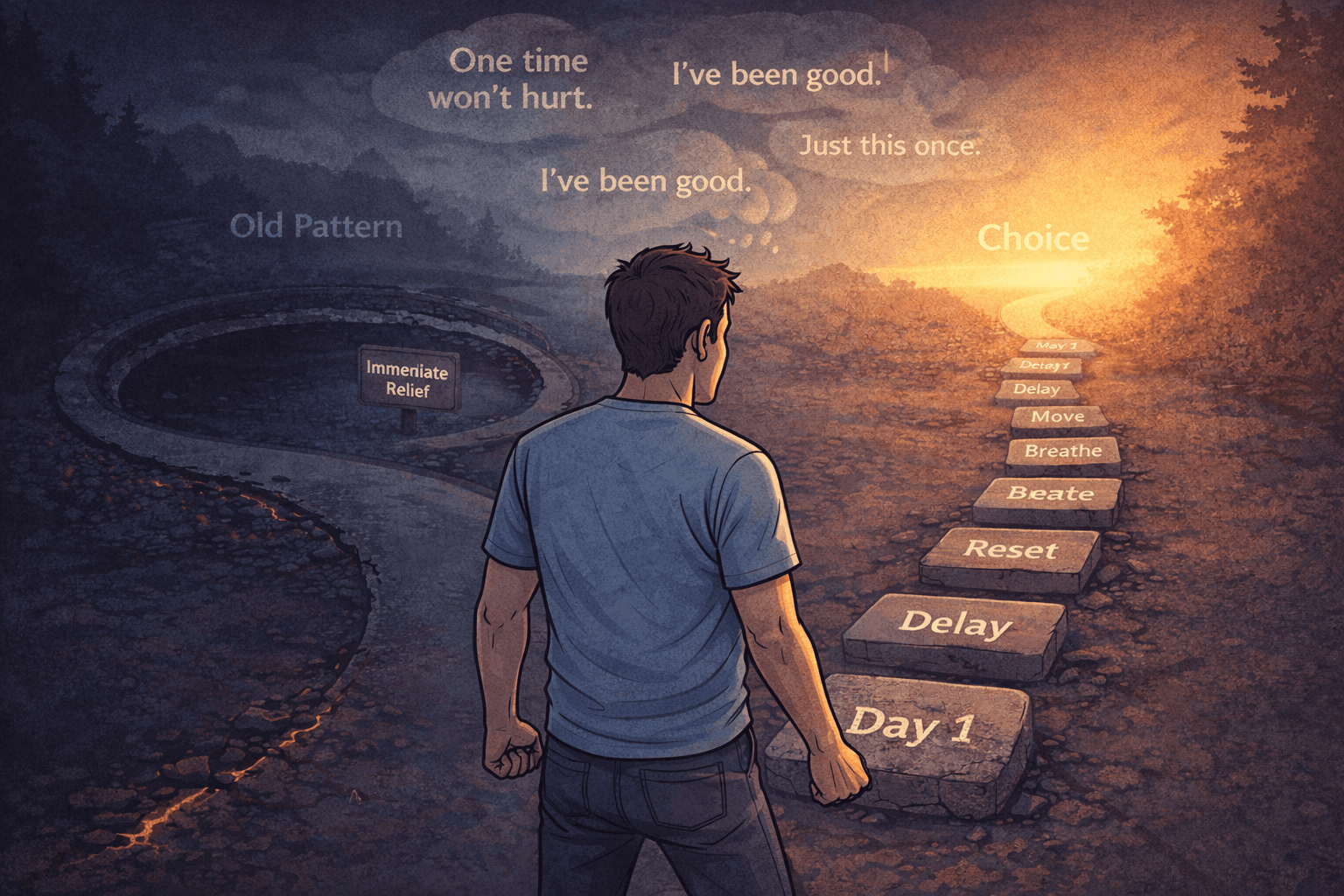
Step 1: Delay the Decision
When the urge appears, do not negotiate with it. Do not argue with yourself about whether you “should” or “shouldn’t.” Instead, delay.
Tell yourself you’ll reassess in ten minutes.
Not tomorrow. Not after a cold shower. Just ten minutes.
Most urges peak and fade if they aren’t reinforced. By delaying, you interrupt the automatic transition from craving to ritual. You’re creating a small wedge of time where choice can re-enter the picture.
You are not saying “never.” You are saying “not right now.” That little bit of space is more than enough to let things decrease in intensity.
Step 2: Change Your Physical State
Urges thrive in stillness and isolation.
If you are lying down, sit up. If you are alone in your room, step outside it. If you are staring at a screen, put it face down.
Whatever physical configuration you’re in when the urge hits, change it.
Even minor physical changes can shift your nervous system enough to weaken the urge. Movement, posture changes, or brief exposure to cold water can reset your physiological state.
You don’t need theatrics. You need disruption.
The body and brain are connected. Change the body, and the intensity of the craving often drops.
Step 3: Do Not Make The Urge A Big Deal
A common mistake is interpreting an urge as a crisis.
“I can’t handle this.” “This is too strong.” “I’m going to fail.”
These thoughts make things worse because they introduce the possibility of failure when there’s no reason to.
Instead, treat the urge as data. It is simply a surge of anticipation. It will crest and fall like a wave. If you observe it without feeding it, it usually passes faster than you expect.
You are training tolerance, not suppressing biology.
Step 4: If You Slip, Avoid the Spiral
Even with structure, you may relapse.
If it happens, resist the urge to escalate.
One of the most damaging patterns is turning a single slip into a full binge. The thinking becomes, “I’ve already messed up, so it doesn’t matter.”
It does matter.
Interrupt the spiral immediately. Do not layer shame on top of the slip. A relapse is feedback, not a verdict.
The faster you return to structure, the harder it will be to slip up again.
Further reading: Porn Relapse—What To Do Next Without Spiraling
Should You Quit Completely or Learn to Moderate?
Everyone eventually wonders if this is a permanent decision or a temporary choice.
Do you need to quit entirely? Or can you learn to engage without losing control?
The answer depends on one thing: whether the behavior still feels like a choice.
For some people, masturbation is occasional and deliberate. It does not interfere with work, relationships, or self-respect. It doesn’t escalate. It doesn’t feel compulsive. In those cases, moderation is realistic.
For some guys, the pattern looks a bit different—and that is an understatement.
If you’ve tried to cut back and repeatedly failed, if you tell yourself you’ll limit it and then exceed your own boundaries, or if the behavior consistently replaces more meaningful activities, then moderation may not be the right starting point.
Moderation requires control.
If control is what’s missing, a temporary period of abstinence is often the fastest way to rebuild it.
Why Abstinence Can Be Useful (Even If It’s Not Permanent)
A period of abstinence does two things.
First, it breaks the frequency cycle. When the brain expects stimulation every day or every two days, anticipation builds quickly. A longer break forces recalibration.
Second, it reveals how automatic the behavior has become. If stopping feels easy, that’s useful information. If stopping feels nearly impossible, that’s useful information too.
Why “Just Moderate” Often Fails
People often attempt moderation without structure.
They say things like:
“I’ll only do it on weekends.” “I’ll limit it to once.” “I won’t watch porn.”
Those intentions collapse because the underlying loop hasn’t been addressed. If the anticipatory system is still wired to expect relief through the ritual, vague limits don’t hold under stress.
Moderation works when:
-
The environment is controlled.
-
Triggers are understood.
-
Urge tolerance is trained.
-
Shame is reduced.
-
Identity is stable.
Without those, moderation becomes another broken promise.
Conclusion: This Is About Control, Not Perfection
If you’ve made it this far, you probably don’t need another lecture about discipline.
You already know how to try harder. You already know how to promise yourself you’ll stop. You already know what it feels like to break that promise.
The point of this guide wasn’t to shame you or convince you that masturbation is inherently evil. It was to show you how the loop works — and how to interrupt it.
Compulsive behavior thrives on three things:
-
Frictionless access
-
Emotional avoidance
-
Lack of structure
When you increase friction, regulate emotion directly, and build structure around your weak points, the behavior loses momentum.
That doesn’t mean you’ll never feel an urge again. You will. Urges are normal. The difference is that you won’t be operating on autopilot.
Control isn’t about never slipping. It’s about shortening the distance between a mistake and a reset. It’s about reducing escalation. It’s about not turning one lapse into a spiral.
Most importantly, it’s about shifting from reaction to choice.
You don’t need to become a different person overnight. You need to build enough stability so you can decide rather than default.
If you want more help, consider giving Relay a try.