

Key takeaways on urge surfing
-
Urge surfing is a technique that helps you manage cravings by observing them without acting until they naturally pass.
-
Most urges rise, peak, and fade within 10 to 30 minutes if they are not reinforced by thoughts or behavior.
-
Trying to suppress or fight urges often makes them stronger by increasing mental focus and tension.
-
Urge surfing works by breaking the automatic link between craving and behavior, weakening the habit over time.
-
The RAIN method—Recognize, Allow, Investigate, Note—provides a simple framework for practicing urge surfing.
-
Urges are temporary neurological events, not commands, and do not require action to resolve.
-
Each time you ride out an urge without acting, you weaken the underlying habit loop and strengthen self-control.
-
Combining urge surfing with environmental changes and accountability significantly improves long-term success.
Frequently asked questions about urge surfing
What is urge surfing?
Urge surfing is a technique for managing cravings by observing them without acting on them. Instead of trying to resist or suppress an urge, you allow it to rise, peak, and pass naturally, like a wave. Most urges last between 10 and 30 minutes if you don’t reinforce them with fantasy or behavior. The goal isn’t to eliminate the urge, but to experience it without reacting, which gradually weakens its intensity.
What are some urge surfing techniques?
Urge surfing techniques focus on awareness and non-reaction. This includes noticing the urge as soon as it appears and labeling it mentally, focusing on the physical sensations in your body, such as tension or restlessness, and using slow, controlled breathing to stay grounded. It also involves watching the urge change over time without trying to control it, while letting go of judgment or frustration about having the urge in the first place.
How to practice urge surfing?
To practice urge surfing, begin by pausing as soon as the urge appears instead of acting on it. Bring your attention inward and notice where you feel the urge in your body. Focus on your breathing, keeping it slow and steady, and stay present with the sensation. The key is to observe the urge without reacting to it. If needed, give yourself a short window of time to sit with the feeling and watch it pass.
Does urge surfing work for urges to watch porn?
Urge surfing is effective for managing urges to watch porn because it interrupts the automatic response cycle. These urges are driven by learned patterns in the brain, and when you stop reacting to them, they naturally weaken. Instead of reinforcing the habit, you allow the urge to fade on its own. Over time, this reduces both the intensity and frequency of cravings.
How do I use urge surfing to stop watching porn?
To use urge surfing to stop watching porn, apply the technique the moment an urge appears. Pause instead of reacting, shift your focus to your breath and body, and avoid engaging with thoughts or fantasies about porn. Stay with the sensation as it rises and falls. Each time you do this, you weaken the connection between the urge and the behavior, making it easier to stay in control over time.
Relay is a therapist-backed group recovery program for pornography and unwanted sexual behavior, combining daily accountability, real-time urge support, and a private peer community
How to Use Urge Surfing to Stop Watching Porn (Step-by-Step Guide)
There is a powerful weapon at our disposal in the fight against pornography: urge surfing, a scientifically proven mindfulness technique that transforms how you respond to cravings. The research and evidence behind urge surfing is compelling. When combined with Acceptance and Commitment Therapy (ACT), urge surfing leads to significant reductions in compulsive behaviors.
Furthermore, everything that researchers have learned about urge surfing confirms an experience that nearly everyone who has struggled with pornography addiction has gone through:
Fighting urges is not only pointless but often backfires. However, the core idea behind urge surfing is that accepting and observing these urges, and waiting for them to pass, has real power to create lasting change in your habits.
This article will explain the science behind why urges feel so powerful, how your brain processes them, and, most importantly, practical steps to break free from urges to watch pornography and reclaim control of your life.
Understanding How Urge Surfing Works
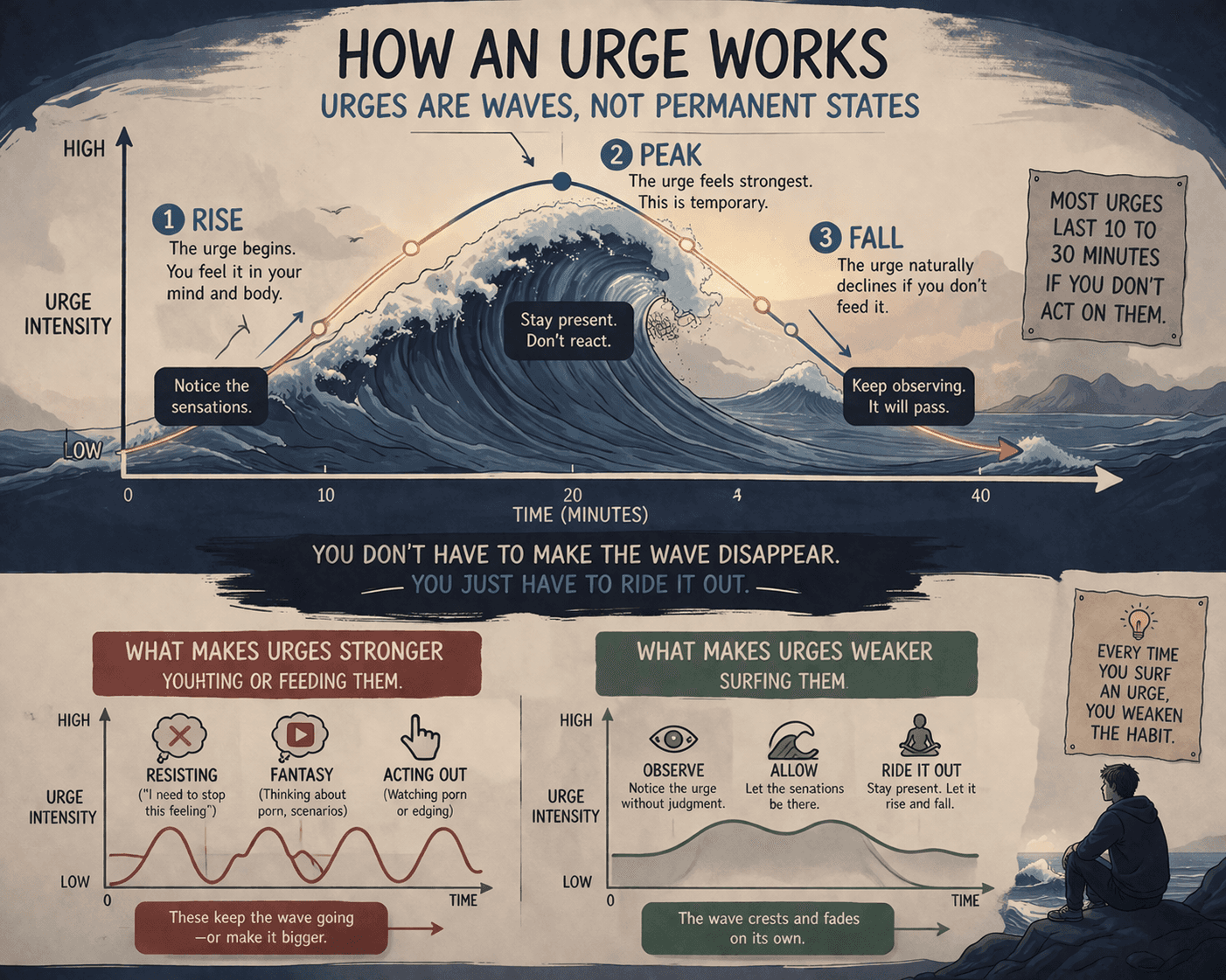
Urge surfing, first developed by psychologists Alan Marlatt and Judith Gordon in the 1980s, emerged out of a shift in how addiction was being understood and treated.
At the time, most approaches focused on resisting cravings through willpower or avoiding triggers entirely. But Marlatt, working in the field of relapse prevention, observed that the more people tried to suppress their urges, the stronger those urges often became (Marlatt & Gordon, 1985).
Through clinical observation and research, he found that cravings weren’t constant. Rather, they followed a predictable cycle. They would rise in intensity, peak, and then fall, even if the person didn’t act on them.
This led to a key insight: urges behave more like temporary waves than permanent states. Instead of fighting cravings, Marlatt and Gordon introduced a different approach rooted in mindfulness.
They encouraged individuals to observe their urges without judgment, notice the physical sensations in their bodies, and allow the experience to pass naturally. This process helped break the automatic link between craving and behavior, reducing the likelihood of relapse.
Over time, this technique became known as “urge surfing” because it teaches individuals to ride out cravings rather than be overwhelmed by them.
It has since been incorporated into evidence-based approaches like mindfulness-based relapse prevention and Acceptance and Commitment Therapy, where it remains a widely used tool for managing addictive behaviors (Bowen et al., 2011).
In our case, we can use this same development to combat urges to watch pornography, because the core idea remains the same: urges behave like waves.
They don’t last forever. They rise, peak, and fall, whether you act on them or not.
Where most people go wrong when dealing with porn addiction is to try to fight the urge to watch or distract themselves. But research shows this often makes them stronger.
Urge surfing works differently. Instead of resisting the urge, observe it and let it pass naturally. We ride it out, like a wave.
What an Urge Actually Looks Like
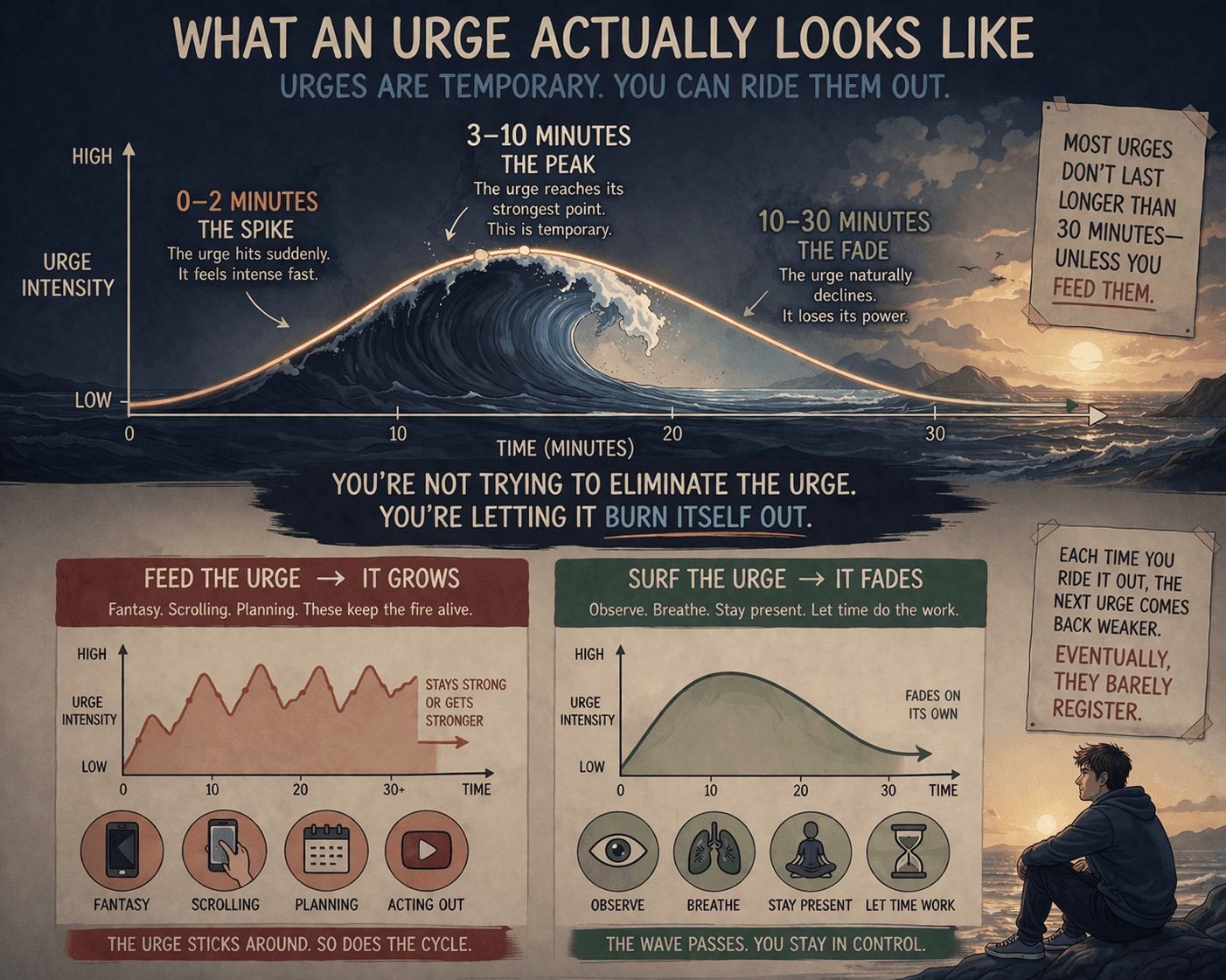
When you feel the urge to watch porn, it doesn’t stay at the same intensity.
It follows a predictable pattern:
-
0–2 minutes: The urge spikes suddenly
-
3–10 minutes: It reaches peak intensity
-
10–30 minutes: It gradually fades
Most urges don’t last longer than 30 minutes—unless you reinforce them with fantasy, scrolling, or planning to act.
This is why urge surfing works: you’re not trying to eliminate the urge—you’re letting it burn itself out.
This feels counterintuitive because we believe that overcoming porn is strongly related to having no desire at all to watch it. Or, at the very least, a dramatically reduced desire. But urge surfing flips this idea on its head.
Urge surfing proves that you don’t need to worry about this, because these urges will not only go away, but when they return, they’ll be weaker than the last time.
Eventually, they’ll barely even register.
The Difference Between "Urges" and "Cravings"
Although people often use the words interchangeably, there is a useful distinction between urges and cravings.
Cravings are deeper motivational states shaped by repetition, emotional needs, and learned associations over time. They reflect your brain’s expectation of reward (Robinson & Berridge, 2008).
Urges are how those cravings show up in the moment. They are immediate, cue-driven impulses that feel like they demand action (Tiffany & Wray, 2012).
In other words, a craving is the underlying drive, and an urge is the feeling you experience when that drive is activated.
Both are driven by your brain’s reward system, and their interplay is part of what drives heavy pornography use.
When you repeatedly use porn, your brain learns to associate certain cues—like boredom, stress, or being alone—with reward. This learning is reinforced through dopamine, which strengthens the neural pathways linking those triggers to the behavior (Volkow et al., 2016). Over time, this process recruits structures like the basal ganglia, which automate habits, and the amygdala, which assigns emotional significance to those cues.
As these pathways strengthen, your brain begins to anticipate the reward before the behavior even happens. This is known as incentive salience, where cues don’t just remind you of porn—they start to pull your attention toward it (Robinson & Berridge, 2008). The craving is the underlying drive created by this learning, and the urge is what you feel when that drive is activated in real time.
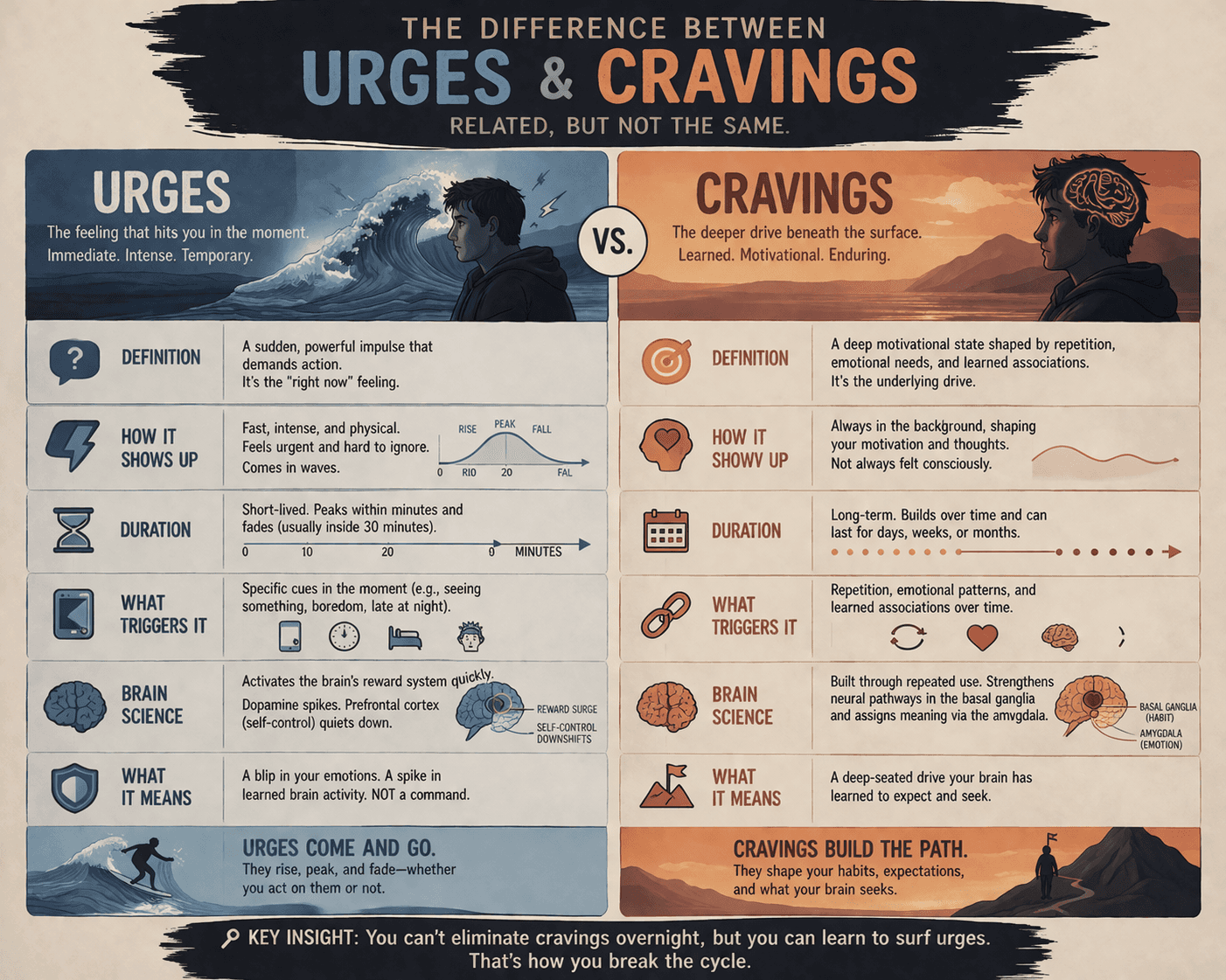
That’s why urges can feel so sudden and powerful. A simple trigger—like opening your phone late at night—can activate this system almost instantly, bringing the craving into conscious awareness as an urge before you’ve made any deliberate decision.
At the same time, the prefrontal cortex—responsible for decision-making and self-control—becomes less active during strong urges. This shifts control away from deliberate thinking and toward automatic behavior, which is why the impulse can feel so difficult to resist in the moment (Goldstein & Volkow, 2011).
But here’s the key insight:
An urge is not a command. It’s a temporary neurological event. A blip in your emotions.
It reflects a spike in learned brain activity, not a need you have to act on. If you don’t reinforce the pathway by engaging in the behavior, the brain’s activation naturally settles. The dopamine signal fades, the emotional intensity decreases, and the urge passes.
This is the foundation of urge surfing: you’re not trying to stop the brain from firing—you’re allowing it to complete its cycle and return to baseline on its own.
Why Porn Urges Feel Especially Intense
Repeated exposure to porn strengthens neural connections between specific triggers—like boredom, stress, or being alone—and the expectation of reward (Volkow et al., 2016).
Removing this reward often leads to temporary symptoms like the nofap flatline, but there are challenges with interrupting—or reinforcing—this reward cyle.
Each time the behavior is repeated, dopamine is released, reinforcing those pathways and making them easier to activate in the future. This is how the brain learns to associate certain situations with relief or pleasure (Volkow et al., 2016).
Over time, this process recruits the basal ganglia, a part of the brain responsible for habit formation. As these patterns become more ingrained, the behavior shifts from a conscious choice to an automatic one. You’re no longer deciding in the moment—you’re responding to a learned loop (Goldstein & Volkow, 2011).
At the same time, the brain’s reward system becomes more sensitive to cues associated with porn. This is where incentive sensitization comes into play, where triggers don’t just remind you of the behavior—they begin to generate a strong motivational pull toward it. That pull is what you experience as an urge (Robinson & Berridge, 2008).
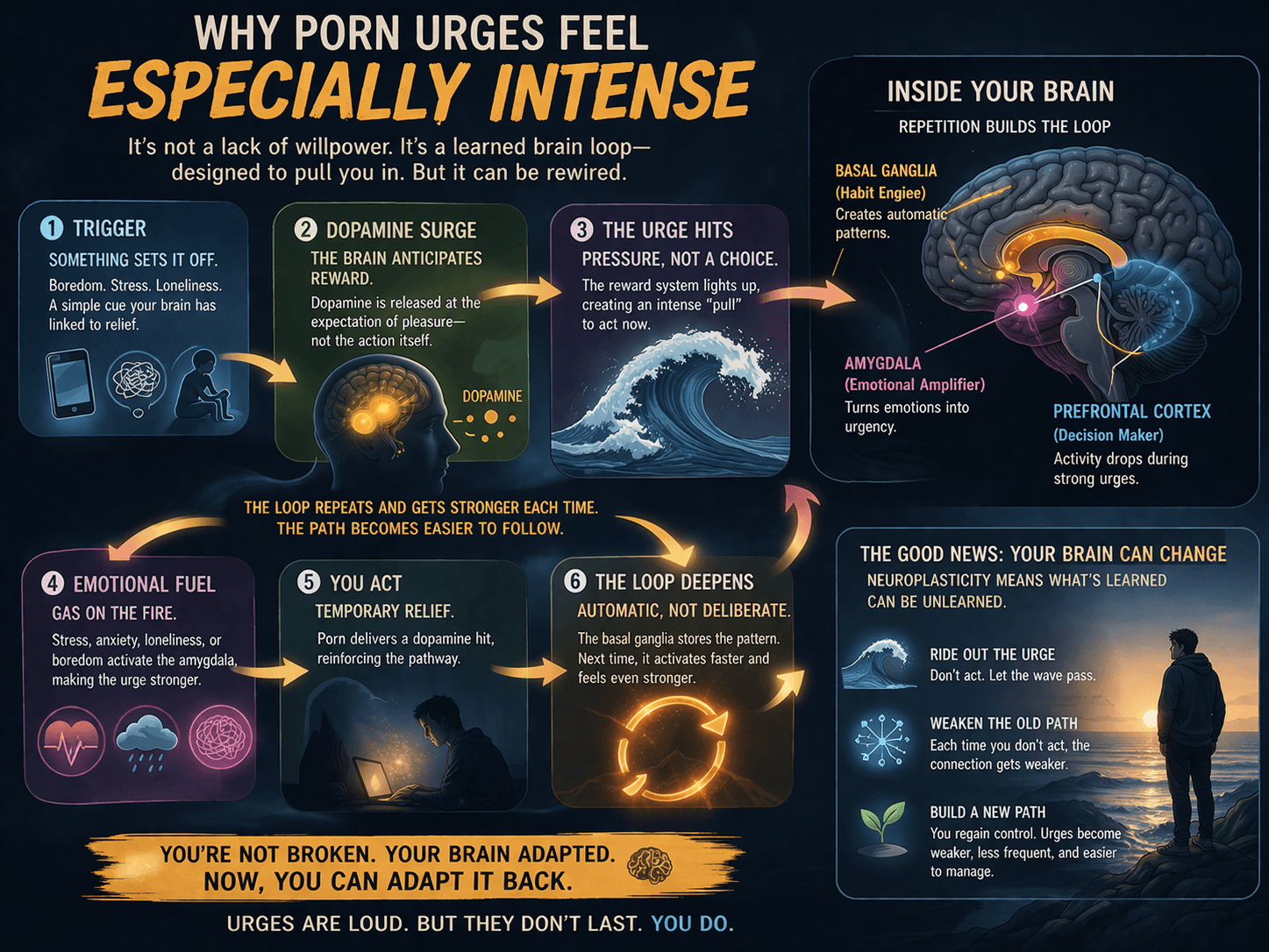
Certain emotional states serve as the neurochemical equivalent of “pouring gasoline on the fire.”
Stress, loneliness, boredom, or anxiety activate the brain’s emotional centers, particularly the amygdala, which only increases the drive to seek relief. If you’ve been repeatedly using porn as a coping mechanism, your brain begins to treat it as the default, reliable solution to discomfort (Volkow et al., 2016).
This is why urges feel so urgent—more like something you need to do, rather than something you choose of your own free will.
Hopefully, this explanation convinces you that there’s nothing wrong with you. It just means that your brain has learned a pattern.
And because of neuroplasticity—the brain’s ability to change through experience—what’s been learned can also be unlearned (Goldstein & Volkow, 2011).
Each time you use the urge surfing technique to ride an urge out without acting on it, you weaken the old pathway and begin reinforcing a new one.
Over time, this reduces both the intensity and frequency of urges, making them easier to manage.
What Porn Urges Feel Like in Your Body
Urges aren’t just mental—they’re physical experiences happening in real time throughout your body. This is a large part of what makes them feel so difficult to resist.
You literally feel pulled. Like an itch you have to scratch, or you lose your mind.
When an urge hits, your brain activates the same systems involved in motivation, stress, and anticipation. This creates a noticeable shift in how your body feels (Volkow et al., 2016).
You might notice
-
Chest tightness or pressure.
-
A sense of restlessness or agitation.
-
Racing thoughts that seem to loop on repeat.
-
Muscle tension.
-
A sense that something needs to be resolved immediately.
These sensations are often accompanied by a strong, almost hypnotic pull toward your phone or computer, as if your body is moving before you’ve fully decided to act.
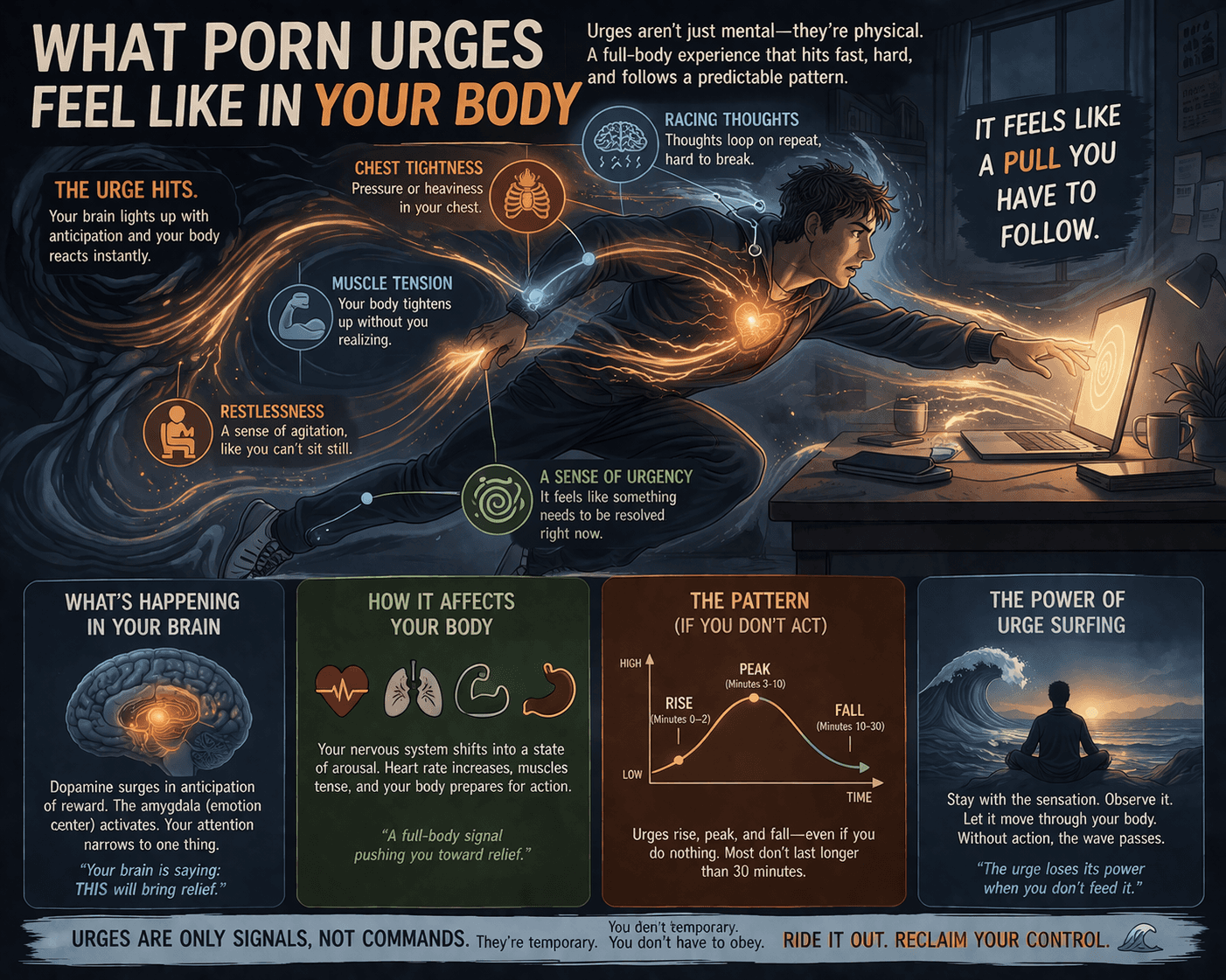
These sensations are driven by your nervous system. As the brain anticipates reward, dopamine activity increases, while the body can enter a mild state of arousal or stress (Volkow et al., 2016).
The amygdala, which processes emotional significance, becomes more active, and your attention narrows toward whatever promises relief (Robinson & Berridge, 2008).
This is why the urge feels so immediate and physical. It’s not just a thought—it’s a full-body signal pushing you toward action.
But these sensations are temporary, and they follow a predictable pattern. They rise, peak, and fall—often within minutes—if you don’t reinforce them by acting on the behavior or feeding them with fantasy (Marlatt & Gordon, 1985).
Urges are only signals—not commands.
Your brain is generating a learned response based on past behavior. It’s trying to solve a problem using a familiar pattern. But that doesn’t mean you have to follow through.
Understanding this changes how you respond and should make urge surfing make a lot more sense. If urges are temporary, and fighting them tends to make them stronger, then the goal isn’t to eliminate the feeling—it’s to experience it without reacting.
This is where urge surfing becomes a powerful tool.
Instead of trying to escape the sensation, you stay with it. You observe it. You let it move through your body without acting on it.
And when you do that, the urge loses its power.
Why Fighting Urges Just Makes Them Stronger
Trying to suppress an urge doesn’t eliminate it—it amplifies it.
This effect is well documented in psychology as the ironic process theory, first described by Daniel Wegner.
The idea is simple: when you try not to think about something, your brain has to keep checking whether you’re thinking about it, which keeps the thought active (Wegner, 1994).
It’s the classic “don’t think about a white bear” problem. The more you try not to think about it, the more it shows up.
The same thing happens with urges.
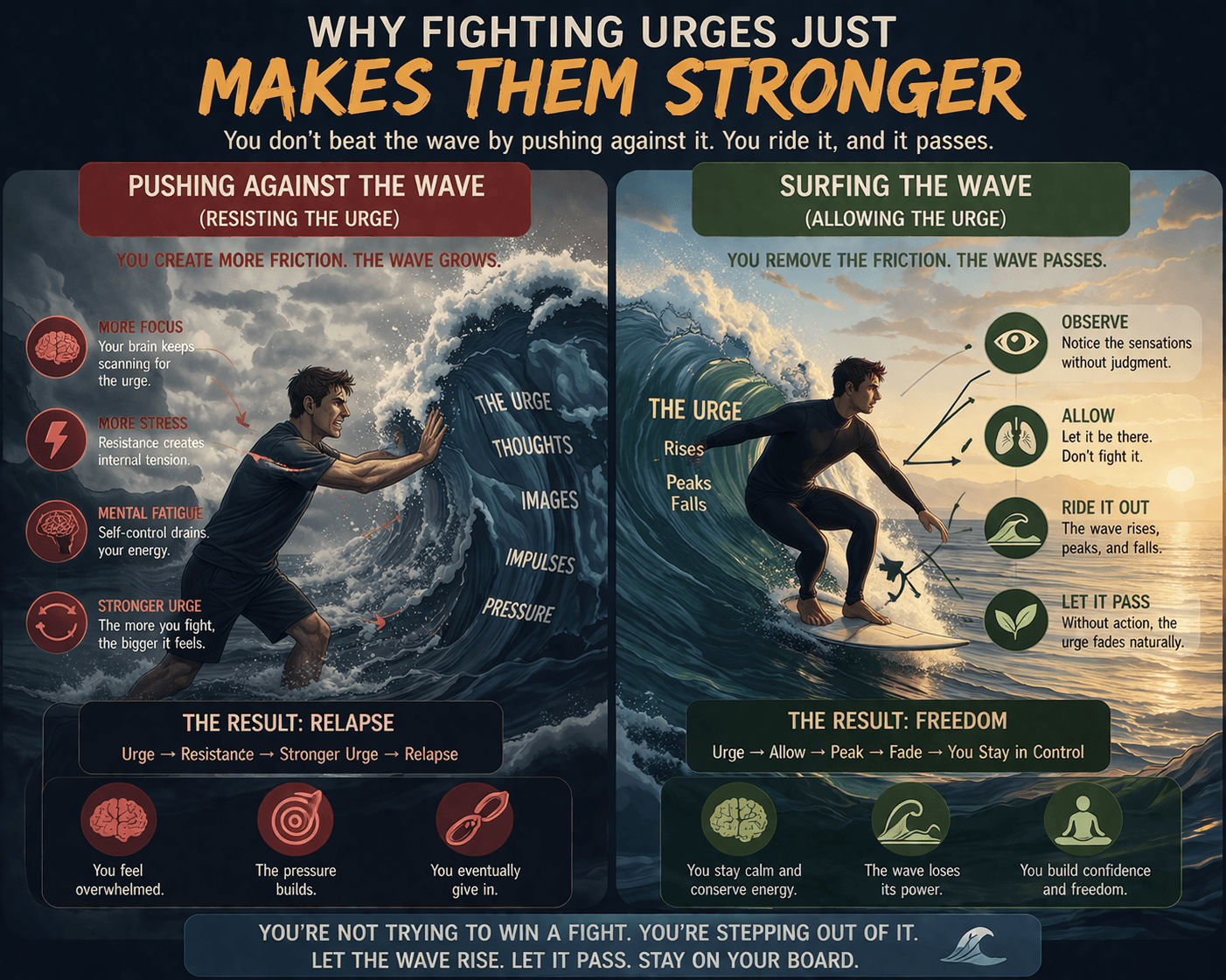
When you resist an urge, part of your mind is actively trying to suppress it, while another part is scanning for it. That internal tension keeps the urge front and center in your awareness.
As a result:
-
Your brain becomes more focused on the urge.
-
Stress and discomfort increase as you try to push it away.
-
Your cognitive load goes up, making self-control harder to maintain.
This is why resisting an urge often makes it feel stronger, not weaker.
Over time, this creates a predictable cycle:
Urge → Resistance → Stronger urge → Relapse
You fight the urge, it intensifies, and eventually the pressure becomes too much. When you give in, it feels like relief—but all you’ve really done is reinforce the loop.
Urge surfing breaks this cycle by removing the resistance entirely.
Instead of trying to suppress the urge, you allow it to exist without feeding it. This takes away the friction that keeps it alive. Without resistance or reinforcement, the urge loses momentum and fades on its own.
You’re not trying to win a fight. You’re stepping out of it completely.
You’re letting the wave rise, peak, and pass—without letting it pull you under.
The RAIN Method for Porn Urges
One of the most effective ways to practice urge surfing is through the RAIN framework. This approach is rooted in relapse prevention research developed by Alan Marlatt and later expanded through mindfulness-based work by Judson Brewer.
RAIN stands for "Recognize, Allow, Investigate, and Note." Each step is simple, but together they interrupt the automatic loop between urge and behavior.
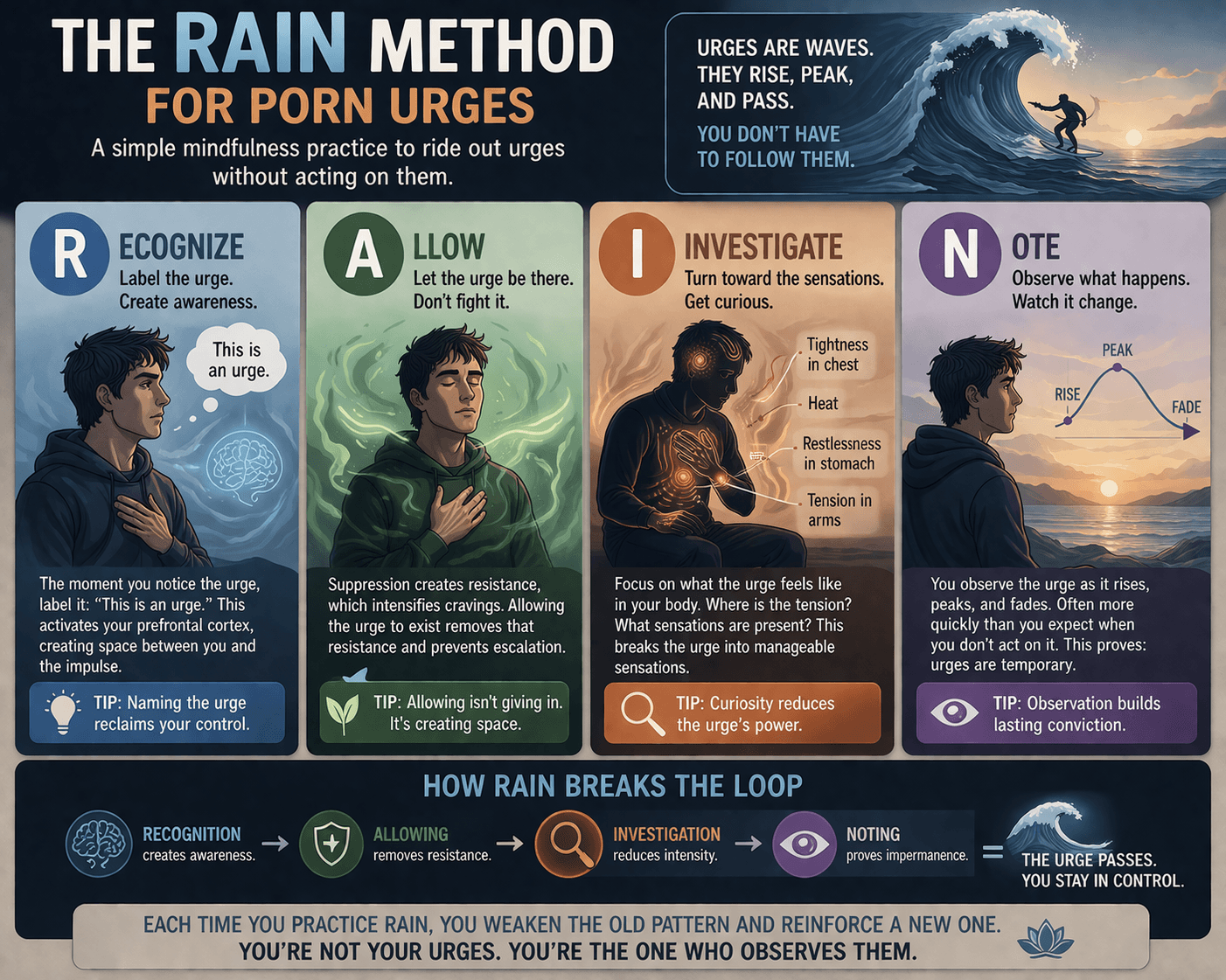
Recognize
The moment you notice the urge, you label it: “This is an urge.”
This small act of labeling recruits your prefrontal cortex—the part of your brain responsible for awareness and decision-making—creating distance between you and the impulse.
Allow
Instead of trying to suppress the urge, you let it exist.
Suppression tends to increase mental resistance, which can intensify cravings. Allowing the urge removes that resistance and prevents the cycle from escalating.
Investigate
You turn your attention to what the urge feels like in your body.
Where is the tension? What sensations are present? Is it pressure, heat, or restlessness?
This shifts you out of abstract thinking and into direct sensory experience, breaking the urge into smaller, manageable components.
Note
You observe what happens next.
The urge changes. It rises, peaks, and fades—often more quickly than expected when you don’t act on it. This reinforces the understanding that urges are temporary states, not commands (Marlatt & Gordon, 1985).
Taken together, RAIN disrupts the habit loop at multiple points. Recognition creates awareness.
Allowing removes resistance. Investigation reduces intensity. Noting proves impermanence. Instead of reacting automatically, you stay present long enough for the urge to pass—and each time you do, you weaken the old pattern and reinforce a new one.
Why urge surfing works
Urge surfing is effective because it targets the core mechanisms behind addictive behavior: It interrupts automatic habit loops.
Addictive behaviors are driven by learned cue → response patterns stored in the brain. Bringing awareness to the urge disrupts this automatic process.
-
It reduces reinforcement.
When you don’t act on an urge, you weaken the neural pathway associated with that behavior. Over time, this reduces both the intensity and frequency of urges.
-
It changes your relationship to discomfort.
Instead of avoiding or escaping uncomfortable sensations, you learn to tolerate and observe them. This decreases the emotional urgency that drives compulsive behavior.
-
It retrains the brain through experience.
Each time you ride out an urge without acting, you reinforce new neural pathways associated with control, awareness, and non-reactivity.
This is the deeper goal of urge surfing: not just resisting a single urge, but gradually rewiring how your brain responds to them.
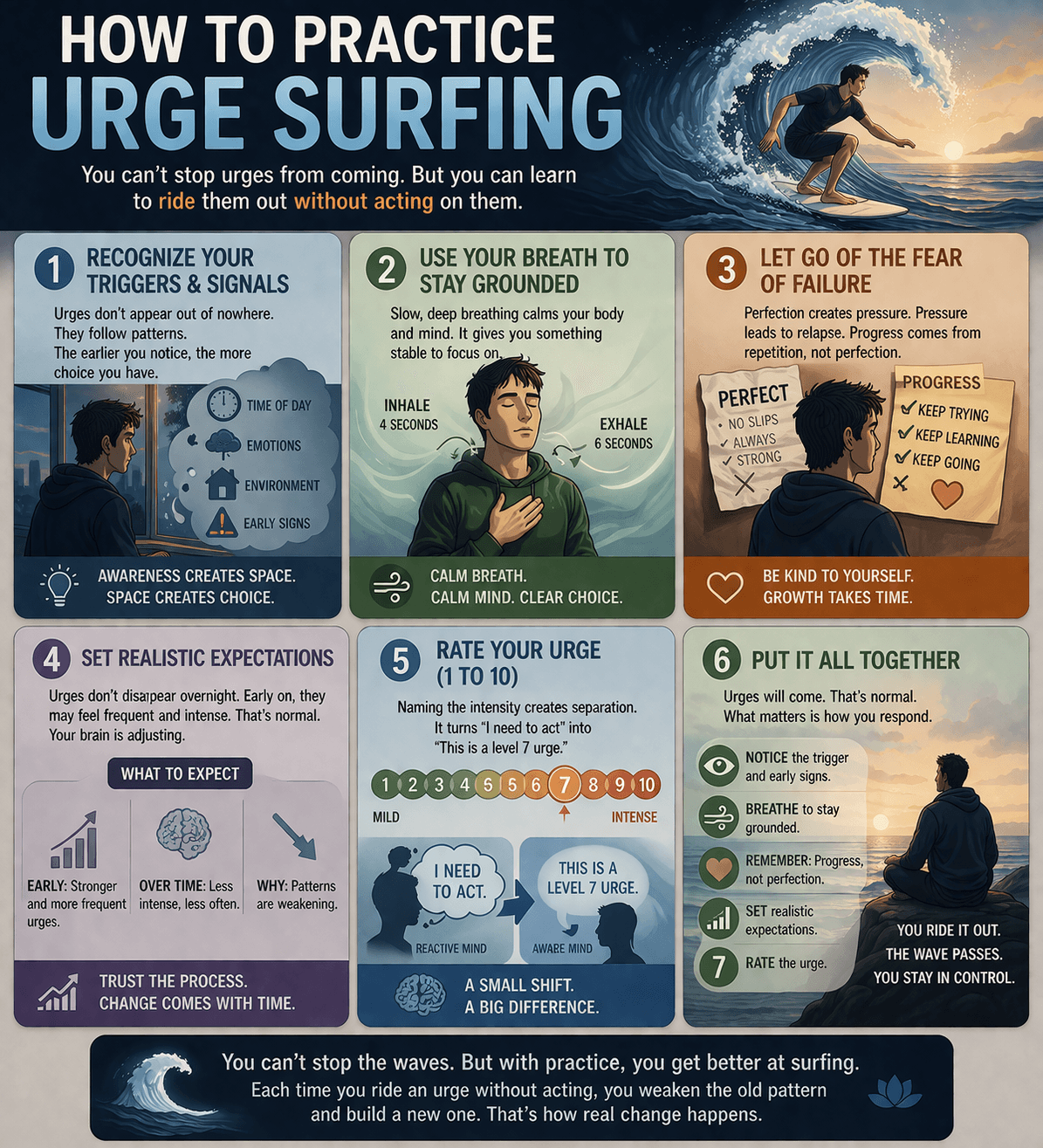
How to Practice Urge Surfing
When you stop trying to control or suppress the urge and instead focus on how you respond to it, you take away the mechanism that gives it power.
To do that effectively, you need a simple and repeatable approach.
-
Start by learning to recognize your triggers and early signals.
Urges rarely appear out of nowhere. They tend to follow patterns—certain times of day, emotional states, or environments. The earlier you notice the buildup, the easier it is to respond intentionally instead of react automatically.
-
Use your breath to stay grounded.
Your breath is one of the fastest ways to regulate your nervous system. Slowing your breathing helps reduce physiological arousal and gives your mind something stable to focus on while the urge passes.
-
Let go of the fear of failure.
Trying to be perfect creates pressure, and pressure often leads back to the very behavior you’re trying to avoid. Progress in this process comes from repetition, not perfection. Every time you observe an urge—even if you don’t handle it perfectly—you’re still building awareness.
-
Set realistic expectations.
Urges don’t disappear overnight. In the early stages, they may feel frequent and intense. That doesn’t mean the process isn’t working—it means your brain is adjusting. Over time, both the intensity and frequency decrease as the underlying patterns weaken.
It can also help to rate your urges on a scale from 1 to 10.
This builds awareness and creates separation between you and the experience. Instead of “I need to act,” it becomes “This is a level 7 urge.” That small shift in framing reduces reactivity and allows you to observe the urge more objectively.
Doing these things won’t stop urges from appearing.
But they will make you far more effective at handling them when they do—and that’s what ultimately leads to change.
When to Use Urge Surfing
Urge surfing works best in the exact moments when you feel that familiar pull toward porn—the moments where it feels like you’re already halfway into the behavior before you’ve made a conscious decision.
These moments aren’t random. They tend to show up in predictable situations:
-
Late at night when you’re alone and your guard is down.
-
During periods of stress, boredom, or frustration, when our brain is looking for relief.
-
While scrolling on your phone, where easy access and habit combine.
-
When you’re procrastinating or avoiding something uncomfortable.
In each of these situations, your brain is trying to regulate your state.
It’s not just about porn—it’s about changing how you feel.
The urge is your brain’s learned shortcut to relief, distraction, or stimulation. You’re not just dealing with a thought—you’re dealing with a conditioned response that’s already in motion.
Urge surfing is so effective here because this is the point where the pattern can be interrupted. Instead of reacting automatically, this is your opportunity to pause, notice what’s happening, and create just enough space between the urge and your response.
You don’t need to win a battle of willpower. Rather, you just need to stay present long enough for the urge to run its course.
And when you do that—even once—you begin to break the pattern.
Creating a Recovery-Friendly Environment Amplifies The Power Of Urge Surfing
Your environment plays a major role in how often urges appear, so controlling that ahead of time makes urge surfing a lot easier.
If you reduce your exposure to triggers, you significantly improve your chances of experiencing urges in the first place.
Focus on a few key changes:
-
Set consistent sleep and wake times.
-
Create clear “no electronics” zones (especially in your bedroom).
-
Build structured daily routines.
-
Put accountability systems in place.
You want to create fewer opportunities for automatic behavior.
The more structure you have, the more friction there is between you and porn, and the easier urge surfing gets.
What to Do If You Slip
Setbacks are a normal part of recovery, but what matters isn’t that it happened—it’s what you do after. Relapses happen, but they don't have to derail your progress.
One of the biggest mistakes people make after a slip is falling into shame. Research in addiction psychology shows that shame and self-criticism don’t prevent relapse. Instead, they often increase the likelihood of it.
When you feel ashamed, your stress levels rise, your sense of control drops, and you become more likely to return to the behavior to cope (Dearing et al., 2005). In other words, the emotional reaction to the slip can do more damage than the slip itself.
That’s why your response matters so much so drop the self-judgment.
Shame keeps you stuck in the cycle. It turns a single mistake into a pattern by reinforcing the emotional state that drives the behavior. Instead, treat the slip as data. Something happened.
There’s a reason for it. Your job is to understand it, not punish yourself for it. You have to do four things immediately.
-
Break isolation.
Addictive behaviors thrive in isolation. The moment you disconnect, the behavior gains more control. Reaching out—even briefly—interrupts that pattern. It shifts you out of your own head and back into reality, where you have more perspective and support.
-
Look for patterns.
A slip is feedback. It tells you something about your triggers, your environment, or your current state.
What triggered this? What time did it happen? What were you feeling leading up to it?
These aren’t questions to assign blame—they’re tools to identify patterns your brain has learned.
-
Adjust your approach.
Once you understand the pattern, you can change your response. Maybe you need a different strategy for late nights. Certain environments should be changed. Maybe you need a stronger interruption when the urge first appears. Recovery is not about perfection—it’s about iteration.
-
Take care of the basics.
Your physical state directly affects your ability to manage urges. Poor sleep, high stress, and low energy all reduce your ability to regulate impulses. When your baseline is off, everything feels harder. Taking care of these fundamentals gives you a stronger foundation to work from.
Every setback gives you information to prevent the next one.
And if you use that information correctly, it doesn’t set you back—it moves you forward.
If You Need More Than Urge Surfing To Quit Porn
Quitting porn addiction isn’t about having more willpower.
It’s about understanding how your brain works—and using that knowledge to your advantage.
Urges feel powerful, but they’re temporary. Most fade within 10 to 30 minutes if you don’t feed them.
Every time you successfully surf an urge, you weaken the habit and strengthen your control. That’s how real change happens—not all at once, but one urge at a time.
If you want structured support while building this skill, Relay is designed to help you do exactly that.
Instead of handling urges alone, you’ll have a system, accountability, and real people supporting your recovery—especially in the moments when it matters most.
You don’t need to fight harder. You need a more powerful weapon and a stronger army.
Relay is both of these things. When combined with urge surfing, you can break free from porn addiction.
Give Relay a 7-Day free trial.
References
Marlatt, G. A., & Gordon, J. R. (1985). Relapse prevention: Maintenance strategies in the treatment of addictive behaviors. Guilford Press.
Bowen, S., Chawla, N., & Marlatt, G. A. (2011). Mindfulness-based relapse prevention for addictive behaviors: A clinician’s guide. Guilford Press.
Robinson, T. E., & Berridge, K. C. (2008). The incentive sensitization theory of addiction: Some current issues. Philosophical Transactions of the Royal Society B: Biological Sciences, 363(1507), 3137–3146. https://doi.org/10.1098/rstb.2008.0093
Tiffany, S. T., & Wray, J. M. (2012). The clinical significance of drug craving. Annals of the New York Academy of Sciences, 1248, 1–17. https://doi.org/10.1111/j.1749-6632.2011.06298.x
Volkow, N. D., Koob, G. F., & McLellan, A. T. (2016). Neurobiologic advances from the brain disease model of addiction. New England Journal of Medicine, 374(4), 363–371. https://doi.org/10.1056/NEJMra1511480
Goldstein, R. Z., & Volkow, N. D. (2011). Dysfunction of the prefrontal cortex in addiction: Neuroimaging findings and clinical implications. Nature Reviews Neuroscience, 12(11), 652–669. https://doi.org/10.1038/nrn3119
Wegner, D. M. (1994). Ironic processes of mental control. Psychological Review, 101(1), 34–52. https://doi.org/10.1037/0033-295X.101.1.34