

Key take aways about the NoFap Flatline
-
A flatline is a temporary period where libido, motivation, and emotional intensity feel reduced after quitting PMO (porn, masturbation, and orgasm).
-
The flatline happens because the brain’s reward system is recalibrating after the removal of high dopamine stimulation.
-
NoFap flatline symptoms commonly include low sexual desire, brain fog, fatigue, and reduced emotional responsiveness.
-
A flatline is not permanent and does not indicate damage to the brain, libido, or sexual function.
-
Most flatlines last from a few days to several weeks, though duration varies based on habits and lifestyle factors.
-
Flatline symptoms often fluctuate, which is a sign of recovery and nervous system adjustment rather than a setback.
-
The flatline reflects habit withdrawal and nervous system stabilization, not depression or low testosterone in most cases.
-
Recovery during a flatline improves by reducing stress, maintaining routines, and avoiding constant self-testing or relapse.
Frequently asked questions about NoFap Flatline
What is a NoFap flatline?
A NoFap flatline is a temporary period where libido, motivation, and emotional intensity feel reduced after quitting porn and masturbation. It is commonly experienced during the brain’s adjustment phase.
Why does the NoFap flatline happen?
It happens because the brain’s reward system is recalibrating after the removal of a highly stimulating habit. This can temporarily reduce dopamine responsiveness, leading to lower desire and motivation.
How long does a NoFap flatline last?
For most people, it lasts from a few days to a few weeks. In some cases—especially with long-term habits—it may last longer, but symptoms typically fluctuate and improve over time.
Is the NoFap flatline permanent?
No. There is no evidence that quitting porn or masturbation causes permanent loss of libido or emotional function. The flatline reflects temporary adaptation, not damage.
Is the NoFap flatline depression or low testosterone?
Not usually. A flatline is a temporary, fluctuating adjustment phase. Depression tends to be persistent and global, while low testosterone often includes physical symptoms.
Relay is a therapist-backed group recovery program for pornography and unwanted sexual behavior, combining daily accountability, real-time urge support, and a private peer community
NoFap Flatline: Why You Feel Numb, Low Libido, or Depressed (And Why It’s Temporary)
If you’re reading this, you’ve tried No Fap, and you know what to expect, but something feels off.
You were expecting to get your interest in real sex back, but your libido dropped out.
You were promised that you’d be excited about life, but your mood feels flat, almost like you’re depressed.
Everyone claimed you’d regain the mental sharpness of your youth, but you feel like you’re living in a haze that’s just as bad as the one you experienced when you were watching porn every day and masturbating constantly.
You don’t feel sad. You don’t feel much of anything. And somewhere underneath all of that is the quiet fear that you’ve broken something that might not come back.
You’re currently experiencing what people call the “NoFap flatline.”
What makes the flatline unsettling isn’t just the symptoms—it’s the uncertainty.
When pleasure, desire, and motivation disappear at the same time, the mind fills in the blanks.
Guys start wondering if all the heavy porn use and masturbation damaged their brains and sex drive beyond repair. After all, if I was a mess when I was addicted to porn, and I don’t feel better when I’m off, maybe I did something irreversible to myself?
Further reading: Porn addiction withdrawals
That fear is often worse than the symptoms themselves. But it’s just that—fear.
There’s a saying that “fear” stands for “false evidence appearing as real.” Nowhere is this more true than the NoFap Flatline.
But what if I told you that this is not only expected but also a sign that things are getting back to normal?
This article isn’t here to scare you, motivate you, or sell you on a miracle timeline for your reboot.
It’s here to explain why the NoFap flatline happens, what’s likely going on under the hood, and how to tell the difference—perhaps for the first time—between a temporary adjustment and something that deserves closer attention.
The goal isn’t reassurance through hype. It’s reassurance through understanding.
What Is a NoFap Flatline?
A NoFap flatline is a temporary phase that some people experience after quitting pornography and habitual, chronic masturbation or excessive masturbation.
During this period, things that once felt automatic—sexual desire, emotional engagement, motivation—can feel noticeably muted or absent.
Further reading: I Can’t Quit Masturbating—What Do I Do?
The most common features of a flatline are:
-
A sharp drop in libido
-
Reduced sexual responsiveness
-
Lower motivation and drive
-
Emotional blunting or numbness
It’s important to remember that a No Fap flatline is not a medical diagnosis, and it isn’t defined by how long it lasts or how severe it feels. It’s a descriptive term people use to make sense of a shared experience during behavior change.
The Simple Definition of No Fap Flatline
At its core, a NoFap flatline is a period of reduced arousal and emotional intensity that occurs after removing a highly stimulating habit.
This definition is precise enough to make some accurate predictions about what to expect and how to manage the symptoms if you’re experiencing them.
These symptoms don’t mean your sex drive is gone forever or that your brain is damaged—and they don’t mean something is “wrong” in the clinical sense. It describes a state of adjustment, not a permanent condition.
Why It’s Called a “Flatline”
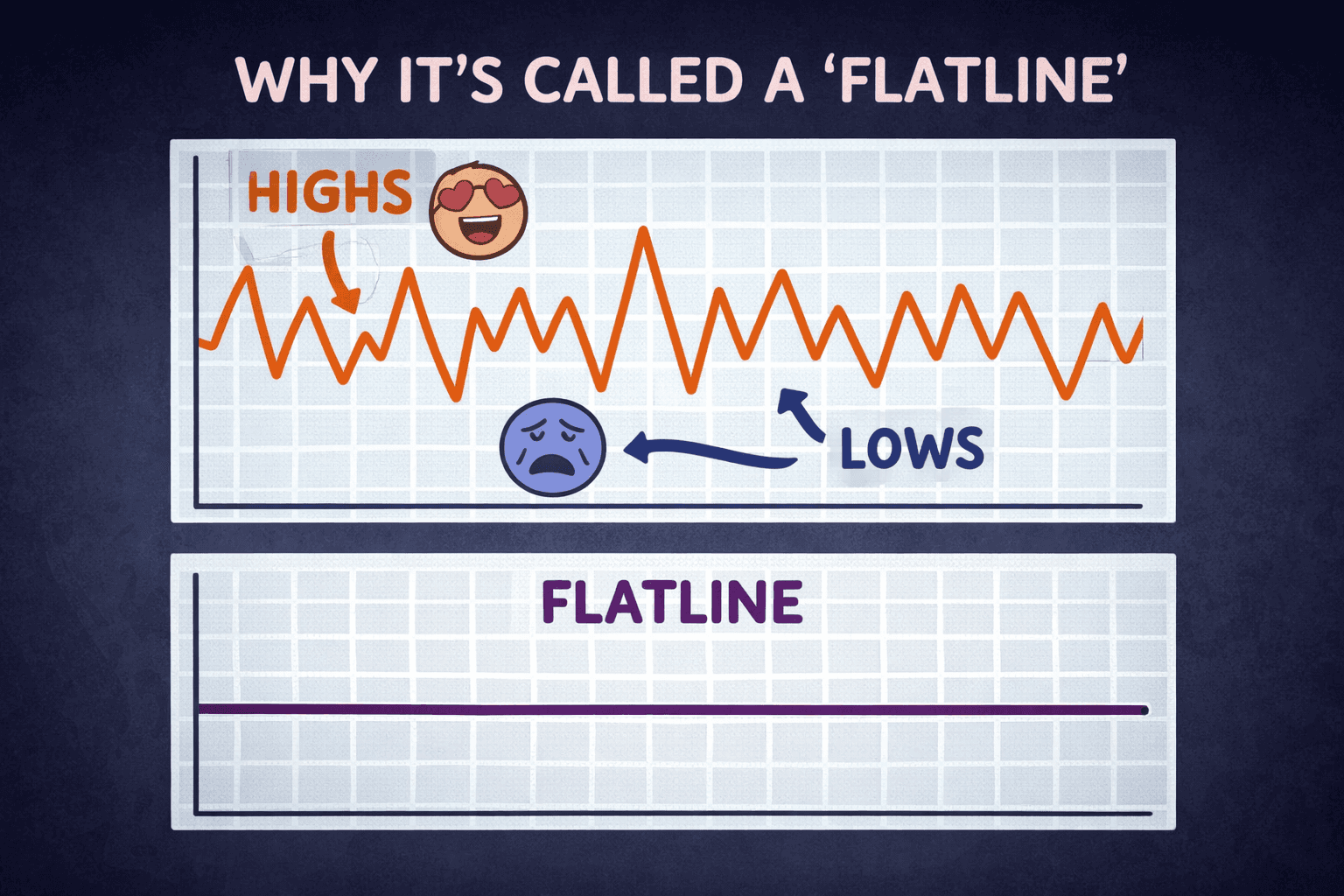
If you’ve been used to experiencing the highs and lows of life, resembling a roller coaster, and we map it like a graph, it’s clearly not flat.
When the highs and lows disappear, the graph looks like a flat line.
The word flatline isn’t medical—it’s experiential.
People use it because their internal signals feel quiet, and life stops being exciting, for better (highs) or worse (lows).
There are no spikes of desire, no rush of excitement, no emotional peaks or valleys. Sexual thoughts don’t pull attention the way they used to, and emotional reactions are flat to the point of effectively being non-existent.
It’s less like feeling depressed and more like feeling offline—as if the system is powered on, but nothing is lighting up yet. That sudden absence of feedback is what makes the flatline so noticeable, and why it can be unsettling if you don’t understand what’s happening.
If you’ve been constantly firing up your arousal system with hyperstimulated images of explicit content, your brain is used to a certain daily spike in dopamine, followed by the calm of release. Now that this is gone, things flatten out as there is a period of readjustment.
Is the NoFap Flatline Real or Just Psychological?
This question presents a false dichotomy by assuming mutual exclusion.
People ask whether the flatline is real or “just psychological,” as if they’re competing explanations. In reality, motivation, desire, mood, and reward processing don’t separate cleanly into mental versus biological categories, especially when habits and reward systems are involved.
Think of it this way:
Depression and anxiety are technically “just psychological,” but they are very real experiences with negative outcomes on quality of life.
We know it’s real. There are thousands of people in the r/NoFap community and various online forums discussing their experiences with it.
A much better question to ask isn’t whether the flatline is real, but whether the experience people describe is consistent with known patterns of behavioral withdrawal symptoms, habit extinction, and stress responses..
Further reading: What happens when you stop watching porn
Why So Many People Report the Same Experience During No Fap
The fact that many people report similar flatline symptoms doesn’t automatically make it a medical condition. Pattern recognition is not the same thing as diagnosis.
But patterns still matter, and anecdotes are a valid form of data, even in a clinical setting.
When many people remove the same high-stimulation behavior and independently report overlapping effects—loss of libido, emotional blunting, low motivation, mental fog—that points toward a shared adjustment process rather than random imagination.
This mirrors what’s commonly observed during the withdrawal or extinction phase of entrenched habits, where the absence of a familiar reward produces a temporary drop in baseline motivation and responsiveness rather than immediate improvement (Bouton, 2004; Lally et al., 2010).
People aren’t all inventing the same story. They’re describing different versions of the same underlying shift: a nervous system recalibrating after the removal of a powerful, repeatable stimulus.
What Science Can and Can’t Say About The No Fap Flatline
To be clear, “NoFap flatline” is not a recognized medical diagnosis, and there is no credible evidence that quitting pornography causes permanent sexual dysfunction or emotional impairment.
What research shows is that the symptoms people label as flatline closely resemble well-documented neurobehavioral adjustment processes.
Repeated exposure to highly stimulating rewards is known to reduce baseline reward sensitivity over time—a phenomenon often described as dopamine downregulation (Volkow et al., 2010).
Further reading: How to sexually reset your brain from porn addiction
When that stimulation is removed, it’s common to experience a temporary period of reduced pleasure, motivation, and drive before the system stabilizes. Importantly, this doesn’t reflect damage; it reflects adaptation.
There’s also a distinction between wanting and liking that helps explain why desire can feel absent even when sexual function itself is intact. Research on incentive sensitization shows that changes in reward processing can temporarily blunt subjective desire without eliminating capacity or interest entirely (Berridge & Robinson, 2016).
At the behavioral level, interrupting a deeply ingrained habit often creates a gap in which the old drive is gone but new motivational patterns haven’t formed yet.
I’ve talked informally about this in reference to my sobriety. I always refer to sobriety as a new good habit, rather than just the absence of an old bad habit.
Habit-formation research consistently shows that change is nonlinear and often involves unstable transitional phases rather than steady improvement (Lally et al., 2010).
Finally, removing a habitual coping behavior can increase short-term stress. Elevated stress hormones are well known to suppress libido, flatten mood, and impair cognitive clarity, even in otherwise healthy individuals (Chrousos, 2009). Chronic or heightened stress alone has been shown to reduce sexual desire and arousal in men without any underlying pathology (Hamilton & Meston, 2013).
None of this proves that every flatline experience is identical, or that it follows a fixed timeline. But it does show that the symptoms people describe fall squarely within established patterns of reward-system adjustment, habit extinction, and stress response—not mysterious damage or imagined dysfunction.
The key point to take from all of this as it relates to the no fap flatline:
The flatline doesn’t require a special explanation to be real. It fits cleanly within what we already know about how the brain and body respond when a powerful habit is removed.
Common NoFap Flatline Symptoms
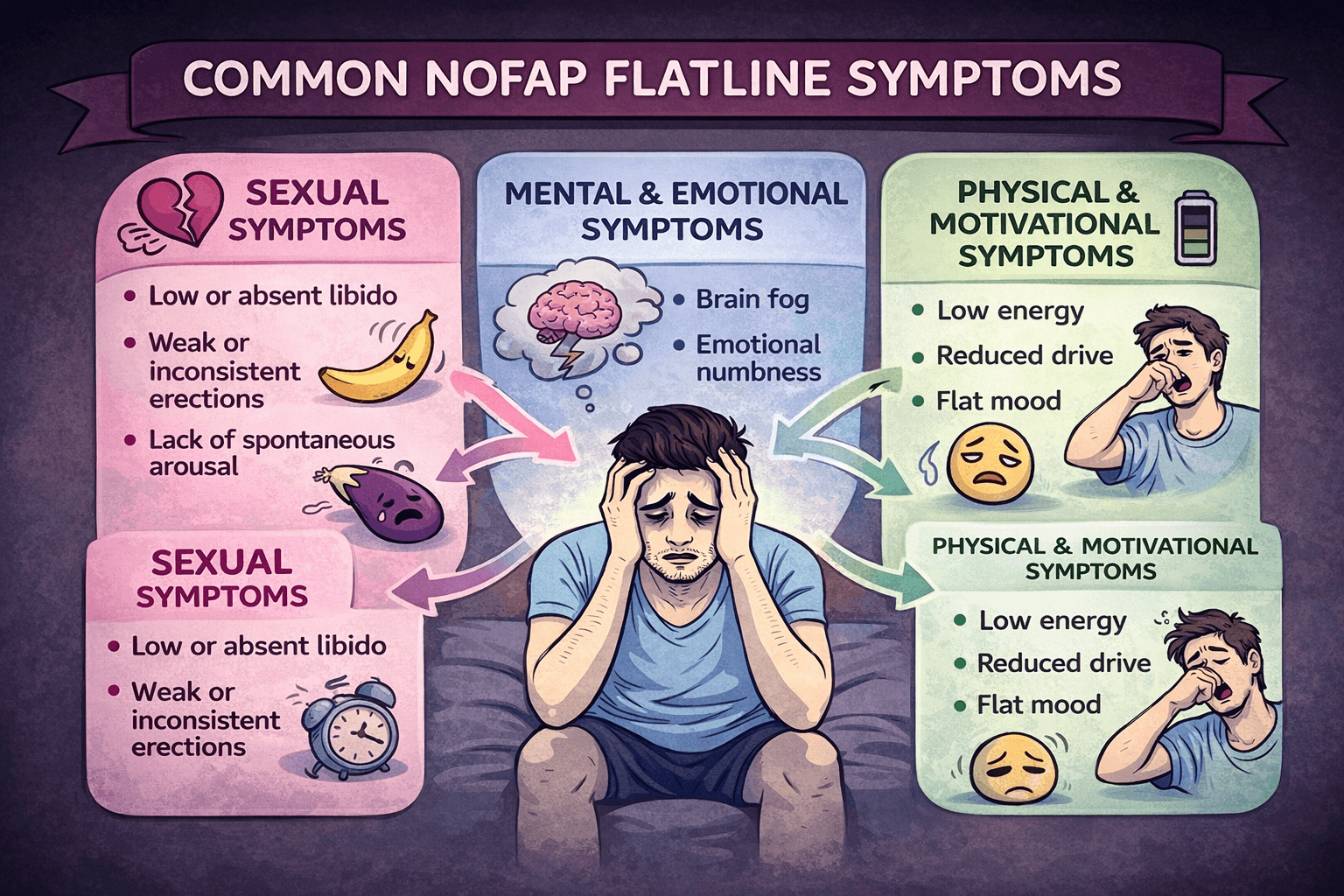
One of the reasons the flatline is so unsettling is that the symptoms don’t stay neatly in one lane. People often expect a purely sexual issue, but what they experience is a broader shift in motivation, mood, and responsiveness.
Not everyone experiences every symptom, and the intensity can vary widely. What matters is the pattern, not any single sign in isolation.
Sexual Symptoms
These are usually the first changes people notice, and the ones that cause the most anxiety. Especially since many men do no fap to combat things like porn-induced erectile dysfunction.
-
**Low or absent libido **Sexual desire can feel dramatically reduced or completely absent, even in situations that previously triggered arousal. This often feels alarming because libido is usually experienced as automatic and reliable.
-
Weak or inconsistent erections Erections may feel less firm, less frequent, or less responsive to mental or visual stimulation. Importantly, this doesn’t necessarily reflect a mechanical or vascular problem, but a reduced arousal signal.
-
Lack of spontaneous arousal Morning wood, random sexual thoughts, or unprompted desire may disappear for a period of time. Many people interpret this as something being “shut off,” when it’s more accurate to think of it as temporarily quiet.
Mental & Emotional Symptoms
These symptoms are just as common as the sexual ones, but they’re discussed less often because mental and emotional disregulation is more challenging to recognize. Many men just assume they’re stressed about other things.
-
Brain fog Concentration can feel dulled. Thinking may feel slower, less sharp, or harder to sustain, especially during tasks that require focus or creativity.
-
Emotional numbness People often describe feeling emotionally flat rather than sad—less excited by good news, less reactive to stress, and generally muted.
-
Anxiety about recovery Worrying about whether the flatline is normal, how long it will last, or whether something is wrong can become a feedback loop that intensifies symptoms.
-
Irritability Small frustrations may feel disproportionately annoying. This often reflects reduced emotional regulation rather than underlying anger.
Physical & Motivational Symptoms
These symptoms can be subtle but persistent. These symptoms can easily be classified as mental or emotional, but the primary distinction is that they are now impeding physical activity rather than just thoughts or mood.
-
Low energy General fatigue or sluggishness is common, even with adequate sleep. People often report feeling “drained” without a clear physical cause.
-
Reduced drive Motivation to pursue goals, socialize, train, or work can drop. Activities that once felt rewarding may feel neutral or effortful.
-
Flat mood Rather than sadness, many people describe a neutral or blank emotional state—neither particularly good nor particularly bad.
Taken together, these symptoms can make the flatline feel overwhelming, especially if you’re expecting immediate improvements after quitting porn or masturbation.
Understanding that this is a cluster of adjustment-related responses, not a personal failure or permanent condition, is the first step toward navigating it calmly.
Why the NoFap Flatline Happens
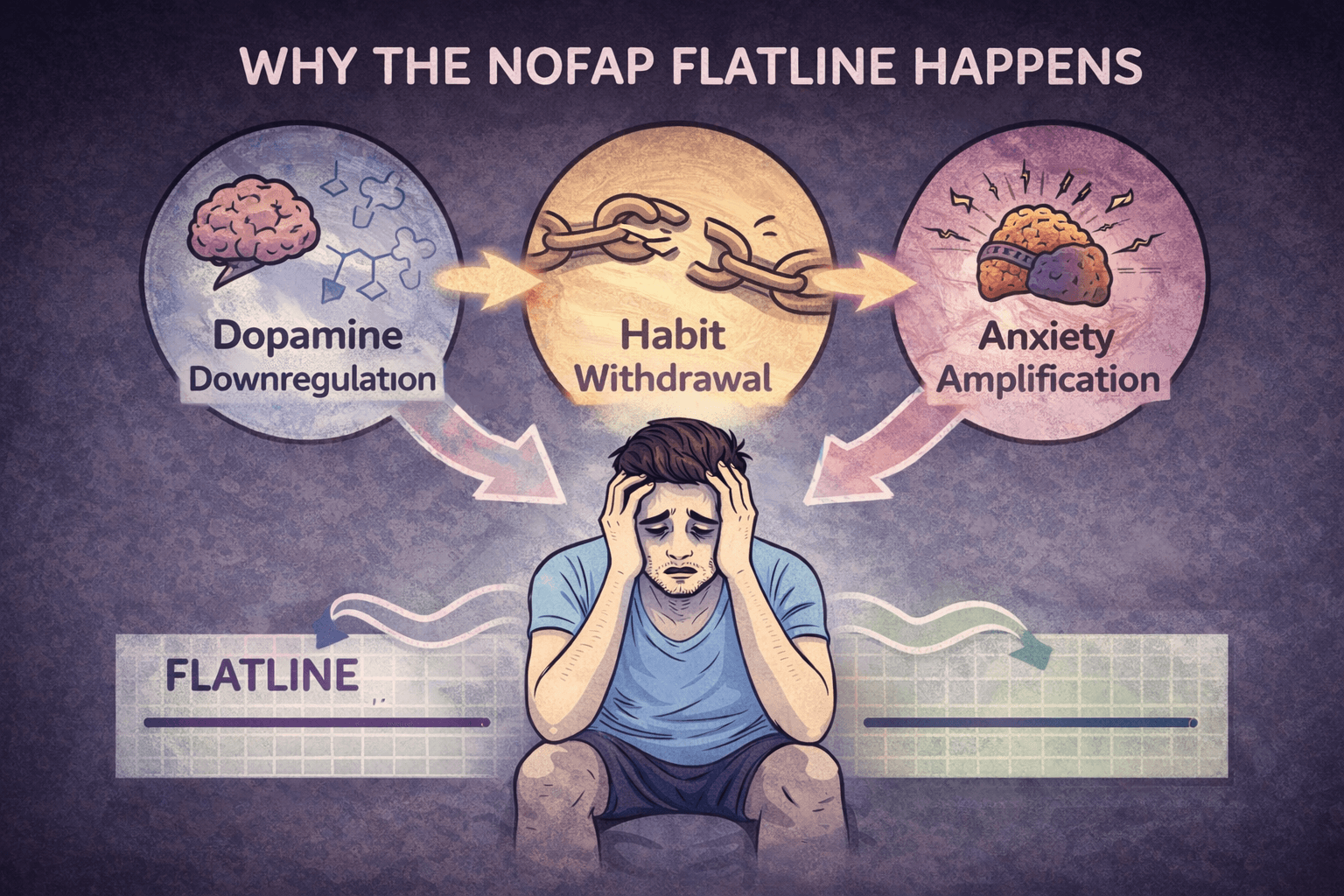
The flatline feels sexual on the surface, but the mechanism behind it is broader than sex. What people are experiencing is better understood as a temporary nervous system and reward-system adjustment, not a failure of libido or masculinity.
Three overlapping processes explain most flatline symptoms.
Dopamine and Reward System Adjustment
Highly stimulating, repeatable behaviors—especially those involving novelty and instant reward—can reduce baseline reward sensitivity over time. Neuroimaging studies consistently show that repeated exposure to intense rewards is associated with reduced dopamine responsiveness in the brain’s reward pathways (Volkow et al., 2010).
When that stimulation is removed, the system doesn’t immediately snap back. Instead, there’s often a temporary period of under-responsiveness, where motivation, pleasure, and desire feel muted. This doesn’t mean dopamine is “damaged” or depleted—it means the system is beginning to rewire and recalibrate toward a lower, more stable baseline.
Anyone who has ever tried to quit caffeine knows exactly what this feels like. When you stop drinking coffee, you deal with serious fatigue that can last up to seven days—even if you were just a casual drinker who didn’t rely on it to wake up. This fatigue occurs because your brain's adenosine receptors (which make you sleepy) have to recalibrate when caffeine comes in and blocks adenosine from doing its job.
This also helps explain why desire can feel absent even when physical function is intact. This is especially common in users hooked on extreme content like hentai, which we break down in our guide to why hentai is so addictive
Research distinguishes between wanting (motivation or craving) and liking (pleasure itself), showing that these systems can become temporarily uncoupled during reward-system changes (Berridge & Robinson, 2016). In practical terms, you can still be capable of arousal while not feeling desire for it yet.
Habit Withdrawal vs. Damage
One of the most important distinctions to make is between withdrawal and injury.
Withdrawal feels like loss. Damage implies something is broken.
When a long-standing habit is removed, especially one that was used frequently or as a coping mechanism, the brain enters an extinction phase.
Research on habit formation and extinction shows that behavior change is rarely smooth; it often involves a transitional period where motivation drops before new patterns stabilize (Lally et al., 2010; Bouton, 2004).
Back to caffeine to make this example clear. One of the most common symptoms of caffeine withdrawal—aside from fatigue—are pounding headaches. Those headaches don’t mean you’re injured. Quite the contrary, actually—the headaches mean that your body is getting back to normal.
That gap—the space where the old drive is gone and the new baseline hasn’t settled—is what many people label as a flatline. The experience can feel dramatic precisely because the habit once provided frequent stimulation and emotional regulation. Its absence exposes the nervous system’s temporary instability, not permanent harm.
Anxiety Makes the Flatline Feel Worse
Anxiety doesn’t cause the flatline, but it can significantly amplify how intense and persistent it feels.
When people begin closely monitoring their libido, erections, mood, or energy, they increase stress at the exact moment the nervous system is trying to stabilize. Elevated stress hormones are well known to suppress libido, flatten mood, and impair cognitive clarity—even in otherwise healthy individuals (Chrousos, 2009).
Research also shows that stress alone can reduce sexual desire and arousal in men, independent of any underlying medical issue (Hamilton & Meston, 2013). This creates a feedback loop: concern about symptoms raises stress, stress worsens symptoms, and the symptoms then reinforce fear.
Seen this way, the flatline isn’t primarily a sexual malfunction. It’s a stress-sensitive adjustment phase involving reward processing, habit disruption, and nervous system regulation. Framing it correctly reduces panic—and panic reduction is often part of recovery itself.
How Long Does a NoFap Flatline Last?
This is usually the question sitting underneath every other worry and concern.
People can tolerate discomfort if they understand it and how long it might last.
But what makes the flatline hard isn’t just the symptoms—it’s not knowing whether there’s an endpoint, or whether you’re stuck in it indefinitely. That uncertainty is what drives most of the panic and compulsive timeline-checking.
The honest answer is that a flatline period doesn’t follow a stopwatch. But they do follow patterns.
Typical Time Ranges (Not Promises)
For many people, flatline symptoms last from the first days to a few weeks, especially if their porn or masturbation habits were moderate and relatively recent. As the nervous system adjusts, libido, motivation, and emotional responsiveness begin returning in uneven waves rather than all at once.
For heavier or long-term users, the adjustment period can last longer. That doesn’t mean the system is damaged—it means the behavior had been doing more regulatory work for longer, so the nervous system needs more time to stabilize without it.
Recovery is also non-linear by nature, often involving mood swings where it’s common to feel better for a few days, then flat again, then better again. That up-and-down pattern often causes people to think they’ve “reset” their progress when, in reality, fluctuation is part of the process.
I break this pattern down more visually—and show where people tend to misinterpret normal dips as setbacks—in my NoFap timeline article, which walks through the common phases people experience after quitting.
Further reading: NoFap timeline benefits
Why Comparing No Fap Timelines Backfires
One of the fastest ways to make a flatline worse is to measure your progress against other people’s stories.
Reddit timelines aren’t predictions. They’re anecdotes—often written at emotional peaks or lows, filtered through fear, relief, or frustration.
Two people can quit the same behavior and experience entirely different timelines based on stress levels, sleep, mental health, life structure, and how intensely they monitor their symptoms.
Nervous systems don’t recover on a shared schedule. The moment you turn someone else’s timeline into a benchmark for your own, you introduce anxiety—and anxiety is one of the most reliable ways to prolong the experience you’re trying to escape.
Is Flatline a Sign of Healing or a Warning Sign?
This is the quiet concern behind most flatline searches.
People aren’t just wondering what is happening—they’re trying to figure out whether the flatline is a normal part of recovery or a sign that something is wrong and being ignored. Most content online dances around that question. It’s better to answer it directly.
The difference usually isn’t subtle once you know what to look for.
Signs It’s Likely a Normal Flatline
A flatline is more likely part of a normal adjustment process when the symptoms show movement, even if that movement is uneven.
-
Symptoms fluctuate Libido, mood, and motivation don’t stay flat forever. You may have days where things feel closer to normal, followed by days where they dip again. That inconsistency is frustrating—but it’s also a sign the system is recalibrating rather than stuck.
-
No pain or physical dysfunction Flatline symptoms are typically about absence or muting, not pain. There’s no persistent genital pain, numbness, or physical distress. Function may feel reduced or unreliable, but not mechanically broken.
-
Gradual return of motivation or interest Even before libido fully returns, people often notice small shifts: more interest in work, better focus, improved mood after exercise, or moments of genuine engagement. These are early signs of stabilization, not setbacks.
Taken together, these signs point toward adaptation, not deterioration.
When to Look Deeper
At the same time, not every low point should be written off as a flatline. Some experiences overlap with flatline symptoms but come from different causes and deserve closer attention.
-
Persistent depression If low mood, hopelessness, or emotional numbness remain constant without fluctuation for extended periods—especially if they were present before quitting porn—that suggests something beyond habit withdrawal may be involved.
-
Hormonal red flags Symptoms like ongoing fatigue, unexplained weight changes, loss of body hair, or consistently absent morning erections over long periods may warrant medical evaluation. These aren’t typical markers of a behavioral adjustment phase.
-
Severe anxiety or panic Occasional worry is common. Persistent panic, obsessive symptom-checking, or anxiety that interferes with daily functioning can turn a temporary adjustment into a prolonged problem. At that point, the anxiety itself becomes a primary issue—not the flatline.
The goal of this distinction isn’t to scare you. It’s to prevent two equally unhelpful extremes: assuming everything is broken, or assuming everything should be ignored.
A flatline is usually a transitional state, not a warning alarm. But paying attention to patterns—rather than forcing reassurance or panic—keeps you grounded, informed, and moving forward.
What NOT to Do During a NoFap Flatline
When people struggle during a flatline, it’s usually not because they’re doing nothing—it’s because they’re doing the wrong things in an attempt to get certainty or relief.
Most bad advice around flatlines encourages checking, forcing, or rushing the process. All three tend to make symptoms louder, not shorter.
Don’t “Test” Yourself Constantly
One of the most common mistakes is trying to verify whether everything still works.
That can look like:
-
Checking porn “just to see if there’s a response.”
-
Forcing arousal through masturbation to confirm erections
-
Mentally scanning your body throughout the day for signs of desire.
These tests don’t provide helpful information.
They train your brain to associate arousal with pressure and evaluation instead of ease and spontaneity. They also keep your nervous system in a heightened state of monitoring, which is the opposite of what allows desire to return naturally.
If you’re asking your body for proof every day, you’re not giving it space to recalibrate.
Don’t Panic-Relapse to “Fix” It
Another common reaction is using porn or masturbation as a diagnostic tool—relapsing to see whether the flatline disappears.
Further reading: Porn relapse
It often does, temporarily. That’s what makes this mistake so convincing.
The short-term relief comes from reintroducing a familiar stimulus, not from solving the underlying adjustment. Once that stimulus is removed again, the nervous system has to restart the recalibration process. What feels like a fix is usually just a reset of the withdrawal cycle.
This doesn’t mean a relapse ruins everything. It means using relapse as reassurance keeps you stuck in the same loop longer than necessary.
Don’t Obsess Over Timelines
Constantly asking “How long should this last?” creates pressure where patience is required.
Recovery from habit-driven overstimulation doesn’t respond to deadlines or comparison. The nervous system stabilizes through consistency, not urgency. The more you measure your progress against a clock—or someone else’s experience—the more stress you add to the process.
And stress, as you’ve already seen, is one of the most reliable ways to prolong flatline symptoms.
The counterintuitive truth is that letting go of the need to check, fix, or rush is often what allows things to normalize in the first place.
What Actually Helps During a Flatline
There’s a reason most effective advice during a flatline sounds boring: boring works.
The flatline isn’t something you power through with hacks or fix with stimulation. It resolves as the nervous system regains stability and baseline responsiveness. The goal during this phase isn’t to feel amazing—it’s to stop making things harder than they need to be.
Stabilize the Nervous System
Before worrying about libido or motivation, focus on the basics that regulate mood, energy, and stress.
-
Sleep Consistent sleep matters more than perfect sleep. Going to bed and waking up at roughly the same time does more for nervous system recovery than chasing optimization routines.
-
Sunlight Daily exposure to natural light—especially in the morning—helps regulate circadian rhythm and mood. This supports energy and emotional stability without adding stimulation.
-
Exercise (not extreme) Movement helps, but overtraining doesn’t. Walking, moderate-intensity lifting, light conditioning, or steady cardio are enough. The goal is regulation, not exhaustion.
These aren’t exciting interventions, but they directly influence the systems involved in flatline symptoms.
Reduce Stimulation, Not Just Porn
Many people quit porn but keep everything else that keeps their reward system overstimulated.
That includes:
-
Constant social media scrolling
-
Endless short-form content
-
Jumping between high-novelty inputs all day
-
Layering stimulation (music + phone + caffeine + multitasking)
This kind of dopamine stacking keeps the nervous system in a reactive state. Reducing overall stimulation—not eliminating pleasure, but lowering intensity—gives the brain space to re-sensitize to normal rewards.
Flatline recovery isn’t just about removing one behavior. It’s about reducing background noise.
Focus on Life Momentum, Not Libido
One of the most effective shifts during a flatline is redirecting attention away from sexual performance and toward forward motion in daily life.
That means:
-
Showing up to work consistently
-
Training on a regular schedule
-
Maintaining routines even when motivation is low
Momentum creates stability. Stability reduces stress. Reduced stress allows desire and motivation to return on their own timeline.
Libido doesn’t respond well to pressure or focus. It responds to a life that’s moving forward without it being constantly interrogated.
During a flatline, the most productive move is often the least dramatic one: keep your life structured, reduce excess stimulation, and let the nervous system catch up.
Flatline vs Depression vs Low Testosterone
One reason the NoFap flatline causes so much anxiety is that its symptoms overlap with other conditions young men already fear—specifically, depression and low testosterone.
On the surface, all three can involve low libido, low motivation, and flat mood.
The key difference isn’t any single symptom. It’s the pattern the symptoms follow.
Key Differences
Situational vs. global symptoms
A flatline is typically situational. Symptoms emerge when quitting a highly stimulating habit and tend to fluctuate over time.
Depression, by contrast, is defined by global mood disturbance—low mood, loss of interest, or hopelessness that affects nearly all areas of life and persists most days for weeks or months (American Psychiatric Association, 2013).
Low testosterone levels can also produce global effects, but these usually extend beyond mood and libido to include physical signs like reduced muscle mass, increased fatigue, and metabolic changes (Bhasin et al., 2018).
Libido loss vs. pleasure loss
In a flatline, libido often drops before other forms of pleasure. People may still enjoy food, music, accomplishment, or social interaction—just less intensely or less consistently. Depression is marked by anhedonia, the reduced ability to feel pleasure from almost anything, not just sex (American Psychiatric Association, 2013).
Low testosterone can reduce sexual desire, but it doesn’t typically eliminate emotional pleasure on its own. When it does, it’s often accompanied by other hormonal or metabolic symptoms (Bhasin et al., 2018).
Temporary vs. persistent patterns
Flatline symptoms are usually nonlinear and temporary. They improve, regress, and improve again as the nervous system stabilizes after habit removal. That fluctuation is consistent with behavioral withdrawal and habit extinction processes (Lally et al., 2010).
Depression is defined by persistence—symptoms that remain relatively stable without spontaneous improvement and interfere with daily functioning over time (American Psychiatric Association, 2013). Similarly, untreated low testosterone tends to produce stable or progressively worsening symptoms rather than waves of improvement and relapse (Bhasin et al., 2018).
To sum up the difference between a flatline, depression, and low testosterone:
-
A flatline feels like a system in transition.
-
Depression feels like a system stuck.
-
Low testosterone usually comes with physical signals that don’t come and go.
Understanding these distinctions doesn’t replace professional evaluation when it’s needed, but it does prevent people from mislabeling a temporary adjustment phase as a permanent problem.
The Flatline Isn’t Proof You’re Broken — It’s Proof You Changed Something
The flatline feels unsettling because it removes familiar signals—desire, motivation, emotional highs—and leaves silence in their place. It’s easy to mistake that silence for damage. But what it usually represents is transition.
When a long-standing, high-stimulation habit is removed, the nervous system doesn’t immediately replace it with something better. There’s often a gap. That gap can feel like emptiness, but it’s better understood as space—space where old patterns no longer dominate and new baselines haven’t fully formed yet.
A flatline isn’t a failure of willpower, masculinity, or biology. It’s not proof that you ruined your brain or lost something permanently. And it isn’t a fixed destination you’re stuck in. It’s a phase that reflects adjustment, not injury.
The mistake most people make is trying to interpret the flatline as a verdict on their future. It isn’t. It’s feedback that something meaningful changed—and that your system is in the process of reorganizing itself around that change.
If you treat the flatline as a transition rather than a diagnosis, the path forward becomes simpler: reduce pressure, maintain structure, and give your nervous system time to catch up to the life you’re building without the old crutch.
That’s not passive. It’s patient. And patience, in this case, is part of the recovery itself.If you are currently struggling with the nofap flatline, or you're worried about trying to quit porn and dealing with this stage of your NoFap journey as a "fapstronaut," Relay can help.
A dedicated team of clinical psychologists and peer recovery specialists are there to help you in your journey to finally kick the porn habit for good. Learn more below.
References
Clinical & Diagnostic Authority
American Psychiatric Association. (2013). Diagnostic and statistical manual of mental disorders (5th ed.). Arlington, VA: American Psychiatric Publishing. https://doi.org/10.1176/appi.books.9780890425596
Bhasin, S., Brito, J. P., Cunningham, G. R., Hayes, F. J., Hodis, H. N., Matsumoto, A. M., Snyder, P. J., Swerdloff, R. S., & Wu, F. C. W. (2018). Testosterone therapy in men with hypogonadism: An Endocrine Society clinical practice guideline. The Journal of Clinical Endocrinology & Metabolism, 103(5), 1715–1744. https://doi.org/10.1210/jc.2018-00229 PMID: 29562364
Neurobiology & Reward System Adjustment
Volkow, N. D., Fowler, J. S., Wang, G.-J., & Goldstein, R. Z. (2010). Dopamine in drug abuse and addiction: Results of imaging studies. Nature Reviews Neuroscience, 11(6), 382–393. https://doi.org/10.1038/nrn2819 PMID: 20395901
Berridge, K. C., & Robinson, T. E. (2016). Liking, wanting, and the incentive-sensitization theory of addiction. American Psychologist, 71(8), 670–679. https://doi.org/10.1037/amp0000059 PMID: 27977239
Stress, Mood, and Sexual Function
Chrousos, G. P. (2009). Stress and disorders of the stress system. Nature Reviews Endocrinology, 5(7), 374–381. https://doi.org/10.1038/nrendo.2009.106 PMID: 19488073
Hamilton, L. D., & Meston, C. M. (2013). Chronic stress and sexual function in women. The Journal of Sexual Medicine, 10(10), 2443–2454. https://doi.org/10.1111/jsm.12249 PMID: 23987137
Habit Formation, Withdrawal, and Motivation
Lally, P., van Jaarsveld, C. H. M., Potts, H. W. W., & Wardle, J. (2010). How are habits formed: Modelling habit formation in the real world. European Journal of Social Psychology, 40(6), 998–1009. https://doi.org/10.1002/ejsp.674
Bouton, M. E. (2004). Context and behavioral processes in extinction. Learning & Memory, 11(5), 485–494. https://doi.org/10.1101/lm.78804 PMID: 15466300