

Key takeaways about porn withdrawal
-
Porn withdrawal symptoms are temporary mental and emotional effects that occur as the brain adjusts to reduced stimulation after quitting.
-
Common symptoms include cravings, irritability, anxiety, low mood, brain fog, insomnia, and temporary loss of libido.
-
These symptoms are typically psychological and behavioral, not physically dangerous, and vary based on usage patterns.
-
Withdrawal happens because the brain’s reward system is recalibrating after repeated exposure to high-stimulation content.
-
Symptoms often peak within the first 1–2 weeks and improve significantly within 30–90 days for most people.
-
The “flatline” phase—temporary low libido or motivation—is a normal part of the adjustment process.
-
Not everyone experiences withdrawal, but those with more frequent or compulsive use are more likely to notice symptoms.
-
Managing withdrawal involves reducing triggers, building healthy habits, and using support systems to prevent relapse.
Frequently asked questions about porn withdrawal
What is porn addiction withdrawal?
Porn addiction withdrawal refers to the mental, emotional, and behavioral symptoms that can occur when someone stops or significantly reduces pornography use after frequent or compulsive consumption. These symptoms are typically linked to changes in the brain’s reward system, especially involving dopamine.
While porn addiction is not officially classified in diagnostic manuals, many people report experiencing a temporary adjustment period when they quit, particularly after heavy use. This period is often described as withdrawal because it can include cravings, mood changes, and difficulty focusing.
What does withdrawal from porn addiction look like?
Withdrawal from porn addiction usually looks like a mix of psychological and behavioral changes rather than severe physical symptoms. Most people experience things like increased cravings, irritability, anxiety, low mood, trouble sleeping, and difficulty concentrating.
In the early stages, these symptoms can feel intense and unpredictable. Over time, they typically shift into lower energy, reduced motivation, or a temporary drop in libido (sometimes called the “flatline”) (Grubbs et al., 2019; Kraus et al., 2018). The exact experience varies depending on how frequently porn was used and how long the habit was in place.
What are porn addiction withdrawal symptoms?
Common porn addiction withdrawal symptoms include:
-
Strong cravings to watch porn
-
Irritability and mood swings
-
Anxiety or restlessness
-
Depression or low motivation
-
Brain fog and difficulty concentrating
-
Insomnia or disrupted sleep
-
Temporary loss of libido (flatline)
-
Increased stress or emotional sensitivity
Not everyone experiences all of these symptoms, and their intensity can vary. In most cases, they are temporary and reflect the brain adjusting to lower levels of stimulation.
How long does porn addiction withdrawal last?
Porn addiction withdrawal typically lasts anywhere from a few days to several weeks, depending on the individual.
-
First few days (1–7): cravings, irritability, anxiety, and sleep issues are often strongest
-
Weeks 2–4: symptoms may begin to stabilize, though urges can still come in waves
-
1–3 months: many people report improved mood, focus, and reduced cravings
Some individuals—especially those with long-term or heavy use—may experience lingering symptoms for a few months. However, most people see noticeable improvement within the first 30 to 90 days (anecdotal reports; limited controlled evidence).
How to overcome porn addiction withdrawal?
Overcoming porn withdrawal involves managing symptoms while your brain adjusts and building habits that reduce the risk of relapse. The most effective strategies include:
-
Remove triggers: block access and change your environment
-
Replace the habit: exercise, hobbies, or productive routines
-
Improve sleep and nutrition: support brain recovery
-
Use accountability: support groups, partners, or structured programs
-
Practice urge management: mindfulness, delaying tactics, and awareness
-
Address underlying issues: stress, loneliness, or emotional triggers
Relay is a therapist-backed group recovery program for pornography and unwanted sexual behavior, combining daily accountability, real-time urge support, and a private peer community
The Truth About Porn Addiction Withdrawal: Real Symptoms & Recovery Timeline
So many guys are worried about the dreaded "porn withdrawal symptoms" that they never even try to quit porn.
Then there are the guys who make a go at it, and a few days in, they feel worse than when they were watching porn in the first place. This, predictably and sadly, drives them back to porn.
But what if there was nothing to worry about, the brain fog, low libido, and fatigue were all temporary, and there was was actually a way to mitigate these symptoms almost to the point of making them non-existent?
Well, this is the article you need to read!
Withdrawal symptoms are usually temporary, but without structure, they can lead to relapse. The goal isn’t just to “push through” but to build a system that makes long-term change sustainable.
The rest of this article will tell you:
-
Why withdrawal symptoms happen.
-
How long you can expect those withdrawal symptoms to last.
-
Why it's actually good sign if you're experiencing them.
-
How to make them easier to deal with.
Let's get into it!
For more a complete run down of what to expect in porn recovery, read about the quitting porn recovery timeline.
What the science says about porn withdrawal symptoms
The research on porn withdrawal symptoms is still developing, and the reality is more nuanced than most people expect. There isn't exactly a clear cut answer on if they technically even exist.
A randomized controlled study by Fernandez et al. (2023) found that short-term abstinence from pornography did not consistently produce measurable withdrawal symptoms across all participants, although individuals with more frequent or problematic use reported increased cravings and psychological discomfort.
However, the same body of research—and related studies—also found that individuals with more frequent or problematic use were more likely to report increased cravings and psychological discomfort when they stopped.
This is the key distinction.
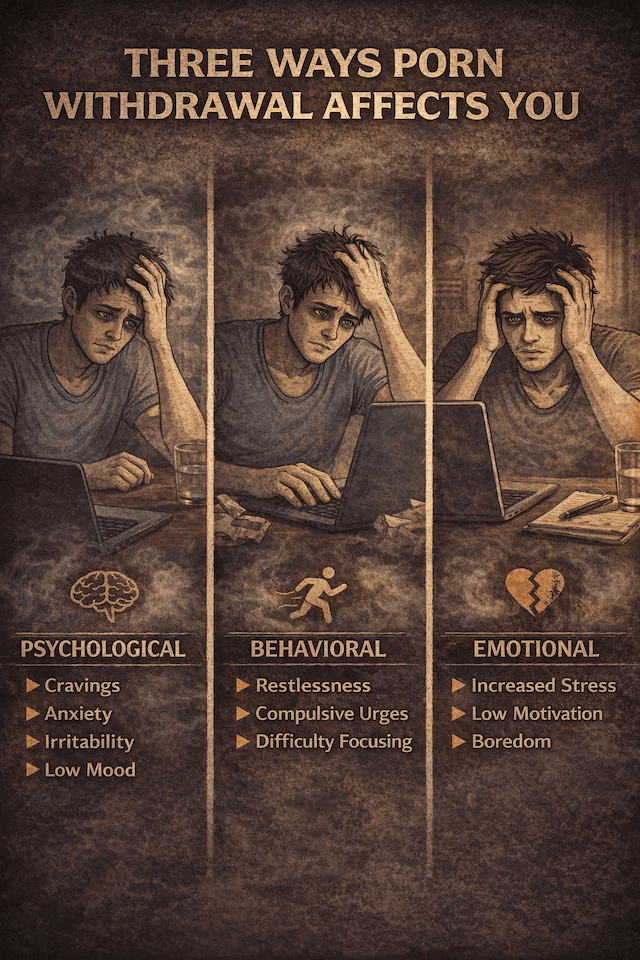
Porn withdrawal is not as clearly defined—or as physically intense—as withdrawal from substances like alcohol or opioids. But that doesn’t mean people don’t experience real symptoms.
Instead, what most people describe as “withdrawal” tends to be:
-
Psychological: cravings, anxiety, irritability, low mood
-
Behavioral: restlessness, compulsive urges, difficulty focusing
-
Emotional: increased sensitivity to stress or boredom
These symptoms are best understood as part of a behavioral adjustment period, where the brain’s reward system is recalibrating after repeated high stimulation.
The good news is that while they are uncomfortable you can live them. Even better, they tend to better quickly, especially if you quit porn using a science and experienced based method like the one we teach here.
Why do so many guys have so many different experiences with porn addiction withdrawal?
Not everyone who quits porn will experience withdrawal symptoms.
The intensity and duration depend on factors like:
-
frequency of use
-
duration of the habit
-
whether the behavior was compulsive or difficult to control
-
underlying stress, habits, or coping mechanisms
Someone who used porn occasionally may notice little to no disruption. However, someone who watched a lot of porn—especially as a coping mechanism—may experience a much more noticeable adjustment period.
Porn addition is like any other addiction, where in many cases, you don't realize you're an addict until you try to stop.
Ok, so is "porn withdrawal" even real?
The most accurate answer is:
It’s real for some people, but not universally, and not identical to substance withdrawal.
If you’re experiencing symptoms after quitting, that doesn’t mean something is wrong with you or that you're making it up.
It just means that you fell into one of those aforementioned categories, so your brain and behavior are adjusting to a change in stimulation and routine.
And most importantly:
These symptoms are temporary and tend to improve as your system stabilizes. Especially when you start to experience all of the wonderful benefits quitting porn.
Understanding the Science Behind Porn Withdrawal
Pornography engages the brain’s reward system. This is the same system involved in motivation, learning, and habit formation.
When you view pornography, your brain releases dopamine (Volkow et al., 2011; Love et al., 2015).
While dopamine is often described as a “pleasure chemical,” its primary role is actually tied to anticipation, motivation, and reinforcement.
Dopamine signals that something is important and worth repeating.
This process involves three key brain regions:
-
the ventral striatum (reward and motivation)
-
the prefrontal cortex (decision-making and impulse control)
-
and dopamine pathways that link cues to behavior
Over time, the brain begins to associate certain triggers—like boredom, stress, or being alone—with the expectation of reward, mainly something that will relieve that stress.
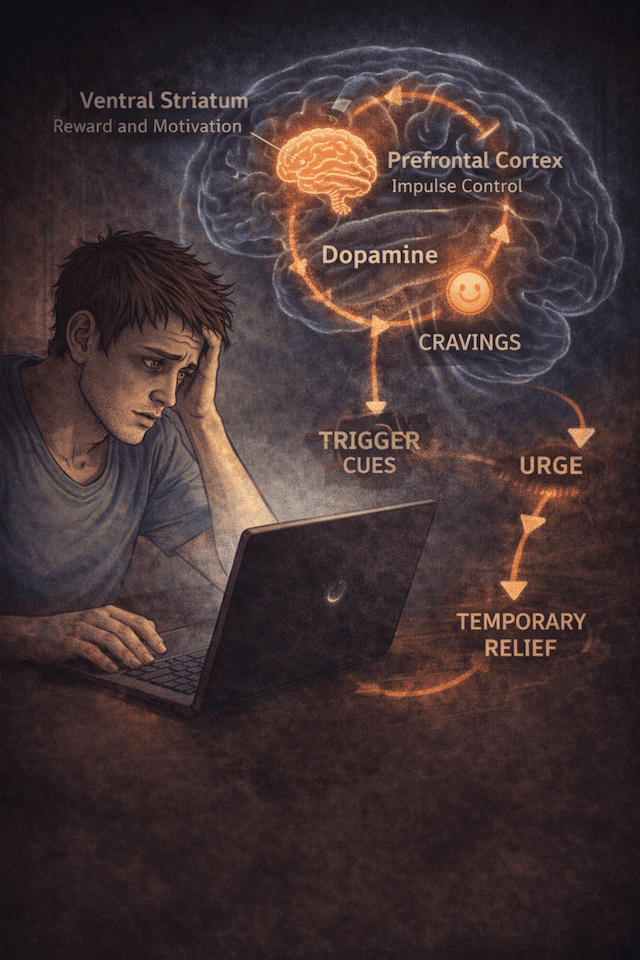
When you feel stressed, your body activates a separate system involving cortisol and heightened arousal. This state doesn’t just feel uncomfortable—it also increases your brain’s drive to seek relief or reward.
In that moment:
-
your brain is more sensitive to anything that promises quick relief
-
previously learned behaviors (like watching porn) become more compelling
-
the urge feels stronger and more automatic
It’s not simply that stress “lowers dopamine and porn raises it.” It’s that stress increases the motivation to escape discomfort, and your brain turns to what it has learned works (Sinha, 2008).
If porn has been used repeatedly during moments of stress, boredom, or discomfort, the brain starts to link:
stress → urge → porn → temporary relief
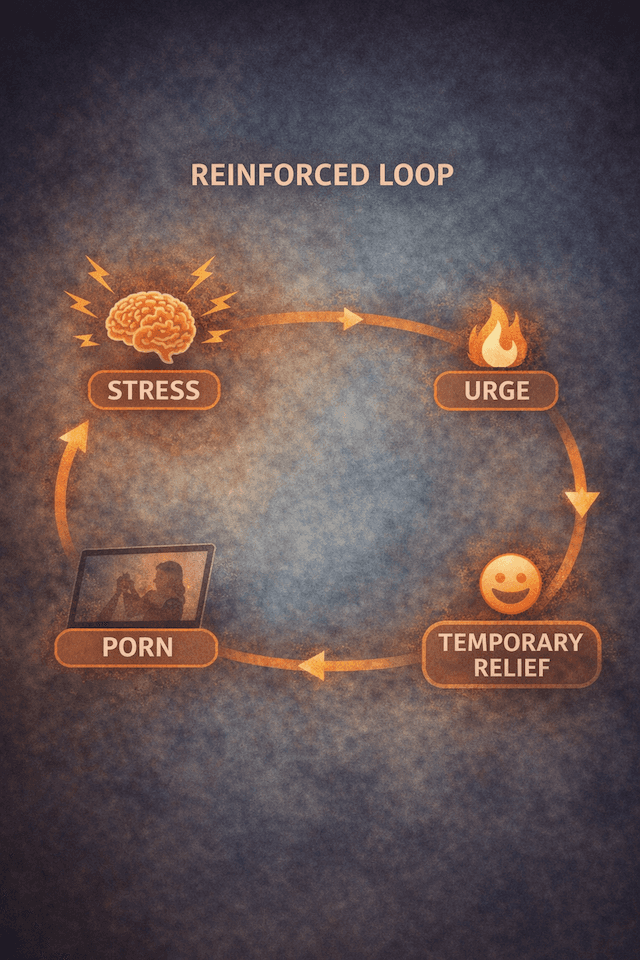
Over time, this creates a reinforced loop:
-
stress or discomfort shows up
-
the brain predicts relief from a specific behavior
-
the urge feels immediate and hard to ignore
This is how certain emotional states become powerful triggers, even if you’re actively trying to quit. And the more you do it, the easier it becomes to fall into the habit.
What starts as a conscious choice can gradually shift into something that feels reflexive—where the urge shows up before you’ve had time to think it through.
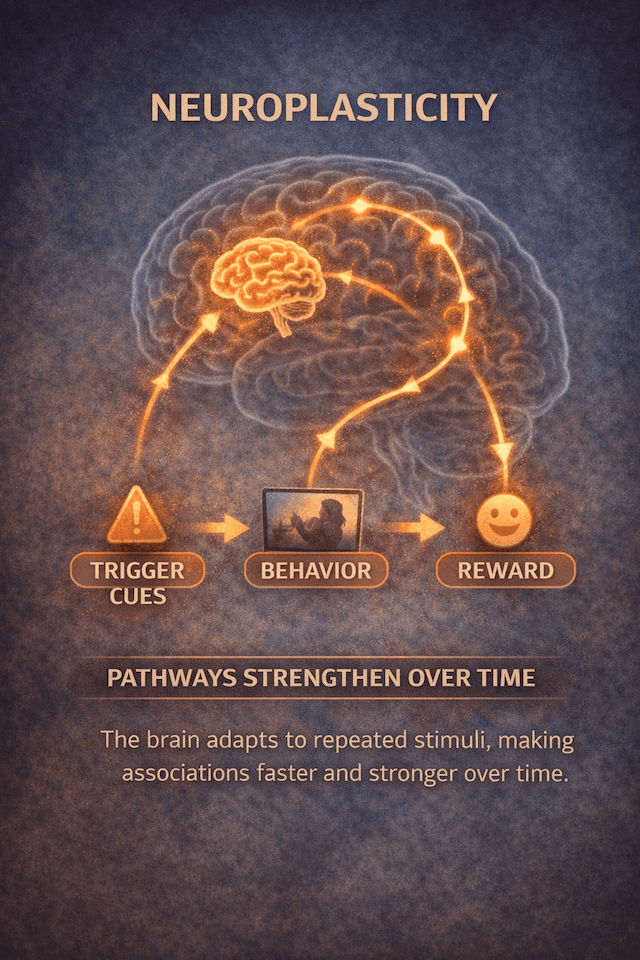
This is where neuroplasticity comes in.
Neuroplasticity and habit formation
Repeated exposure to highly stimulating content can influence how this system responds over time. Neuroplasticity refers to the brain’s ability to adapt based on repeated experiences—strengthening certain pathways while allowing others to weaken (Doidge, 2007; Draganski et al., 2004).
In practical terms, this means:
-
the brain becomes more efficient at recognizing and responding to cues
-
the connection between trigger → behavior → reward becomes stronger (Everitt & Robbins, 2016)
-
less conscious effort is required to initiate the behavior
At a neural level, frequently used pathways are reinforced through repeated activation. The brain essentially becomes “better” at executing the pattern, which is why the behavior can start to feel automatic or habitual.
This is how habits form—not just with porn, but with any repeated behavior.
Over time, the brain also becomes more sensitive to the predictors of reward, not just the reward itself. This is why something as simple as opening your laptop late at night or feeling a certain type of stress can trigger an urge before any conscious decision is made.
Importantly, novelty plays a role here as well.
The brain tends to respond strongly to new or varied stimuli, which can increase engagement and reinforce repeated use in some individuals. When content is constantly changing or easily accessible, it can amplify this learning process by repeatedly activating the reward system in slightly different ways.
The result is a pattern where both the triggers become stronger and the response becomes faster, making the habit feel harder to interrupt—even when you consciously want to stop.
However, it’s important to be precise:
This does not mean porn permanently “damages” the brain. It means the brain adapts to patterns of stimulation and, more importantly, can rewire itself again during recovery.
In some individuals, frequent exposure to high levels of stimulation may lead to temporary changes in sensitivity, where everyday activities feel less rewarding by comparison.
But these changes are not permanent.
Because the same neuroplasticity that strengthens habits can also:
-
weaken them
-
reshape them
-
and support recovery over time
How Porn Affects Your Brain Chemistry
Highly stimulating content can lead to repeated dopamine spikes, especially when combined with novelty and easy accessibility.
But what matters isn’t just the dopamine itself—it’s how the brain learns from repeated stimulation.
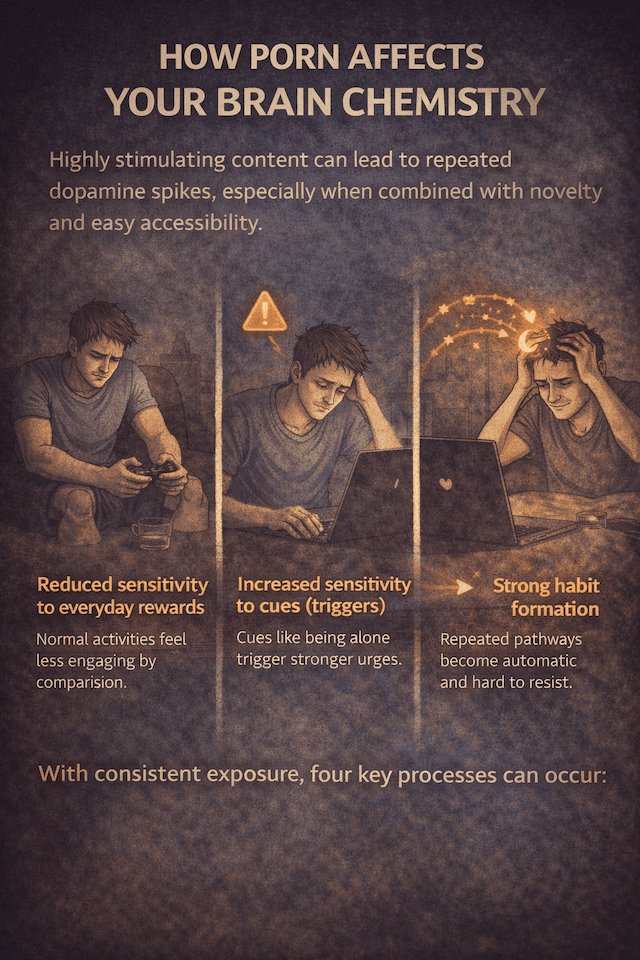
Reduced sensitivity to everyday rewards
Over time, the brain may become less responsive to lower levels of stimulation (Volkow et al., 2014).
This is sometimes referred to as downregulation of reward sensitivity, where everyday activities (work, social interaction, hobbies) feel less engaging by comparison.
Normally engaging things like talking a walk, talking with friends, or working out become less enjoyable. They simply don't "hit" the same way they used to.
Increased sensitivity to cues (triggers)
At the same time, the brain can become more responsive to cues associated with the behavior, such as:
-
being alone
-
feeling bored or stressed
-
certain environments or times of day
This is known as cue sensitization, where triggers become strongly linked to the expectation of reward. One of the universal pieces of advice when it comes to quitting porn is to avoid your triggers (Robinson & Berridge, 2008).
This is because the mere awareness of something that you associate with watching porn—even if has nothing to do with sex—can motivate a desire to watch porn.
For example, just pulling out your laptop at night can be a powerful trigger, which is why I often recommend that guys who are trying to quit porn to limit their computer use to only public places.
Habit loops are reinforced
These two processes combine to strengthen a behavioral loop:
trigger → urge → behavior → reward → reinforcement
Over time, this loop becomes more automatic and less dependent on conscious decision-making.
It takes less effort to watch because you've watched so often.
You build a higher tolerance
This pattern is sometimes described as “tolerance,” but in behavioral contexts it’s more accurate to describe it as adaptation. Either way, the idea is still the same.
It takes a higher dose to get more of the same effect. In this case, that means watching more extreme porn, like hentai.
Unlike substance dependence, these changes:
-
are typically less severe
-
vary widely between individuals
-
and are more closely tied to learning and habit formation than physical dependence
Not everyone experiences these effects to the same degree. They are more likely in cases of frequent or compulsive use. Still, you feel a dependence on pornography.
What Happens in the Brain During Withdrawal
When someone stops using porn after frequent exposure, the brain goes through a readjustment period as it adapts to the absence of a previously consistent source of stimulation.
This phase reflects a temporary imbalance between:
-
reward sensitivity (what feels good)
-
and cue-driven motivation (what the brain expects)
Symptoms of withdrawal
During withdrawal, people may experience:
-
cravings → driven by learned cue-reward associations
-
difficulty focusing → reduced stimulation compared to previous baseline
-
mood fluctuations → shifting reward sensitivity
-
reduced motivation → everyday activities feel less rewarding at first
In simple terms, the brain is still “expecting” a level of stimulation that is no longer being provided.
These symptoms are also described as part of the No Fap Flatline.
The Reward System Recalibration
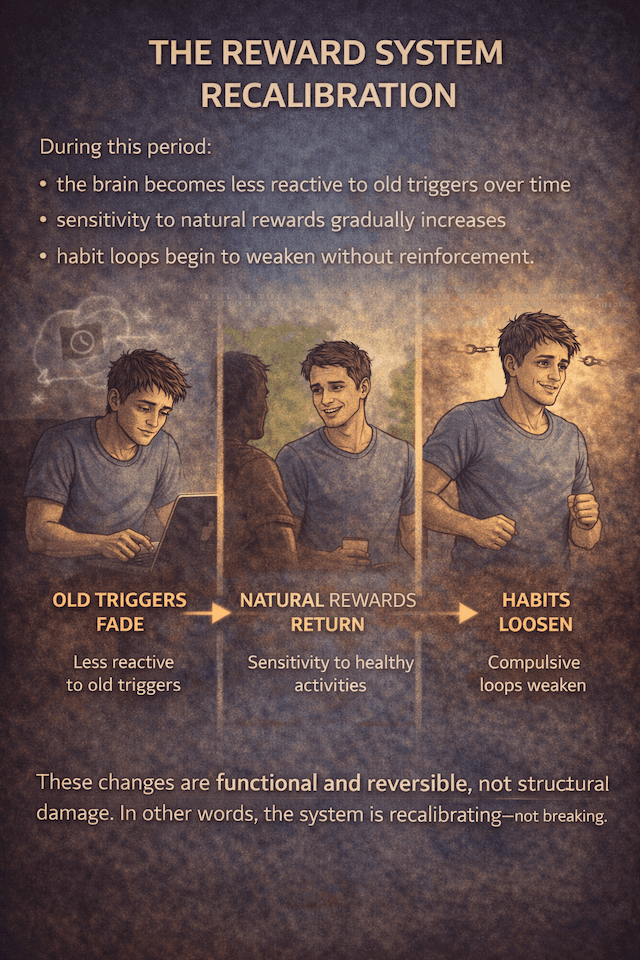
During this period:
-
the brain becomes less reactive to old triggers over time
-
sensitivity to natural rewards gradually increases
-
habit loops begin to weaken without reinforcement
This is not a breakdown of the system. It’s just a readjustment process.
Some researchers describe this as involving temporary changes in:
-
reward processing
-
attention
-
and impulse control
But importantly:
These changes are functional and reversible, not structural damage. In other words, the system is recalibrating—not breaking.
What you’re experiencing during withdrawal isn’t a sign of harm—it’s a sign that the brain is:
-
adapting
-
updating expectations
-
and moving toward a more balanced response to stimulation
“Hypofrontality” and Brain Function
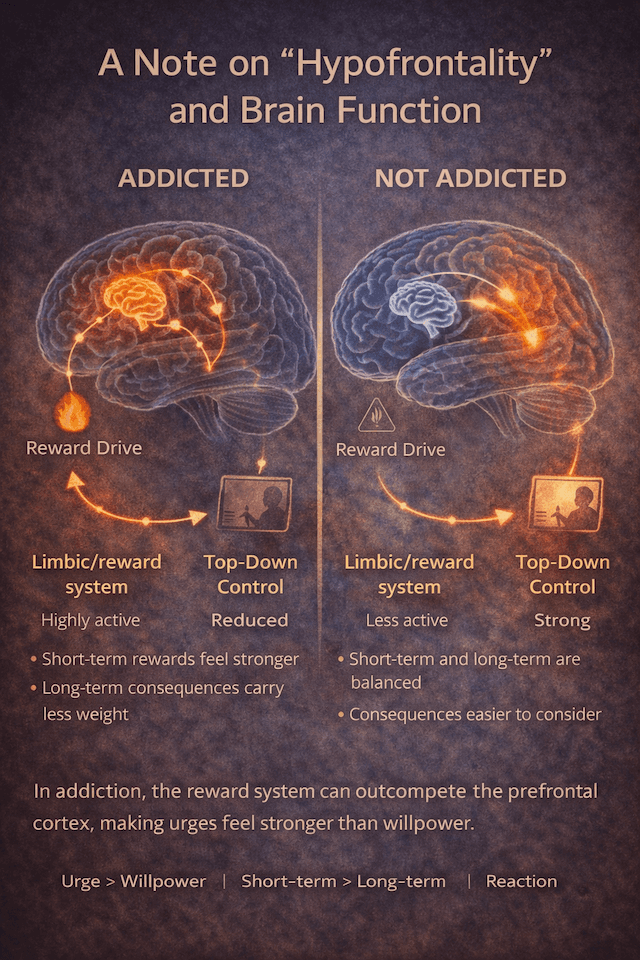
You may come across the term hypofrontality, which refers to reduced activity in the prefrontal cortex—the part of the brain involved in decision-making, impulse control, and long-term planning.
In addiction research, this concept is used to describe a state where:
-
short-term rewards feel more compelling
-
long-term consequences feel less salient
-
self-regulation becomes more difficult
From a neuroscience perspective, this can be understood as a temporary imbalance between two systems:
-
the prefrontal cortex (top-down control, planning, inhibition)
-
the limbic/reward system (bottom-up drive, motivation, reward seeking)
When the reward system is highly activated—especially by repeated, high-stimulation inputs—the relative influence of the prefrontal cortex can feel reduced. This doesn’t mean it’s “turned off,” but rather that its regulatory control is outcompeted in the moment.
While hypofrontality is discussed in addiction science, it’s important to use the term carefully:
-
It is not specific to porn use
-
It is typically observed in controlled research settings, not diagnosed in everyday individuals
-
It describes a functional state, not permanent damage
A more practical way to understand it:
-
urges feel stronger than your usual willpower
-
focus becomes harder to maintain
-
decisions become more reactive and less deliberate
What Actually Happens During Porn Addiction Withdrawal
As the behavior is reduced or stopped:
-
cue-driven activation of the reward system gradually decreases
-
the prefrontal cortex regains more consistent influence over behavior
-
decision-making becomes less reactive and more intentional
👉 In simple terms: It becomes easier to pause, think, and choose differently.
The “Dopamine Reset” Explained (Without the Hype)
The idea of a “dopamine reset” is commonly used to describe recovery, but it’s not a formal medical term. It’s a simplified way of describing how the brain’s reward system rebalances over time.
3 things happen while your brain's dopamine system is rebalancing
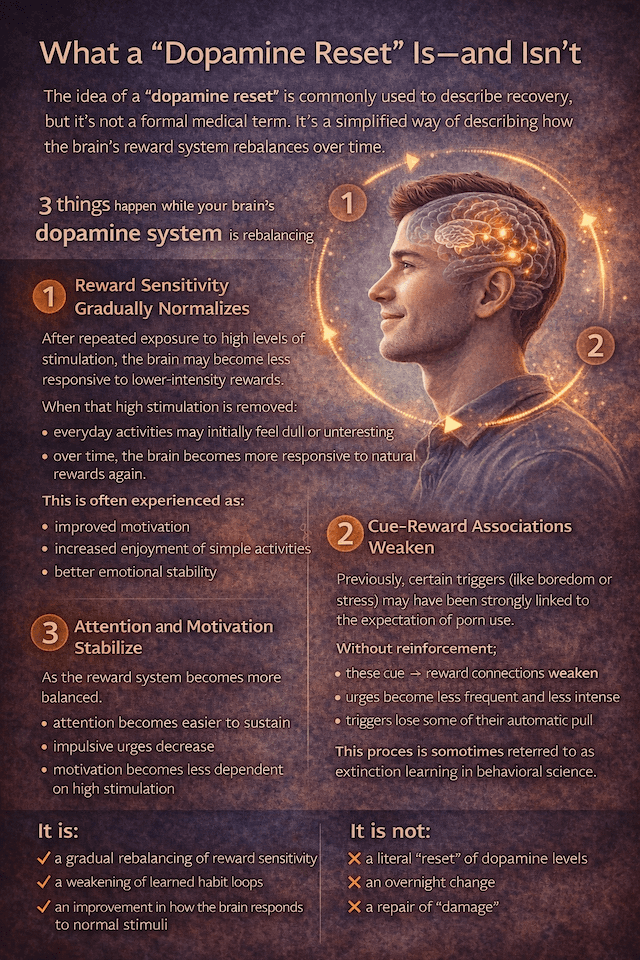
1. Reward Sensitivity Gradually Normalizes
After repeated exposure to high levels of stimulation, the brain may become less responsive to lower-intensity rewards.
When that high stimulation is removed:
-
everyday activities may initially feel dull or uninteresting
-
over time, the brain becomes more responsive to natural rewards again
This is often experienced as:
-
improved motivation
-
increased enjoyment of simple activities
-
better emotional stability
2. Cue-Reward Associations Weaken
Previously, certain triggers (like boredom or stress) may have been strongly linked to the expectation of porn use.
Without reinforcement:
-
these cue → reward connections weaken
-
urges become less frequent and less intense
-
triggers lose some of their automatic pull
This process is sometimes referred to as extinction learning in behavioral science.
3. Attention and Motivation Stabilize
As the reward system becomes more balanced:
-
attention becomes easier to sustain
-
impulsive urges decrease
-
motivation becomes less dependent on high stimulation
This reflects a more stable interaction between:
-
reward processing
-
and executive control (prefrontal cortex function)
What a “Dopamine Reset” Is—and Isn’t
It is:
-
a gradual rebalancing of reward sensitivity
-
a weakening of learned habit loops
-
an improvement in how the brain responds to normal stimuli
It is not:
-
a literal “reset” of dopamine levels
-
an overnight change
-
a repair of “damage”
Why This Matters for Withdrawal Symptoms
Understanding this process helps explain why withdrawal symptoms happen—and why they feel the way they do.
They’re not random. They reflect specific changes in how your brain is processing reward, attention, and motivation.
For example:
-
cravings → driven by learned cue → reward associations that haven’t fully weakened yet
-
low motivation → reduced responsiveness to everyday rewards during early adjustment
-
brain fog → temporary disruption in attention and stimulation levels
-
flatline → short-term recalibration of sexual response after overstimulation
This process is:
-
gradual → changes happen over weeks, not days
-
variable → your experience depends on your habits, environment, and usage patterns
-
adaptive → the brain is adjusting, not deteriorating
For most people, these changes are reversible over time, especially with consistent behavior change and reduced exposure to triggers.
These symptoms aren’t signs of damage—they’re signs of adjustment.
Your brain is:
-
updating what it responds to
-
letting go of old patterns
-
and learning to function without constant high-intensity input
That process can feel uncomfortable in the short term.
But it’s also what allows things to:
-
stabilize
-
improve
-
and return to a more balanced baseline over time
Popular Recovery Guides
Common Porn Withdrawal Symptoms (And Why They Happen)
Porn withdrawal symptoms can affect your thoughts, mood, behavior, and even your physical state. While the experience varies from person to person, most symptoms follow a predictable pattern tied to how the brain adapts to changes in stimulation.
Understanding why these symptoms happen can make them easier to manage—and less alarming when they show up.
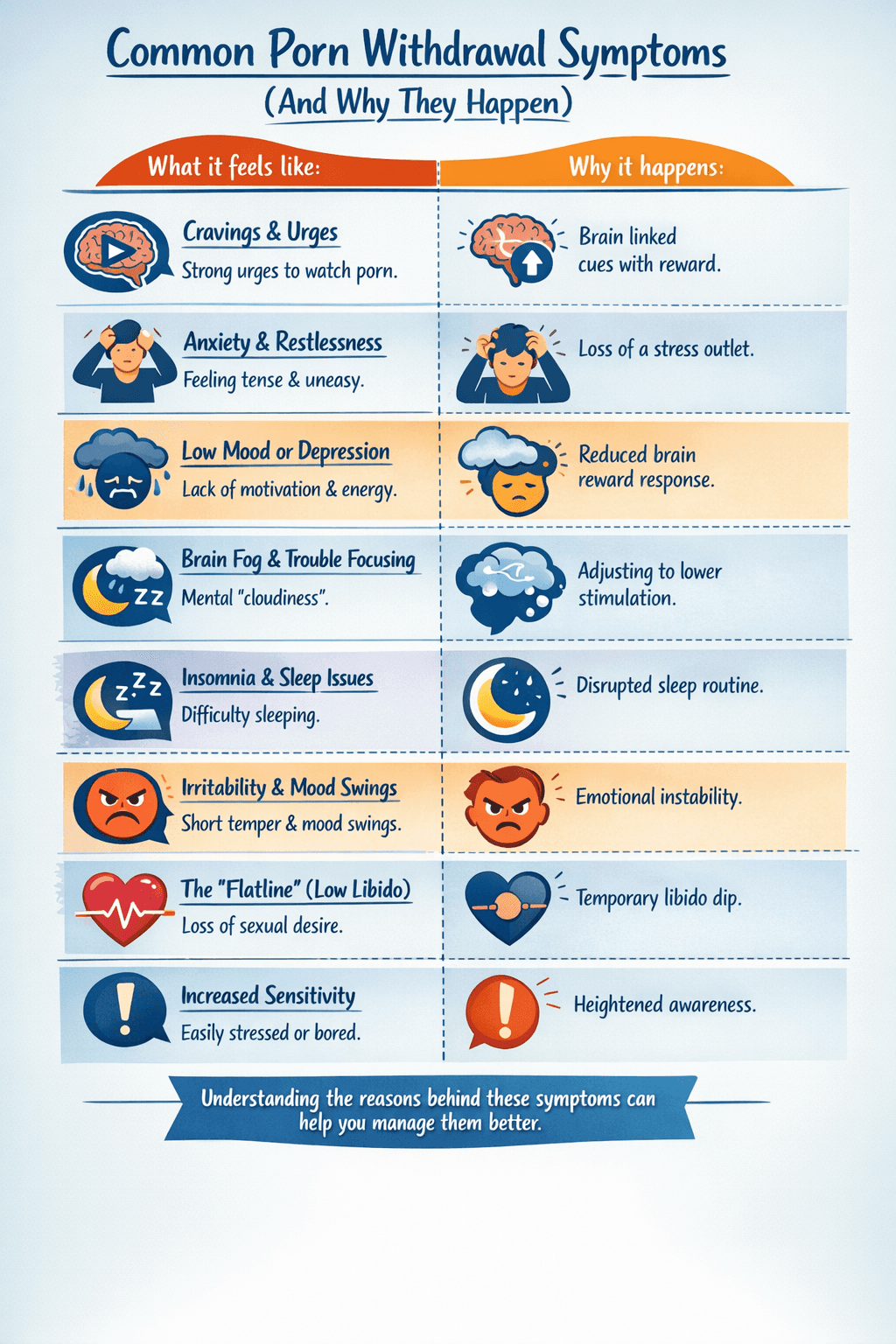
1. Cravings and Urges
What it feels like: Strong, sometimes sudden urges to watch porn—often triggered by boredom, stress, or specific routines.
Why it happens: Your brain has learned to associate certain cues with reward. These cue → behavior connections don’t disappear immediately when you stop—they weaken over time. This is why urges can feel automatic early on, but they dissipate over time.
2. Anxiety and Restlessness
What it feels like: A sense of uneasiness, tension, or difficulty relaxing—especially in the first week.
Why it happens: If porn was used as a way to cope with stress or regulate emotions, removing it can temporarily leave that gap unfilled. At the same time, your brain is adjusting to lower stimulation levels.
3. Low Mood or Depression
What it feels like: Reduced motivation, low energy, or a general sense of emotional flatness.
Why it happens: During early withdrawal, the brain may be less responsive to everyday rewards. This can make normal activities feel less engaging until sensitivity begins to return.
4. Brain Fog and Difficulty Concentrating
What it feels like: Trouble focusing, slower thinking, or feeling mentally “cloudy.”
Why it happens: Your brain is adjusting from high-intensity stimulation to lower baseline input. Attention and motivation can temporarily dip during this transition.
5. Insomnia or Sleep Disruption
What it feels like: Difficulty falling asleep, staying asleep, or feeling rested.
Why it happens: Changes in routine, stimulation, and stress levels can disrupt sleep patterns. If porn was part of a nightly habit, your brain may take time to adjust to a new rhythm.
6. Irritability and Mood Swings
What it feels like: Short temper, frustration, or sudden emotional shifts.
Why it happens: As your brain adjusts, emotional regulation can be less stable. Small stressors may feel more intense until things rebalance.
7. The “Flatline” (Low Libido)
What it feels like: A temporary drop in sexual desire, sometimes accompanied by low energy or emotional numbness.
Why it happens: After frequent stimulation, the brain may temporarily reduce responsiveness to sexual cues. This is part of the recalibration process—not a permanent issue.
8. Increased Sensitivity to Stress or Boredom
What it feels like: Feeling more easily overwhelmed or uncomfortable when idle.
Why it happens: Without a habitual outlet for stimulation or distraction, underlying stressors and emotions can become more noticeable.
What All of These Symptoms Have in Common
Even though these symptoms feel different, they share a common cause:
Your brain is adjusting to a change in stimulation and habit patterns
They reflect:
-
learned reward associations weakening
-
sensitivity to natural rewards returning
-
and habit loops losing strength over time
How Long Do These Withdrawal Symptoms Last?
Most symptoms:
-
peak in the first 1–2 weeks
-
gradually decrease over time
-
become much more manageable within 30–90 days
However, the exact timeline depends on:
-
frequency of past use
-
duration of the habit
-
and individual differences
The Key Takeaway
These symptoms aren’t random—and they aren’t permanent.
They’re part of the process of your brain:
-
adapting
-
recalibrating
-
and learning to function without constant high-intensity stimulation
Breaking free from porn addiction follows a predictable recovery pattern, though individual experiences may vary based on usage history and addiction severity. Some individuals may spend longer in the acute phase than others, or experience fluctuations between one or two of the phases based on their abstinence.
These withdrawal symptoms, while uncomfortable, aren’t a sign that you’re failing in your goal to quit porn. They’re signs that your brain is undergoing change.
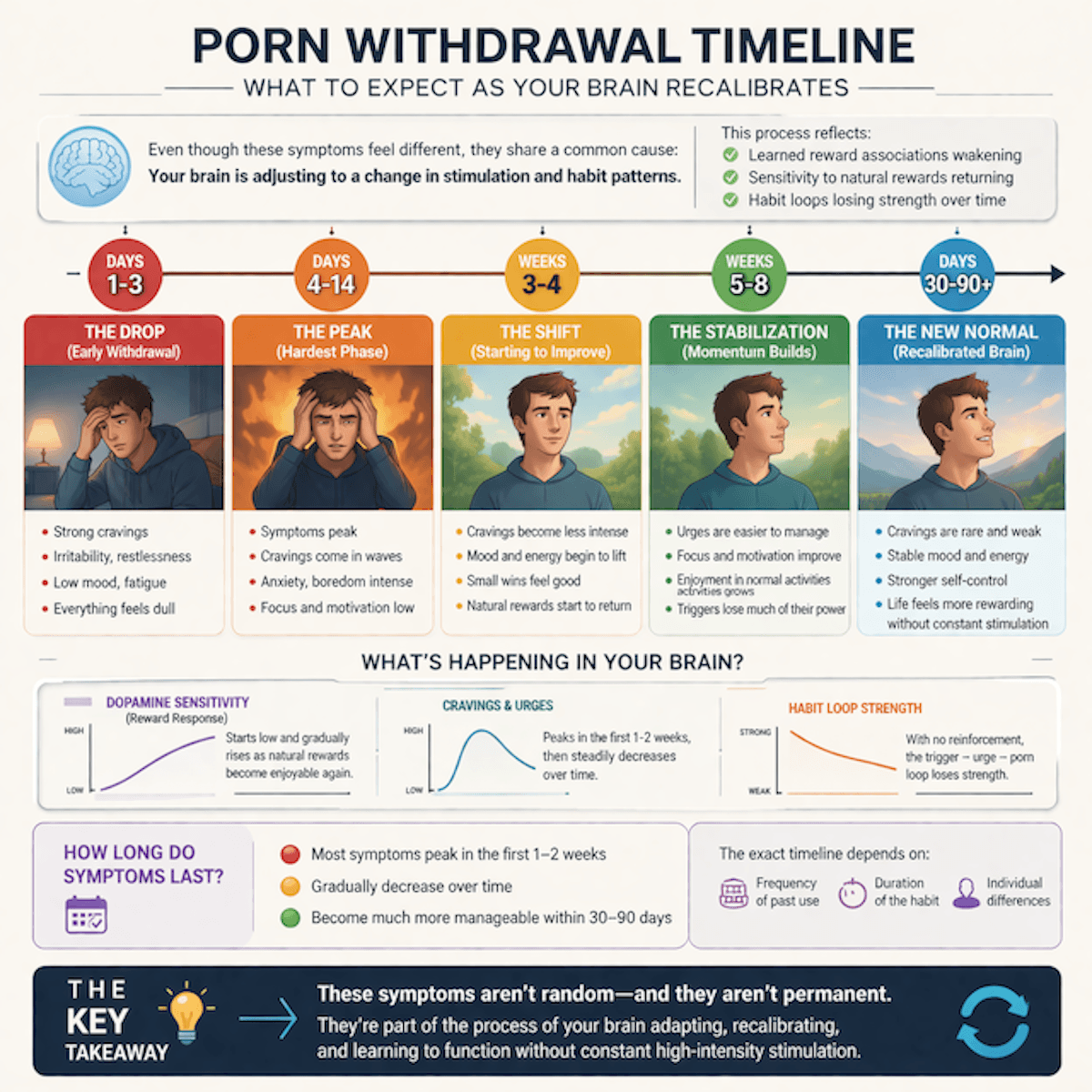
Days 1–3: The Dopamine Crash
This is where the process begins—and where many people struggle the most.
Common experiences:
-
intense cravings to watch porn
-
irritability and restlessness
-
feeling “off” or uncomfortable
-
strong urges to go back
What’s happening: Your brain is used to frequent dopamine spikes. When that stimulation suddenly stops, there’s an immediate drop in reward signaling.
👉 This is the phase where many people relapse—not because they lack discipline, but because the contrast feels sharp and uncomfortable. Read our guide that will give you exact plan on how to deal with a porn relapse.
Days 4–7: Peak Discomfort
For many people, symptoms intensify before they get better.
Common experiences:
-
anxiety or uneasiness
-
insomnia or disrupted sleep
-
brain fog and difficulty focusing
-
mood swings
What’s happening: Your brain is trying to stabilize without the artificial stimulation it relied on. Sleep and focus often take a hit during this adjustment.
If you feel worse before you feel better, that’s normal. This is often the peak.
Week 2: Emotional Instability
At this point, the intensity may fluctuate instead of staying constant.
Common experiences:
-
waves of motivation followed by crashes
-
lingering cravings (often triggered by boredom or stress)
-
increased emotional sensitivity
What’s happening: Your brain is starting to recalibrate, but it hasn’t fully adjusted yet. You may feel “normal” one moment and struggle the next.
Weeks 3–4: The Flatline Phase
This is one of the most misunderstood parts of recovery.
Common experiences:
-
low libido or no sexual desire
-
low motivation and energy
-
emotional numbness or apathy
This phase is often called the “flatline.”
What’s happening: After overstimulation, your brain temporarily down-regulates sexual response and reward sensitivity. This is part of the reset—not a permanent problem.
I give a more in-depth treatment of this phase with this article covering the NoFap Flatline.
Many people panic here and think something is wrong. It’s not. This phase passes.
Month 1–3: Stabilization and Recovery
This is where things start to noticeably improve.
Common experiences:
-
reduced cravings
-
improved mood and emotional stability
-
better focus and energy
-
return of normal libido
What’s happening: Your brain’s reward system is becoming more balanced. Natural sources of dopamine (like work, relationships, and exercise) start to feel rewarding again.
Many people report significant progress within 30 to 90 days. If you're still uncertain and feeling worried, we have an article that covers the porn addiction recovery timeline and variances within it more in depth here.
Important: Everyone’s Porn Addiction Recovery Timeline Is Different
This timeline is a general pattern—not a strict rule.
Your experience can vary based on:
-
how long you’ve been using porn
-
how frequently you used it
-
underlying stress, habits, or mental health
Some people move faster, others slower—but the overall progression tends to follow a similar path.
What This Means for You
Withdrawal symptoms aren’t a sign that something is wrong.
They’re a sign that something is changing
Your brain is adjusting, recalibrating, and learning to function without constant artificial stimulation.
And that process—while uncomfortable—is exactly what recovery looks like.
Is It Normal to Feel This Way After Quitting Porn?
If you’re going through withdrawal symptoms, there’s a good chance you’ve asked yourself:
“Is this normal… or is something wrong with me?”
In most cases, what you’re experiencing is completely normal.
When you stop a habit that your brain has become used to—especially one tied to reward, routine, or emotional coping—there’s almost always an adjustment period. For some people, that adjustment is barely noticeable. For others, it can feel intense and unpredictable.
Why It Can Feel So Uncomfortable
Many of the symptoms people experience during withdrawal—like cravings, anxiety, low motivation, or brain fog—come from the brain adjusting to a change in stimulation and routine.
If porn was something you used regularly, your brain learned to expect it.
When that expectation isn’t met, you may notice:
-
stronger urges than usual
-
lower mood or motivation
-
difficulty focusing
-
a sense that something feels “off”
👉 This doesn’t mean something is broken. 👉 It means your brain is adapting.
Why Your Experience Might Be Different From Someone Else’s
Not everyone goes through withdrawal the same way.
The intensity and duration of symptoms can vary based on:
-
how frequently you used porn
-
how long the habit lasted
-
whether it was tied to stress, boredom, or emotional coping
-
your overall environment and daily habits
Someone with occasional use might feel little to no disruption. Someone with frequent or compulsive use may experience a more noticeable adjustment period.
When People Start to Worry (and Why They Don’t Need To)
There are a few points in the process where people often get concerned:
-
when cravings feel stronger than expected
-
when motivation drops suddenly
-
during the flatline phase, when libido temporarily decreases
-
when progress doesn’t feel linear
These moments are common—and they’re part of the process.
Recovery doesn’t happen in a straight line. It tends to come in waves, with periods of improvement followed by temporary setbacks.
What You Should Expect Instead
Rather than asking, “Should I feel this?”, a better question is:
“Is this part of the adjustment process?”
In most cases, the answer is yes.
Over time, as your brain adapts:
-
cravings become less frequent
-
focus improves
-
mood stabilizes
-
natural motivation returns
Evidence-Based Strategies for Managing Withdrawal
Successful recovery from porn addiction requires a multi-faceted approach combining lifestyle changes, professional guidance, and strong support networks. Research shows that implementing these strategies significantly improves recovery outcomes.
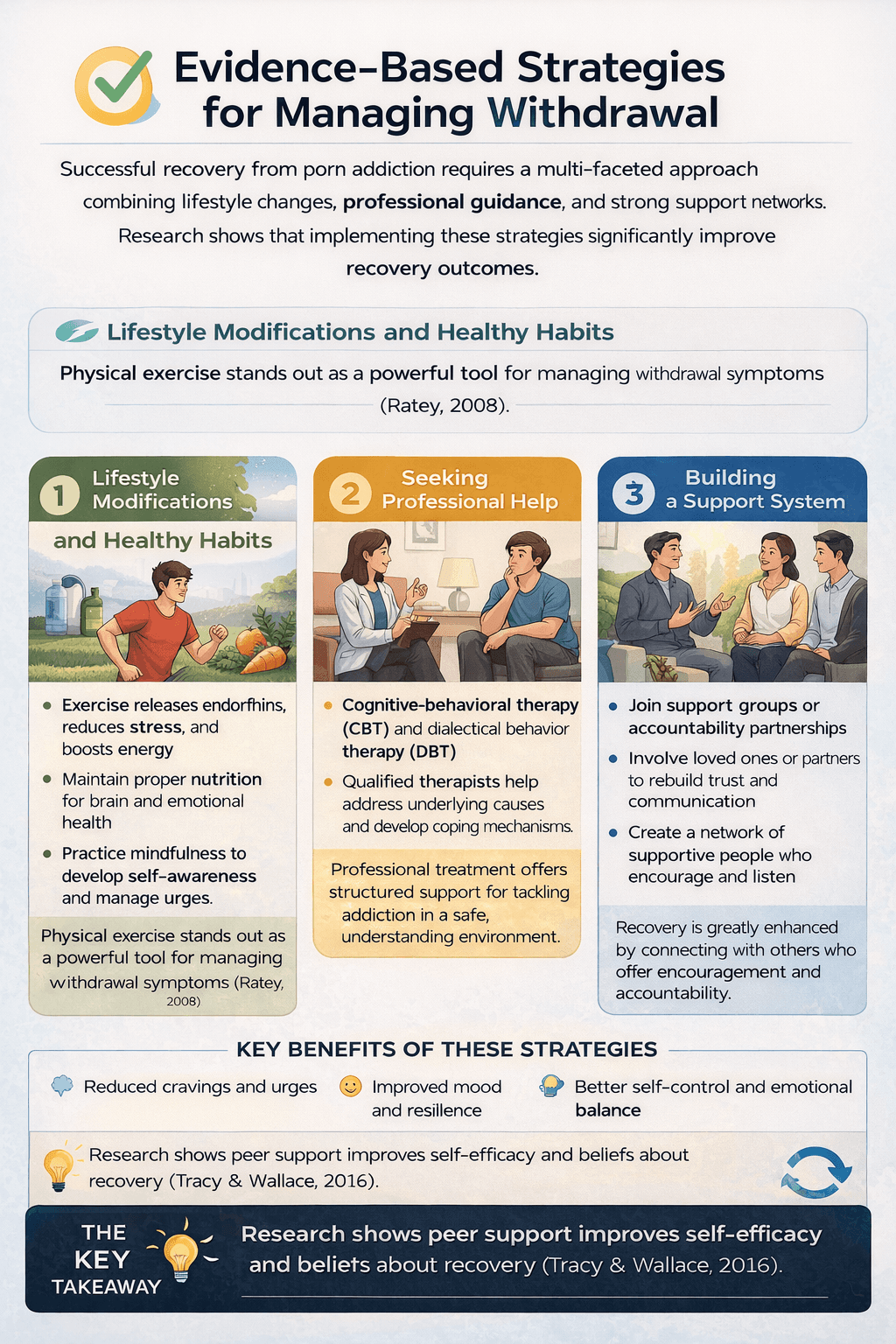
Lifestyle modifications and healthy habits
Physical exercise stands out as a powerful tool for managing withdrawal symptoms (Ratey, 2008). Regular workouts offer multiple benefits:
-
Release natural endorphins to improve mood
-
Reduce stress and anxiety levels
-
Enhance sleep quality
-
Boost overall energy levels
Altogether, maintaining proper nutrition supports brain health and emotional stability. Certainly, reducing processed foods while increasing whole grains and lean proteins helps enhance overall well-being. Mindfulness practices, comparatively, prove equally effective in developing greater self-awareness and managing urges.
Having the courage to seek professional help
If things are especially tough, you might need to seek additional help.
Professional treatment offers structured support through evidence-based approaches. Cognitive-behavioral therapy (CBT) and dialectical behavior therapy (DBT) help identify underlying causes and develop healthier coping mechanisms. Forthwith, working with qualified therapists creates a safe environment to address addiction openly and honestly.
Building a support system
Generally, recovery flourishes with strong support networks. Support groups provide a safe space where individuals share experiences and gain practical strategies. Concurrently, accountability partnerships offer consistent encouragement and oversight throughout the recovery journey.
Emphatically, involving partners or family members in the recovery process through couples therapy helps rebuild trust and communication. Evidence shows that peer support services explicitly improve self-efficacy and personal views about recovery (Tracy, K., & Wallace, S. 2016).
Hence, establishing these connections early in the recovery process proves invaluable for long-term success.
What you should do next
Breaking free from porn addiction presents real challenges, though understanding the science and symptoms makes the journey more manageable. Your brain needs time to reset its reward pathways and rebuild natural dopamine responses. While withdrawal symptoms might feel overwhelming, they signal positive neurological changes taking place.
Research proves that recovery follows a predictable pattern, starting with intense initial symptoms that gradually decrease over time. Most people notice significant improvements within 90 days, especially when following evidence-based strategies and maintaining healthy habits. Remember that each recovery journey differs, and patience becomes essential for lasting change.
Relay stands out as a powerful ally through this challenging process. This program combines expert-developed curriculum with supportive accountability groups, helping you address addiction's root causes rather than just symptoms. Their comprehensive approach proves particularly effective during withdrawal phases, offering both professional guidance and peer support when you need it most. Click here to try it out!
Success in overcoming porn addiction depends largely on having the right support system and tools. Try Relay, the #1 group-based porn addiction recovery app, to effectively manage withdrawals and maintain your commitment to quitting porn.
Through dedicated support groups, professional guidance, and proven strategies, lasting recovery becomes achievable, regardless of how long you've struggled with addiction.
References
-
Grubbs JB, Kraus SW, Perry SL. Self-reported addiction to pornography in a nationally representative sample: The roles of use habits, religiousness, and moral incongruence. J Behav Addict. 2019;8(1):88–93. doi:10.1556/2006.7.2018.134
-
Fernandez DP, Kuss DJ, Justice LV, Fernandez EF, Griffiths MD. Effects of a 7-day pornography abstinence period on withdrawal-related symptoms in regular pornography users: A randomized controlled study. Arch Sex Behav. 2023;52(4):1819–1840. doi:10.1007/s10508-022-02519-w
-
Kraus SW, Voon V, Potenza MN. Should compulsive sexual behavior be considered an addiction? Addiction. 2016;111(12):2097–2106. doi:10.1111/add.13297
-
Volkow ND, Wang GJ, Fowler JS, Tomasi D. Addiction circuitry in the human brain. Annu Rev Pharmacol Toxicol. 2012;52:321–336. doi:10.1146/annurev-pharmtox-010611-134625
-
Love T, Laier C, Brand M, Hatch L, Hajela R. Neuroscience of Internet pornography addiction: A review and update. Behav Sci (Basel). 2015;5(3):388–433. doi:10.3390/bs5030388
-
Draganski B, Gaser C, Busch V, et al. Neuroplasticity: Changes in grey matter induced by training. Nature. 2004;427(6972):311–312. doi:10.1038/427311a
-
Everitt BJ, Robbins TW. Drug addiction: Updating actions to habits to compulsions ten years on. Annu Rev Psychol. 2016;67:23–50. doi:10.1146/annurev-psych-122414-033457
-
Sinha R. Chronic stress, drug use, and vulnerability to addiction. Ann N Y Acad Sci. 2008;1141:105–130. doi:10.1196/annals.1441.030
-
Volkow ND, Wang GJ, Telang F, et al. Decreased dopamine brain reactivity in marijuana abusers is associated with negative emotionality and addiction severity. Proc Natl Acad Sci U S A. 2014;111(30):E3149–E3156. doi:10.1073/pnas.1411228111
-
Robinson TE, Berridge KC. The incentive sensitization theory of addiction: Some current issues. Philos Trans R Soc Lond B Biol Sci. 2008;363(1507):3137–3146. doi:10.1098/rstb.2008.0093
-
Hofmann SG, Asnaani A, Vonk IJ, Sawyer AT, Fang A. The efficacy of cognitive behavioral therapy: A review of meta-analyses. Cognit Ther Res. 2012;36(5):427–440. doi:10.1007/s10608-012-9476-1
-
Tracy K, Wallace SP. Benefits of peer support groups in the treatment of addiction. Subst Abuse Rehabil. 2016;7:143–154. doi:10.2147/SAR.S81535
-
Ratey JJ. Spark: The Revolutionary New Science of Exercise and the Brain. New York: Little, Brown and Company; 2008.
-
American Psychiatric Association. Diagnostic and Statistical Manual of Mental Disorders, 5th ed., Text Revision (DSM-5-TR). Washington, DC; 2022.
-
World Health Organization. International Classification of Diseases 11th Revision (ICD-11). 2019.