

Key takeaways about gooning
-
Gooning is a prolonged, trance-like state of sexual stimulation where attention becomes locked on arousal and time and control are lost.
-
Gooning develops from repeated edging, which trains the brain to reward ongoing stimulation instead of orgasm or completion.
-
Unlike porn addiction, which focuses on consumption, gooning centers on sustained attention and immersion in arousal.
-
Gooning is difficult to stop because it removes natural stopping points and reinforces long periods of high stimulation.
-
Common effects of gooning include time loss, reduced focus, emotional detachment, and increased dependence on high-stimulation content.
-
Gooning can accelerate escalation to more extreme content due to the need for sustained novelty during long sessions.
-
Stopping gooning requires eliminating edging, changing environments, replacing the behavior, and reducing isolation through accountability.
-
Recovery focuses on regaining control over attention, time, and behavior rather than relying on willpower alone.
Frequently asked questions gooning
Why can't I stop gooning?
Many people struggle to stop gooning because the behavior rewards prolonged stimulation rather than completion. Over time attention becomes conditioned toward novelty, immersion, and arousal itself, making urges feel automatic.
What happens when you stop gooning?
People often report better focus, less brain fog, improved emotional presence, and more control over their time after stopping gooning. The first days may feel difficult, but urges often weaken over time.
Is gooning bad for your brain?
Gooning may contribute to attentional narrowing, compulsive habits, and dependence on high-stimulation content. The main issue is not physical damage but repeatedly training the brain toward prolonged stimulation and reward seeking.
Why is gooning so hard to quit?
Gooning removes natural stopping points. Instead of ending with orgasm, the behavior rewards staying aroused and immersed, making disengagement harder and strengthening the habit loop.
How long does recovery from gooning take?
Recovery timelines vary. Some people notice improvements within days, while others require weeks or months before urges and compulsive behaviors become less intense.
Relay is a therapist-backed group recovery program for pornography and unwanted sexual behavior, combining daily accountability, real-time urge support, and a private peer community.
How to Stop Gooning—Everything You Need To Know To Break Free
So you found out that you’ve become a goon, or what the internet often calls a gooner.
You know that you spent a lot of time watching internet porn, but you didn’t think it was anything close to an addiction.
Maybe you started like everyone else—searching for the perfect clip right before you went to bed or rubbing one out before work or school. But then something happened that wasn’t expected: you couldn’t stop watching.
What was supposed to be a short 5-minute trip to your favorite streaming site has somehow become hours in the dark. You could have sworn that it was just 11 pm, but now the sun is coming up, you’re exhausted, and you’ve gotta get to work.
In your confusion, you call off sick and get a few hours of sleep. But then you find yourself glued to the screen again for hours. You completely forgot that you were supposed to go on a date with a cute girl you matched with on Hinge.
You text her, but she doesn’t respond.
To make yourself feel better, you check out your favorite porn site for a quick fix, but again, before you know it, night becomes morning, you haven’t slept, and you don’t know where the time went.
You started gooning. You’ve become a goon.
But don’t worry, because the rest of this article is going to explain what gooning is, how this happened to you, how you can stop gooning, and get back to a life free of high-stimulation internet porn.
Further reading: Porn addiction recovery timeline
What is Gooning?
Let’s start with how Urban Dictionary defines “gooning.”
“Gooning may be most simply defined as that state usually achieved after a prolonged edging session, when a man becomes completely hypnotized by the feeling radiating his penis.”
The definition continues for a few more blocks, but the basic idea is that gooning is when you enter a trance during a prolonged masturbation session.
Now that may sound crazy, like there is a level of pornography consumption and addiction that robs you of your willpower and sensibility, but there are plenty of anecdotes on Reddit.
To really understand gooning, you have to understand “edging.”
What Is Edging?
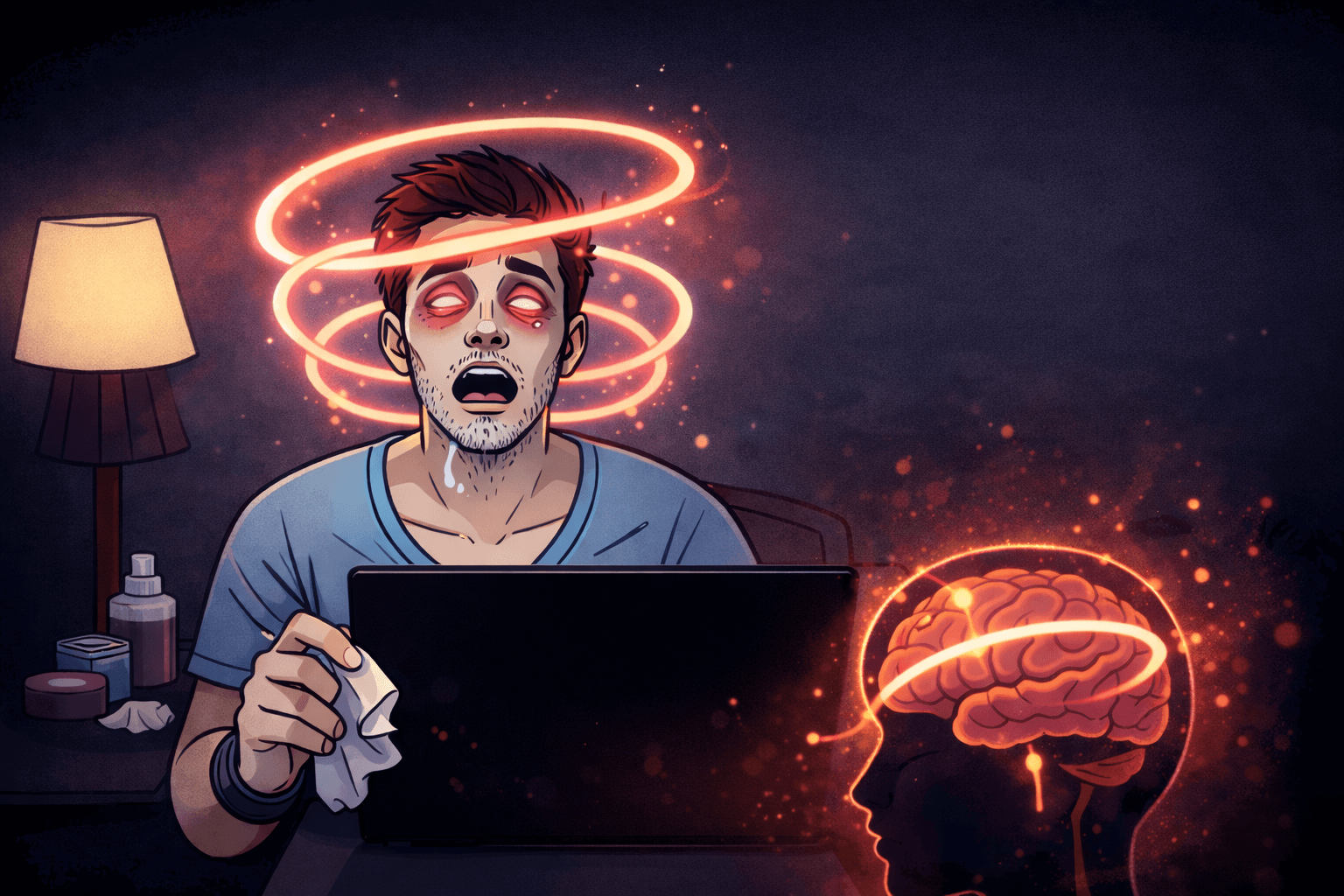
Edging is the deliberate practice of bringing yourself close to orgasm and then stopping or slowing stimulation to stay aroused.
When done occasionally, it’s simply a way to delay climax. But when edging is repeated for long periods—especially alongside high-novelty internet porn—it changes what the brain is being rewarded for.
Instead of orgasm acting as a natural endpoint, the reward system begins reinforcing prolonged arousal and sustained focus itself.
Further reading: NoFap flatline
Over time, this trains the brain to treat staying stimulated as the goal.
Disengagement becomes harder, urges last longer, and attention narrows. Rather than building toward release and resolution, sexual stimulation turns into an open-ended loop—one that’s easy to fall into and difficult to exit.
This is not how edging was originally understood or practiced**.**
In older Tantric and Taoist traditions, sexual arousal was treated as a powerful force that required structure, limits, and conscious direction. In Tantric texts like the Vijnana Bhairava Tantra, moments of intense sensation—including sexual arousal—were used as opportunities to stabilize attention rather than lose control of it.
Even the Kama Sutra, often misrepresented as a sex manual, emphasized balance, timing, and restraint, assuming that desire had to be governed if it was going to enhance life rather than dominate it.
Taoist traditions were even more explicit.
In works like The Tao of Love and Sex and Taoist Yoga: Alchemy and Immortality, sexual energy was treated as biologically costly and psychologically destabilizing when indulged without discipline.
Practices centered on regulation and conservation, not prolonged stimulation. What Tantric texts described as bindu-saṁyama (restraint of sexual essence) or kṣobha-nirodha (control of arousal), and what Taoist traditions called zhǐ xiè (stopping the discharge), were methods of gaining control over arousal—not surrendering to it.
With modern internet technology, those ideas have been inverted. Edging is no longer about regulation in the service of clarity and development.
It’s become a practice that deliberately prolongs stimulation, exploits novelty, and trains the brain to remain locked in arousal without resolution.
To understand why this state eventually becomes something else entirely, we have to look at why it’s called gooning in the first place.
If you've ever wondered about the psychological and neurological reasons why quitting porn is so difficult, read this article. I explain how the 17 tricks of porn and how they take advantage of your brain, and how they are so difficult to walk away from.
Why is it called Gooning?
When I was growing up, a “goon” was a villain’s henchman. Before the hero got to fight the villain and save the world, he had to make his way through the villain’s goons.
In these shows and movies, goons are portrayed as low-intelligence thugs who aren’t capable of original thought and lack agency. They just do what they're told and sacrifice themselves for the villain’s case.
After a session of gooning, this is what you become. Your only objective is to follow your libido, and you become a slave to urges and pleasure.
Gooning vs. edging: The difference clearly explained
Edging is the repeated act of bringing sexual arousal close to orgasm and then stopping before release.
When done occasionally, it’s simply a technique for delaying climax, and by itself doesn’t imply any deeper problem. The cycle still has a clear endpoint: arousal rises, orgasm occurs, and the nervous system resets.
Gooning describes what can happen when edging is repeated for long periods, leading to a gooning state especially in environments built around high novelty and constant stimulation, such as modern internet pornography. In this context, the reward system begins to shift.
Instead of orgasm marking the end of the cycle, the brain starts reinforcing the state of arousal itself—staying stimulated, focused, and engaged for as long as possible.
This is why gooning is harder to stop.
So is gooning just another type of porn addiction?
The short answer is “no.” Gooning and porn addiction, on the surface, are the same thing.
The long answer is that gooning and compulsive pornography consumption are two heads of the same beast, but each with a different face.
Porn addiction is typically about compulsive consumption: needing more content, more novelty, or more frequency to achieve the same effect.
Gooning, by contrast, is defined less by how much porn is consumed and more by how attention is captured.
The stimulation becomes immersive and self-reinforcing, pulling the person into a trance-like state that is difficult to disengage from even when pleasure diminishes.
At that point, the behavior isn’t driven by the need or desire to orgasm, but by the brain’s learned attachment to prolonged arousal and narrowed focus.
However, just because gooning is not just another porn addiction doesn't mean that the techniques to quit porn addiction won't work on it. Before we get those, I strongly consider checking out our 5-step guide to quitting porn.
It is, by far, the most detailed but simple to execute plan on the internet to help you kick your porn addiction.
Is gooning worse than just watching porn?
Both heavy porn use and gooning can negatively affect your life, but gooning tends to be more disruptive because it changes how time, attention, and reward work in the brain, not just how much porn you consume.
And quitting gooning still comes with the same challenges.
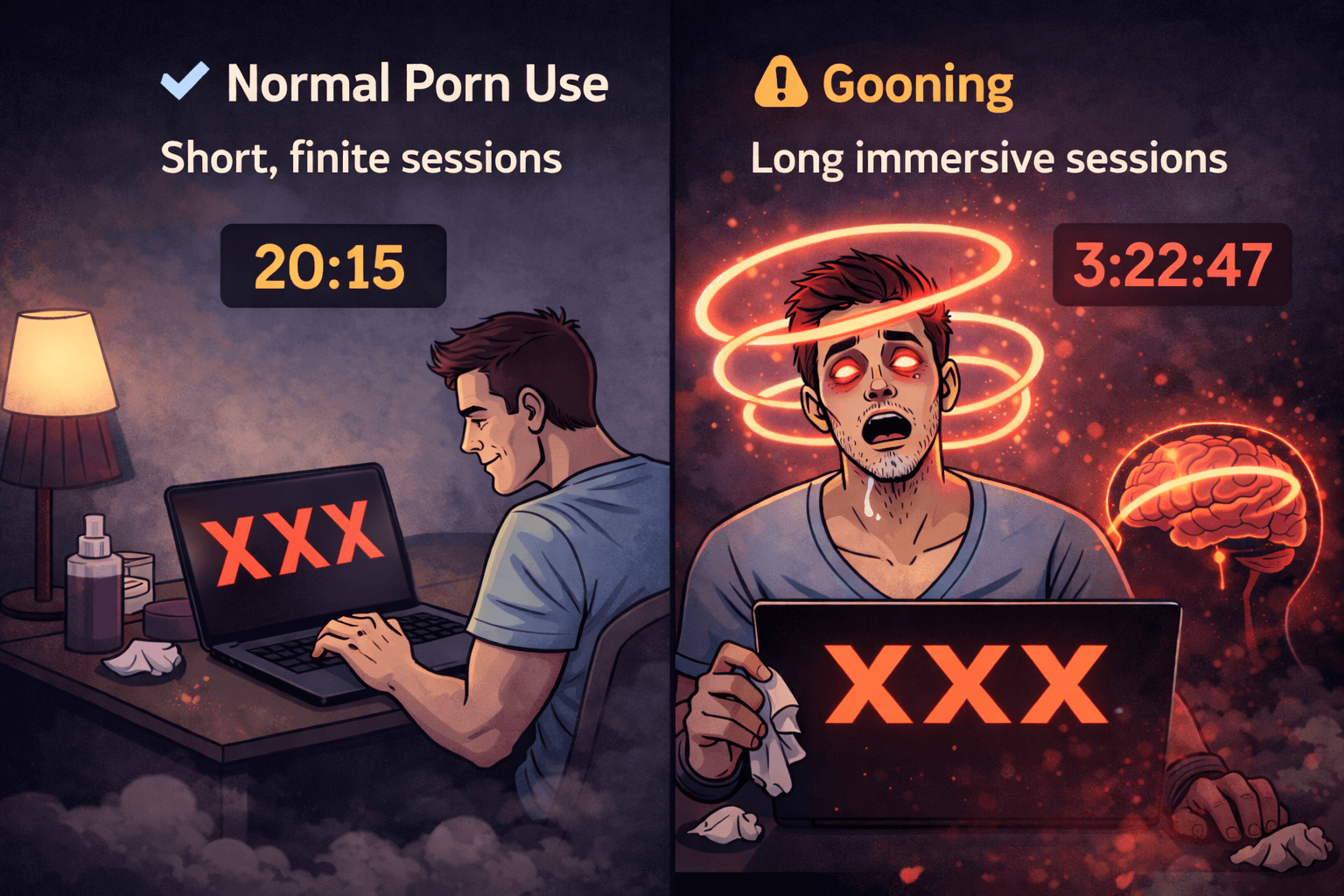
Gooning requires far more time
With typical porn use, the behavior is usually finite: a short search, a brief session, and then it ends. Gooning stretches that window dramatically. Sessions can last hours or even span entire nights, which increases isolation, secrecy, and neglect of responsibilities. The longer time investment doesn’t just increase exposure—it amplifies the social and emotional costs.
Gooning trains the brain to reward immersion instead of completion
In normal porn use, orgasm still acts as a stopping point. With gooning, that stopping point is intentionally removed. Over time, the brain learns that staying aroused and locked in is its own reward.
This makes disengagement harder, even when pleasure fades, and can lead to restlessness, distraction, and a constant pull toward stimulation.
Gooning increases dissociation and attentional narrowing
Because the goal is prolonged arousal rather than release, attention becomes more tunnel-like. People often lose track of time, ignore hunger or fatigue, and feel mentally “gone” during sessions.
This dissociative pattern is far less common with shorter porn use and makes it harder to return to normal focus and emotional presence afterward.
Gooning accelerates escalation
Sustaining arousal for long periods requires novelty, often curated through an endless video playlist.
As a result, gooning pushes the brain toward more extreme, specific, or rapidly changing stimuli faster than typical porn consumption.
Over time, this can dull responsiveness to ordinary sexual cues and increase dependence on artificial stimulation to feel engaged.
In short: gooning isn’t just “more porn.” It reorganizes attention, time, and reward around prolonged stimulation, turning a behavior that normally ends into a state that’s difficult to exit. That’s why many people find it more disruptive than heavy porn use alone.
Further reading: How to sexually reset your brain from porn addiction
How Gooning Affects the Brain
Gooning appears to create an unusually intense form of attentional capture.
Instead of quickly reaching satisfaction and disengaging, the brain becomes trained to seek prolonged stimulation and novelty.
Over time this can contribute to:
-
brain fog
-
compulsive urges
-
time loss
-
reduced focus
-
difficulty disengaging
The issue isn't dopamine itself. It's repeatedly training attention toward endless stimulation.
Why Can't I Stop Gooning?
If you feel like you "should" be able to stop but somehow keep ending up back in the same loop, you're not weak.
Gooning removes natural stopping points. Traditional porn use still has an ending: arousal rises, orgasm happens, and the experience ends.
Gooning changes that.
Instead of rewarding completion, your brain begins rewarding prolonged stimulation itself. Hours can disappear because attention narrows, novelty keeps arriving, and your environment keeps feeding the loop.
Many people who struggle with gooning are not addicted to orgasm—they're addicted to immersion.
That is why willpower alone often fails.
How to Stop Gooning
Step 1: Understand What You’re Actually Trying to Stop
Once you’ve accepted the problem and decided you want your life back, the next step is understanding what you’re dealing with.
Gooning isn’t just watching porn too much—it’s a loop that rewards prolonged arousal, isolation, and attentional capture.
If you treat it like a simple habit you can “white-knuckle” through, you’ll keep failing for the same reason most people do: willpower alone can’t break a system that’s been training your brain for hours at a time.
Step 2: Change Your Environment to Break the Gooning Loop
The most effective first move is changing your environment, not fighting urges where you are.
Gooning almost always happens under the same conditions: alone, indoors, bored, and digitally overstimulated by social media and other platforms.
Removing yourself from those conditions—leaving your room, getting out of the house, or going somewhere public—cuts off the loop before it fully activates.
This isn’t avoidance; it’s strategy. You don’t beat a fire by standing in it and hoping your self-control keeps you from burning up. You remove the fuel, starve the fire, and save yourself.
Step 3: Stop Edging Completely
Edging is the on-ramp to gooning. Every time you deliberately hover near orgasm, you’re teaching your brain that staying aroused is the reward. Over time, orgasm stops acting as a natural stopping point, and disengagement becomes harder and harder.
If you continue edging, you’re not interrupting the loop—you’re strengthening it. Stopping gooning requires restoring a clear beginning and end to sexual stimulation, or removing porn from the equation altogether.
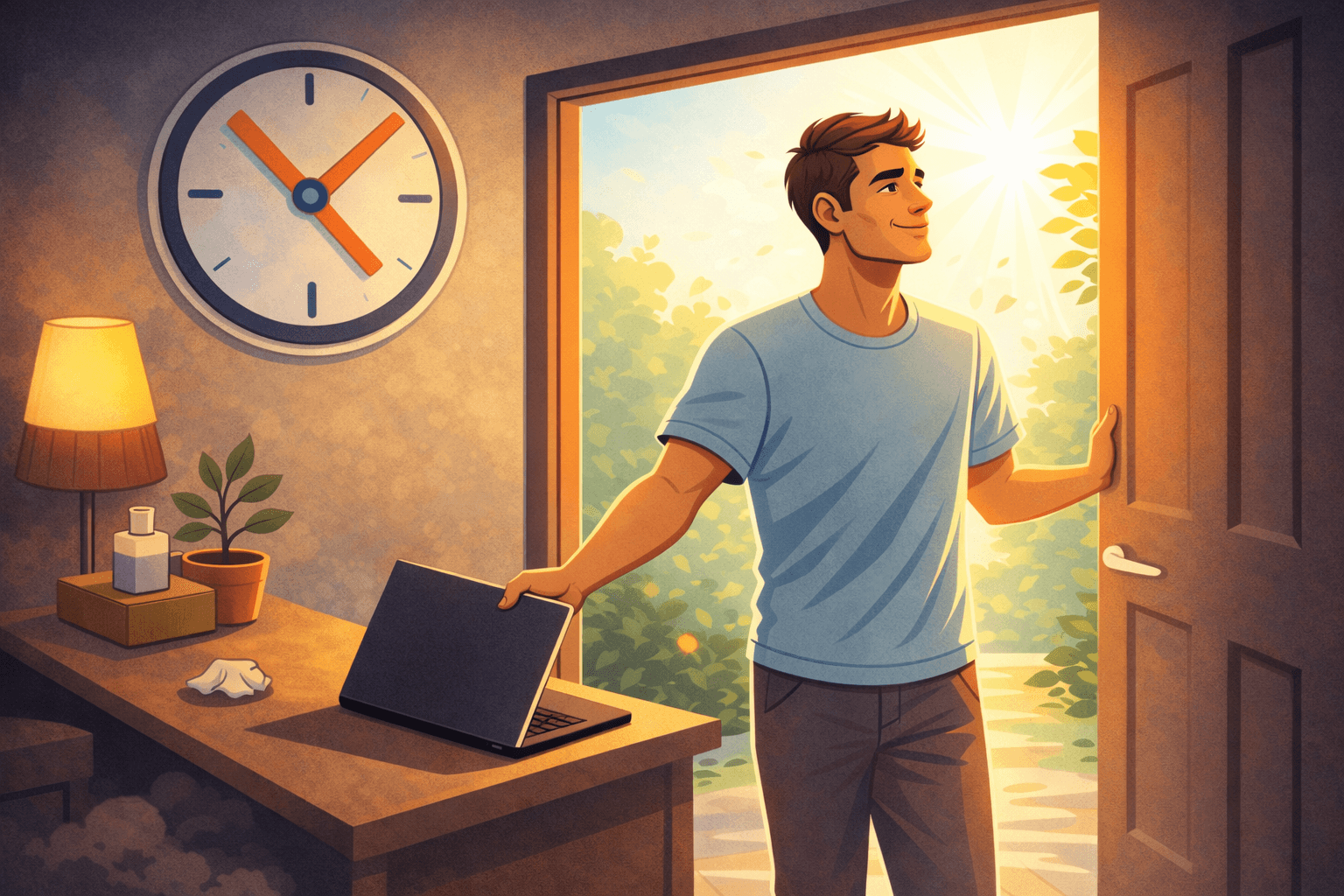
Step 4: Replace Gooning With Healthy Dopamine Sources
You can’t just subtract a behavior that consumed hours of attention without replacing it.
This is why exercise shows up repeatedly in selfimprovement and recovery advice—it’s not about fitness, it’s about regulation. Physically demanding activity burns off excess arousal, narrows attention in a healthy way, and restores a sense of bodily presence.
Creative work, deep-focus sessions, or structured hobbies serve a similar role by giving your brain something engaging to latch onto without dissociation.
Step 5: Create an Emergency Plan for Urges
Waiting until you’re already aroused to decide what to do is a mistake. You need a plan before the urge hits.
When the pull starts, your job is to delay and disrupt: step away from screens immediately, change your physical state by standing up, walking, taking a cold shower, or breathing deeply. Urges and cravings peak and fall like a wave if you don’t keep feeding them. The goal isn’t to fight the urge head-on—it’s to outlast it.
Further reading: Porn relapse
Step 6: Break the Secrecy That Keeps Gooning Alive
Gooning thrives in isolation, shame, and silence. Bringing the struggle out of hiding weakens it.
That might mean a trusted person, a support group, or a simple accountability check-in. This doesn’t require confessing every detail—it means refusing to fight alone.
The moment the behavior stops being private, it no longer feels inevitable.
Step 7: Focus on Regaining Control, Not Perfection
Stopping gooning isn’t about becoming more disciplined or hating yourself into change. It’s about dismantling a loop that was built to keep you stuck.
Once you change the environment, eliminate edging, replace the stimulation, prepare for urges, and stop isolating, the trance loses its grip. What’s left isn’t perfection—it’s control. And control is enough to get your life back.
Further reading: NoFap timeline benefits
How Long Does It Take To Recover From Gooning?
Recovery varies depending on session length, frequency, and overall porn use.
Many people notice:
Days 1–7: strong urges and habit pull
Weeks 2–4: improved focus and less compulsive thinking
1–3 months: reduced dependence on stimulation and greater emotional presence
Recovery is rarely linear.
What Happens When You Stop Gooning?
The first few days can feel uncomfortable because your brain has become used to intense stimulation and long periods of arousal.
Over time many people report:
-
better focus
-
less brain fog
-
improved sleep
-
less compulsive thinking
-
stronger motivation
-
feeling more present
The goal isn't superpowers. The goal is getting your attention and time back.
Get Support If You Don’t Want to Do This Alone
If you want help putting these steps into practice, this is where Relay can make a difference. Relay is built around the exact problems that make gooning hard to stop: isolation, lack of structure, and trying to fight urges alone.
Instead of relying on willpower, Relay pairs you with a small, private support group and a psychologist-designed curriculum that helps you recognize triggers, respond to urges in real time, and stay grounded when the pull hits.
It doesn’t promise instant fixes—it gives you accountability, structure, and real human connection, which are what actually break the loop long-term.
FAQs about gooning
Is it okay to goon everyday?
Gooning every day usually signals compulsive behavior rather than healthy sexual expression.
When prolonged stimulation starts affecting your time, focus, mood, or relationships, it’s a sign the habit is doing more harm than good.
What are the benefits of not gooning?
Stopping gooning can improve focus, emotional stability, and overall motivation by reducing overstimulation of the brain’s reward system.
Many people also regain a stronger sense of control over their time and attention.
What is gooning in Gen Z?
In Gen Z slang, gooning refers to a trance-like state during prolonged masturbation, often involving porn and edging. It’s used to describe losing track of time and awareness while staying highly stimulated.
Why do I feel horrible after gooning?
People often feel bad after gooning because prolonged stimulation can cause a dopamine crash, leading to brain fog, emptiness, or guilt. This reaction is physiological and psychological, not a moral failure.