

Key takeaways about the benefits of not masturbating
-
The benefits of not masturbating are mostly subjective and include improved focus, motivation, and emotional control for some individuals.
-
Scientific evidence does not support universal health benefits from abstaining from masturbation for everyone.
-
Many reported benefits are linked to breaking compulsive habits, reducing pornography use, and improving behavioral patterns.
-
Masturbation itself is generally considered normal and healthy, with problems arising mainly when it becomes compulsive or distressing.
-
Improvements from abstinence often come from better self-control, reduced internal conflict, and healthier coping strategies.
-
There is no reliable evidence that stopping masturbation leads to sustained increases in testosterone levels.
-
The effects of stopping masturbation vary widely depending on individual habits, values, and psychological context.
-
For some people, stopping masturbation may not provide benefits and can increase stress if driven by guilt or unrealistic expectations.
Frequently asked questions about the benefits of not masturbating
Are there proven benefits to not masturbating?
No universal medical benefits have been proven. Most reported benefits are subjective and depend on individual habits, context, and underlying behaviors.
What benefits do people commonly report?
People often report improved focus, increased motivation, reduced anxiety, better emotional control, and stronger alignment with personal values.
Why do some people feel better after stopping?
Improvements are often linked to breaking compulsive habits, reducing pornography use, lowering internal conflict, and developing healthier coping strategies.
Is masturbation itself harmful?
For most people, masturbation is considered a normal and healthy behavior. Problems arise when it becomes compulsive, distressing, or interferes with daily life.
Does stopping masturbation increase testosterone?
There is no reliable evidence that abstaining from masturbation leads to sustained increases in testosterone levels.
Relay is a therapist-backed group recovery program for pornography and unwanted sexual behavior, combining daily accountability, real-time urge support, and a private peer community.
Benefits of Not Masturbating: What People Report (and What Science Says)
This article is intended for people who are worried about whether their masturbation is a problem. While I think every man could benefit from reading this article, it is not for guys who are comfortable with masturbation and are not experiencing any issues of shame, guilt, self-doubt, or any physical side effects.
Many men have reported positive changes after reducing or stopping masturbation, including improvements in focus, mood, and overall well-being. For example, members of r/NoFap report things like:
-
“Greater energy levels, more confidence, higher libido, mental clarity, and less anxiety.”
-
“Living a life.”
-
“For me it’s all about more confidence, being less awkward in social environments, and extra levels of energy, especially to do exercise. It’s totally worth it. I’m at the end of my first week and I’m already feeling like a new person 💪”
For many guys—especially those who feel like masturbation conflicts with their values or goals—taking a break can feel beneficial. For others, masturbation may not cause any problems at all.
If you're trying to break the habit entirely, this complete guide explains how to stop masturbating.
Experiences vary widely and are overwhelmingly positive, but research on the benefits of masturbation abstinence is limited. In this context, “benefits of not masturbating” refers to subjective improvements some people report after reducing or stopping masturbation, rather than guaranteed medical outcomes.
It can be hard to find high-quality, objective information on the internet about whether or not abstaining from masturbation is good for you. There are several reports, but what is the scientific answer to questions like:
-
Is masturbation healthy?
-
What happens if I stop masturbating?
-
What are the benefits of masturbating?
-
Are there any positive effects of stopping?
These questions, and many more, have been cropping up more and more, showing that guys want to know what, if any, are the objectively measurable, tangible benefits of not masturbating. Along with this cohort of curious gentlemen are men who wonder if they are masturbating too much, if such a thing even exists in the first place.
Masturbation is a fairly normal part of the sexual maturing process, but it can become highly habit-forming in adults, which often brings along many negative consequences. So, if you’re trying to quit or reduce your masturbation habits, it can be incredibly challenging.
But is it worth it to stop masturbation?
That depends on your individual situation, challenges, and set of values. In this article, we’ll explore some of the commonly reported benefits of reducing or stopping masturbation, as well as what science does—and does not—currently support. This can help you decide whether making a change makes sense for you.
Masturbation vs. Pornography: An Important Distinction
In discussions about masturbation and its potential effects, it’s important to clearly distinguish masturbation itself from masturbation along with pornography use. Masturbation and watching pornography are often discussed together, but they are not the same thing.
While guys often watch pornography while masturbating (or, if you prefer, masturbate while watching porn), the two don’t have to go together. You can use your imagination while masturbating or, perhaps less commonly, watch pornography like you would a sitcom or documentary.
While I could not find any studies that explicitly reported how many men never use pornography while masturbating, there is research that points us in the right direction. Here are a variety of stats on the separation of masturbation and pornography:
-
Bespoke Surgical ran a survey on masturbation habits with 1040 respondents and found that 25% of people watch porn every time they masturbate. This doesn’t measure absolutely how many masturbate only without porn, but it indicates a substantial portion of masturbation doesn’t always occur with porn.
-
A web-based survey designed by “medical practitioners with an interest in sexual health” had 2544 male respondents. 17.7% of men reported that they had never masturbated without pornography. This implies that 82.3% of them had, at some point, masturbated without pornography. (Jacobs et al., 2021)
While masturbation and pornography often go together, research suggests they can have very different psychological and behavioral impacts.
Most medical and psychological research indicates that masturbation alone is generally considered normal and not inherently harmful for many people.
Many men masturbate occasionally without experiencing negative effects on their mental health, relationships, or daily functioning.
In contrast, many of the negative effects commonly attributed to masturbation—such as reduced motivation, difficulty with arousal, emotional numbing, or increased compulsive behavior—appear to be more strongly associated with problematic pornography use, particularly when pornography is consumed frequently, in escalating forms, or as a primary coping mechanism for stress or loneliness.
Pornography is designed to be highly stimulating and novelty-driven, which can reinforce habitual reward-seeking patterns in some individuals.
When masturbation becomes closely paired with pornography, especially over long periods of time, the combined behavior may feel more difficult to regulate and may have a greater impact on mood, attention, and sexual expectations.
This distinction matters because reducing or stopping masturbation alone may not address underlying issues if problematic pornography use is the primary driver of distress. Likewise, someone may choose to stop pornography use while continuing to masturbate without experiencing the same negative effects.
If your masturbation is paired with pornography use, then using a porn blocker can be a great help in quitting. Check out this list of the 7 best porn blockers we've found—some of which you surely never heard of.
Understanding the difference helps ensure that any changes are targeted, intentional, and aligned with the actual source of the problem, rather than based on overly broad assumptions.
What Science Says vs. What People Report
When evaluating the benefits of not masturbating, it’s important to separate what scientific research currently supports from what people commonly report based on personal experience.
These two perspectives are often discussed together, but they are not the same—and understanding the difference helps prevent confusion or unrealistic expectations.
What Science Says
From a medical and scientific standpoint, there is limited direct evidence that abstaining from masturbation produces universal physical or mental health benefits.
Most major medical and mental health organizations consider masturbation to be a normal and common sexual behavior for many people. Large-scale reviews and clinical guidelines have not found evidence that masturbation itself causes hormonal imbalance, physical harm, or long-term psychological damage in otherwise healthy individuals (Coleman, 2003).
However, research does acknowledge several related factors that can influence how someone experiences masturbation:
-
Compulsive sexual behavior: When sexual habits feel difficult to control or cause distress or functional impairment
-
Conditioning and arousal patterns: Especially when masturbation is frequently paired with pornography
-
Psychological stressors: Such as guilt, shame, or internal conflict related to personal, cultural, or religious values
In short, science does not support the idea that masturbation is inherently harmful—but it does recognize that context, frequency, and individual psychology matter. We can look this the way we look at a food or sex addiction.
By themselves, neither of these two things is harmful. In fact, they are natural and normal. However, problems arise when they are indulged in compulsively, to excess, used as a way to cope with negative emotions, and the user feels shame or guilt afterwards.
Then something that is normally harmless becomes something with the capacity for self-destruction.
What People Report
Despite limited clinical evidence, many individuals report noticeable changes after reducing or stopping masturbation. These reports are especially common in online communities, personal essays, and self-experimentation narratives.
Commonly reported benefits of not masturbating include:
-
Improved focus and mental clarity
-
Reduced anxiety or emotional reactivity
-
Increased motivation or discipline
-
A stronger sense of alignment with personal or spiritual values
While these reports are positive and encouraging, it must be remembered that these types of results are most often reported by people who felt their masturbation habits were:
-
Closely tied to pornography use
-
Used as a coping mechanism for stress, boredom, or loneliness
-
In conflict with deeply held values or long-term goals
It’s important to note that these outcomes are subjective and highly variable. Some people report meaningful improvements, while others notice little to no change.
Science vs. Experience at a Glance
| Topic | What Science Says | What People Commonly Report |
|---|---|---|
| Masturbation itself | Generally normal and healthy for many people | Can feel problematic in certain personal contexts |
| Mental health effects | No clear evidence of universal benefit for abstinence | Some report reduced anxiety or improved mood |
| Dopamine and motivation | Involved in reward learning, not proof of addiction | Feeling more driven or focused after stopping |
| Sexual functioning | No evidence of permanent harm from masturbation | Some report changes in arousal patterns over time |
| Relationships | Effects depend on communication and values | Some feel more present or connected |
| Overall benefit | No one-size-fits-all conclusion | Benefits often tied to behavior change and self-control |
Why the Gap Exists
The difference between scientific findings and personal reports likely reflects behavioral and psychological changes, rather than direct biological effects.
For some people, reducing masturbation:
-
Frees up time and mental bandwidth. When masturbation and pornography consumption are paired, quitting frees up a lot of time that was previously occupied by masturbation and looking for scenes to masturbate to.
Because internet pornography has strong addictive potential, when you stop masturbating to it, you are also no longer compelled to spend so much time watching. Men who masturbate without pornography are less likely to experience this benefit.
-
Interrupts habitual reward-seeking loops. When masturbation is repeatedly paired with pornography, it can become part of a habitual reward loop rather than a deliberate choice. Over time, the brain learns to associate boredom, stress, or discomfort with a quick dopamine-driven escape. Stepping away from masturbation—especially when pornography is involved—can interrupt this automatic pattern.
By breaking the cue–habit–reward cycle, some men report feeling less compelled to seek constant stimulation and more able to pause before acting on urges. This does not mean urges disappear entirely, but the gap between impulse and action often widens, making behavior feel more intentional rather than reactive.
- Reduces internal conflict or guilt. If your masturbation habits conflict with your personal values, relationships, or long-term goals, the behavior itself can create ongoing internal tension. This can show up as guilt, shame, or a sense of acting against one’s better judgment. Reducing or stopping masturbation—particularly when pornography is involved—may lessen this internal conflict.
When actions are more aligned with personal standards, some men report feeling calmer and more self-consistent. It’s important to note that this benefit is subjective and value-dependent; men who do not experience moral or psychological conflict around masturbation may not notice this effect to the same degree.
- Encourages healthier coping strategies. Stressful events naturally reduce your dopamine below baseline, and viewing pornography increases your dopamine levels to a point where you feel relief. If your masturbation is linked with pornography consumption, then this benefit is more likely to present itself.
These changes can feel like direct benefits of not masturbating, but they are more likely to be linked with reducing or eliminating pornography use.
There is no scientific consensus that stopping masturbation is necessary—or beneficial—for everyone. However, for individuals who feel their habits are negatively affecting their mental health, relationships, or sense of control, taking a break can feel meaningful and empowering.
Understanding both what science says and what people report allows you to approach the decision with clarity, realism, and self-awareness, rather than ideology or fear.
Key Takeaways
-
Masturbation is generally considered normal and healthy for many people, and stopping is not medically necessary for everyone.
-
There are no proven, universal health benefits to abstaining from masturbation, but some people report subjective improvements after reducing or stopping.
-
Reported benefits are typically psychological or behavioral, such as improved focus, reduced anxiety, or better alignment with personal values.
-
Experiences vary widely and depend on factors like frequency, emotional context, pornography use, and individual beliefs.
-
Many negative effects commonly attributed to masturbation appear more strongly linked to problematic pornography use rather than masturbation itself.
-
For some people, stopping masturbation may not help and can increase stress or guilt, especially if driven by shame or fear.
-
The most important factor is context: whether a habit supports or undermines your mental health, relationships, and goals.
Are There Proven Benefits to Not Masturbating?
There are no proven, universal medical benefits to stopping masturbation for everyone. Most large-scale scientific research does not show that abstaining from masturbation directly improves physical health, hormone levels, or mental health across the general population.
However, many people report subjective benefits after reducing or stopping masturbation—especially when the behavior previously caused distress, guilt, or felt difficult to control. These reported benefits are typically psychological or behavioral rather than biological and often relate to changes in habits, focus, and emotional regulation.
In short, science does not confirm guaranteed benefits, but personal experience varies widely.
What Happens When You Stop Masturbating?
What happens when someone stops masturbating depends largely on why they stopped and how the behavior fit into their life beforehand.
Some people report:
-
Improved focus or mental clarity
-
Reduced anxiety or emotional volatility
-
Increased motivation or discipline
-
Greater satisfaction in relationships
Others notice little change at all, especially if masturbation was never problematic for them.
In the short term, some individuals may experience increased sexual tension or stronger urges, which typically stabilize over time. Longer-term changes—if they occur—are more often linked to habit change, reduced internal conflict, or the breaking of compulsive patterns rather than to direct physical effects.
Is Masturbation Bad for You?
From a medical standpoint, masturbation is generally considered a normal and healthy behavior for many people.
Most research does not suggest that occasional masturbation is harmful. However, some individuals report negative effects when masturbation becomes frequent, compulsive, or associated with distress, guilt, or interference with daily life.
If you’ve been experiencing any of these negative side effects, it may be a sign that masturbation has become a problematic habit for you, and it’s time to change.
-
Guilt and shame: Many people feel extreme guilt about masturbating because of spiritual, religious, or cultural beliefs. When you repeatedly engage in behavior that runs counter to your beliefs or values, it can take a serious psychological toll.
-
Dependency: Masturbation activates the brain’s reward system, which involves dopamine signaling. For some people, this can contribute to habitual patterns that feel difficult to change—particularly when masturbation is used as a primary way to cope with stress, boredom, or negative emotions. This does not mean masturbation itself is addictive, but rather that certain habits can become reinforcing over time.
-
Decrease in sexual sensitivity: Masturbating too much might make it more difficult for you to reach orgasm over time, especially orgasm with a significant other. This has to do with masturbation’s effect on the arousal template in the brain.
-
Edema: In extreme cases, some males can develop swelling from masturbating too much or for long periods.
-
Change in sexual pleasure perception: Over time, the brain adapts to the sexual stimuli it encounters most often. For some people, frequent masturbation—especially when paired with pornography—may influence arousal patterns. These effects are generally considered learned and reversible, rather than permanent physical changes.
Is Stopping Masturbation Healthy for Everyone?
No. Stopping masturbation is not necessary—or beneficial—for everyone.
For many people, masturbation is a normal, healthy part of sexuality and does not cause negative effects. In these cases, stopping may offer no meaningful benefit and could even increase stress or frustration if motivated by guilt or fear.
However, for individuals who feel their masturbation habits are compulsive, closely tied to pornography use, in conflict with personal or spiritual values, or interfering with relationships or daily life, reducing or stopping masturbation can feel healthy and empowering.
The key factor is context, not the behavior itself.
Does not masturbating raise my testosterone?
There is no reliable evidence that not masturbating leads to a sustained increase in testosterone. A small early study suggested a temporary rise around day seven of abstinence, but that paper was later retracted, meaning its findings should not be relied upon as scientific evidence.
A 2003 study published in the Journal of Zhejiang University Science reported that serum testosterone levels in healthy men remained near baseline during the first several days of ejaculation abstinence, then increased briefly around the seventh day, followed by a return toward baseline (Jiang et al., 2003). This study is often cited online to support the claim that abstinence boosts testosterone.
However, this paper was formally retracted in 2021, indicating that the journal determined the findings are not scientifically reliable and should not be used as evidence for health claims (Jiang et al., 2021).
Despite the retraction of earlier findings, there is a biologically plausible explanation for a short-lived testosterone fluctuation. Sexual arousal and anticipation can transiently activate the hypothalamic–pituitary–gonadal (HPG) axis, increasing gonadotropin-releasing hormone (GnRH) and luteinizing hormone (LH) signaling, briefly stimulating testosterone production (Archer, 2006; Roney & Simmons, 2013).
However, testosterone secretion is tightly regulated by negative feedback mechanisms. When levels rise above an individual’s physiological range, hypothalamic and pituitary signaling is downregulated, returning testosterone toward baseline. This homeostatic control makes sustained elevation unlikely in healthy men, regardless of ejaculation frequency (Veldhuis et al., 2001; Hayes et al., 2001).
What People Often Notice Over Time
People who choose to reduce or stop masturbation often describe their experience as gradual and highly individual, rather than immediate or dramatic. The timeline below reflects commonly reported experiences, not guaranteed outcomes.
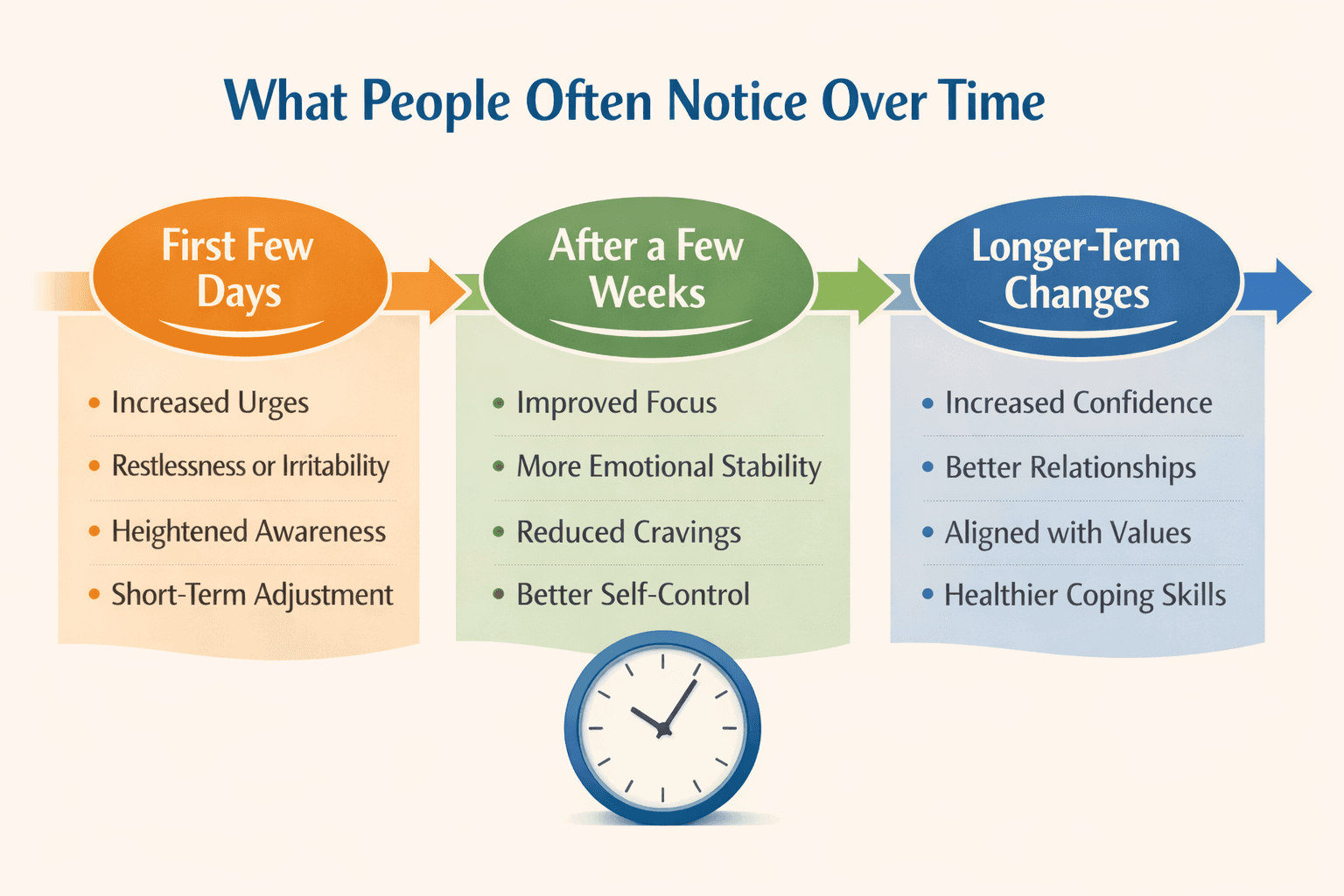
In the First Few Days
In the early stages, some people notice heightened awareness of sexual urges or increased restlessness. This is often described as the mind and body adjusting to a change in routine.
Common short-term experiences may include:
-
Stronger or more frequent urges
-
Mild irritability or restlessness
-
Heightened awareness of habits and triggers
Others report little to no change during this period, especially if masturbation was not a frequent or emotionally loaded habit.
After a Few Weeks
Over time, some people report that urges become easier to manage as new routines take shape. For individuals who previously used masturbation as a coping mechanism, this period can involve learning alternative ways to manage stress or boredom.
Commonly reported experiences after a few weeks include:
-
Improved sense of self-control
-
Reduced preoccupation with sexual urges
-
More stable mood or focus
-
Greater awareness of emotional triggers
Not everyone experiences these changes, and some people notice only subtle differences.
Longer-Term Changes
For those who continue over a longer period, reported changes tend to be behavioral and psychological, rather than physical. Any benefits that emerge are often tied to broader lifestyle adjustments rather than abstinence alone.
Some people report:
-
Increased confidence or discipline
-
Improved relationship satisfaction
-
Stronger alignment with personal or spiritual values
-
Healthier coping strategies for stress
Others find that once initial curiosity or motivation fades, masturbation no longer feels central to their well-being—positive or negative.
A Note on Individual Variation
It’s important to emphasize that there is no universal timeline. Factors such as frequency of past habits, emotional context, pornography use, stress levels, and personal beliefs all influence how someone experiences change.
For some, benefits appear quickly. For others, they may not appear at all.
When Stopping Masturbation May Not Be Helpful
Stopping masturbation is not necessary or beneficial for everyone, and in some cases, it may not improve outcomes at all.
For individuals who do not experience distress, compulsion, or conflict around masturbation, stopping may offer little benefit and can sometimes increase stress, frustration, or unnecessary guilt—especially if the decision is driven by fear, shame, or misinformation rather than personal values or goals.
Some people also find that focusing too heavily on abstinence can:
-
Increase anxiety or preoccupation with sexual thoughts
-
Reinforce shame around normal sexual feelings
-
Shift attention away from more relevant issues, such as stress management, relationship communication, or problematic pornography use
In these situations, addressing underlying factors—such as emotional regulation, habits around pornography, or overall mental health—may be more effective than abstaining from masturbation itself.
This is why many health professionals emphasize context over rules. What matters most is whether a behavior supports or undermines your well-being, not whether it conforms to a universal standard.
When you need more help
While masturbation may not be inherently harmful, compulsive masturbation can have significant negative effects. By quitting, you can experience a range of benefits, from increased energy and improved relationships to better mental health and spiritual well-being.
If you’re struggling to stop, consider reaching out for help. You don’t have to do it alone.
References
Jacobs, T., Geysemans, B., Van Hal, G., Glazemakers, I., Fog-Poulsen, K., Vermandel, A., De Wachter, S., & De Win, G. (2021). Associations between online pornography consumption and sexual dysfunction in young men: Multivariate analysis based on an international web-based survey. JMIR Public Health and Surveillance, 7(10), e32542. https://doi.org/10.2196/32542
Coleman, E. (2003). Masturbation as a means of achieving sexual health. Journal of Psychology & Human Sexuality, 14(2–3), 5–16. https://www.tandfonline.com/doi/abs/10.1300/J056v14n02_02
Veldhuis, J. D., Keenan, D. M., Liu, P. Y., et al. (2001). Testosterone secretion in healthy males is regulated by complex feedforward and feedback mechanisms. American Journal of Physiology – Endocrinology and Metabolism, 281(1), E52–E62. https://pubmed.ncbi.nlm.nih.gov/20478434/
Hayes, F. J., Seminara, S. B., DeCruz, S., et al. (2001). Differential regulation of gonadotropin secretion by testosterone in the human male. Journal of Clinical Endocrinology & Metabolism, 86(1), 53–58. https://pubmed.ncbi.nlm.nih.gov/11231978/
Archer, J. (2006). Testosterone and human aggression: An evaluation of the challenge hypothesis. Neuroscience & Biobehavioral Reviews, 30(3), 319–345. https://doi.org/10.1016/j.neubiorev.2004.12.007
Jiang, M., Xin, J., Zou, Q., & Shen, J. W. (2003). A research on the relationship between ejaculation and serum testosterone level in men. Journal of Zhejiang University Science, 4(2), 236–240. https://doi.org/10.1631/jzus.2003.0236 https://pubmed.ncbi.nlm.nih.gov/12659241/
Jiang, M., Jiang, X., Zou, Q., et al. (2021). Retraction note to: A research on the relationship between ejaculation and serum testosterone level in men. Journal of Zhejiang University Science A. https://doi.org/10.1631/jzus.2003.r236
Bespoke Surgical. (2019, November 8). Masturbation survey: How often do people masturbate? https://bespokesurgical.com/2019/11/08/masturbation-survey/
Reddit. (n.d.). r/NoFap. https://www.reddit.com/r/NoFap/