Key takeaways about quitting porn cold turkey
-
Quitting porn cold turkey means stopping all use immediately to break the cue–reward habit loop.
-
This approach can trigger temporary symptoms like cravings, irritability, and mood changes as the brain adjusts.
-
Early stages often involve strong urges and mental preoccupation due to disrupted reward expectations.
-
Over time, cravings weaken and become easier to manage as habit circuits lose reinforcement.
-
Cold turkey can be effective for people who struggle with moderation or binge patterns.
-
Gradual reduction may reduce discomfort but can increase the risk of relapse for some individuals.
-
Recovery depends more on consistency, environment, and strategy than on willpower alone.
-
Long-term success comes from reducing triggers, building new habits, and strengthening impulse control over time.
Frequently asked questions about quitting porn cold turkey
What does quitting porn cold turkey mean?
It means stopping all pornography use immediately instead of gradually reducing consumption.
What happens when you quit porn cold turkey?
You may experience cravings, mood changes, irritability, and temporary drops in motivation as your brain adjusts to the absence of stimulation.
Is quitting porn cold turkey effective?
Yes, for some people. It works best for those with binge patterns or who struggle with moderation, because it creates a clean break in the habit cycle.
Is it better to quit porn cold turkey or gradually?
There is no universal best method. Cold turkey creates a clear break, while gradual reduction may reduce discomfort but increase the risk of relapse.
How long does it take to recover after quitting porn?
Many people report noticeable changes within 30–90 days, though recovery timelines vary depending on usage patterns and consistency.
What does it mean to quit porn cold turkey?
Quitting porn “cold turkey” means stopping all consumption immediately, without gradually reducing usage. The term comes from substance addiction recovery, where abrupt cessation can trigger withdrawal symptoms.
But does porn work the same way? And is cold turkey the best strategy?
Further reading: What Happens When You Stop Watching Porn
While many people quit pornography on their own, others experience temporary symptoms such as mood changes, irritability, or strong cravings. If your use feels compulsive or causes significant distress, professional support may help.
The withdrawal timeline of quitting porn cold turkey
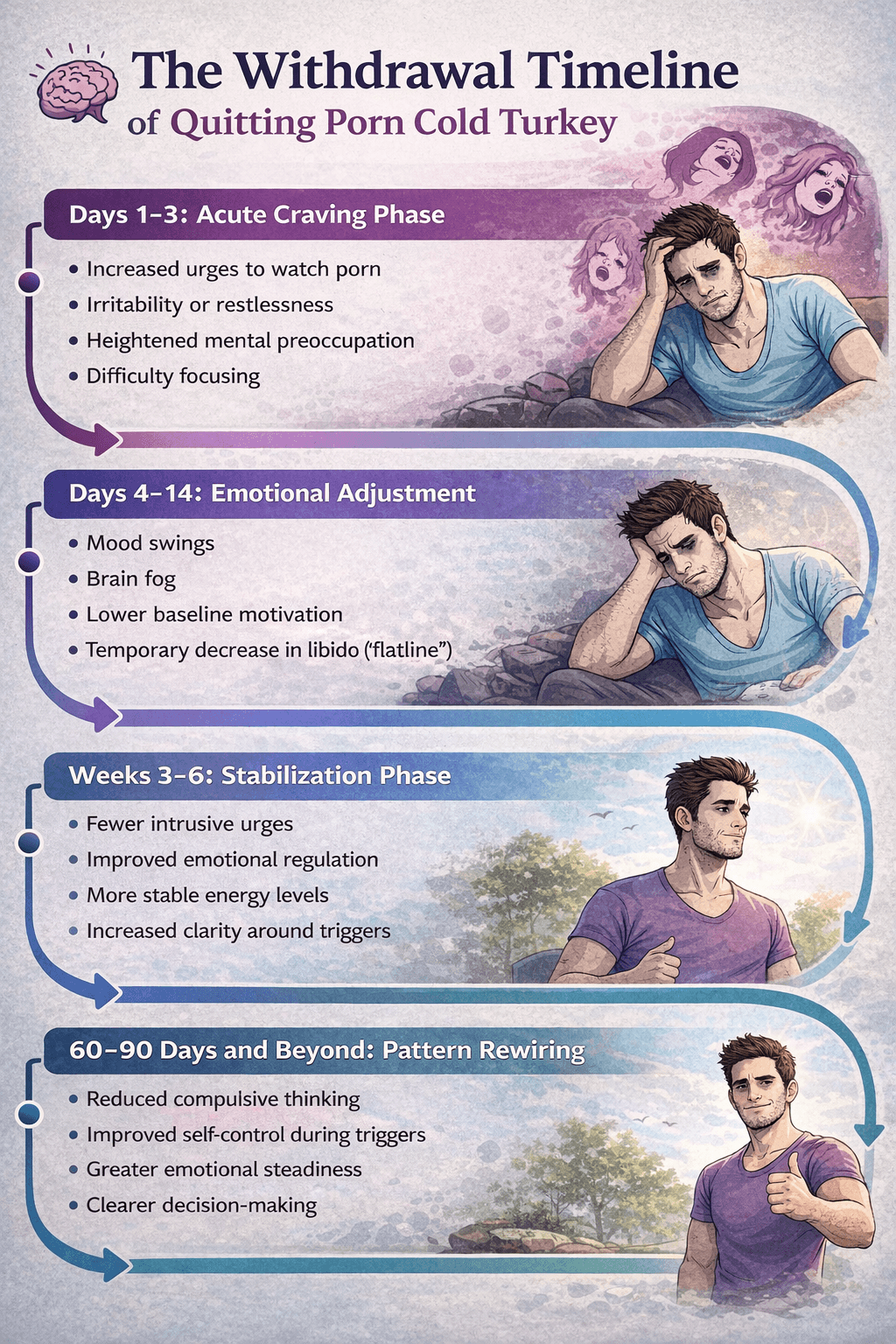
When you stop consuming pornography abruptly, your brain and behavior don’t adjust instantly. While pornography does not produce the dangerous physical withdrawal seen in certain substance addictions, many people report a temporary period of psychological discomfort as their habits and reward expectations recalibrate.
The timeline below reflects commonly reported patterns in behavioral addiction recovery. Individual experiences vary depending on frequency of use, intensity of content, and underlying emotional triggers.
Days 1–3: Acute craving phase
During the first few days, cravings often feel strongest. This is when the brain expects the reward it has become conditioned to anticipate.
Common experiences may include:
-
Increased urges to watch porn
-
Irritability or restlessness
-
Heightened mental preoccupation
-
Difficulty focusing
This phase is largely driven by habit interruption rather than physical withdrawal.
Days 4–14: Emotional adjustment
As the initial shock fades, many people report fluctuating mood and motivation.
Possible experiences include:
-
Mood swings
-
Brain fog
-
Lower baseline motivation
-
Temporary decrease in libido (“flatline”)
Further reading: Nofap Flatline
This period can feel discouraging, but it often reflects the brain adapting to the absence of repeated high-intensity stimulation.
Weeks 3–6: Stabilization phase
For many individuals, cravings begin to lose intensity during this window.
You may notice:
-
Fewer intrusive urges
-
Improved emotional regulation
-
More stable energy levels
-
Increased clarity around triggers
Behavioral patterns begin weakening when they are no longer reinforced consistently.
60–90 Days and Beyond: Pattern Rewiring
Longer periods of abstinence tend to reduce the automatic nature of the cue–response cycle.
People commonly report:
-
Reduced compulsive thinking
-
Improved self-control during triggers
-
Greater emotional steadiness
-
Clearer decision-making
This does not mean urges disappear entirely. Rather, they often become less dominant and easier to manage.
Further reading: Nofap Timeline Benefits
What happens in your brain when you quit porn cold turkey?
To understand whether quitting porn cold turkey works, it helps to understand what pornography does in the brain.
Pornography activates the brain’s reward system, particularly circuits involving dopamine. Dopamine isn’t a “pleasure chemical” — it’s a motivation and learning signal. When something produces a strong dopamine response, your brain tags it as important and worth repeating.
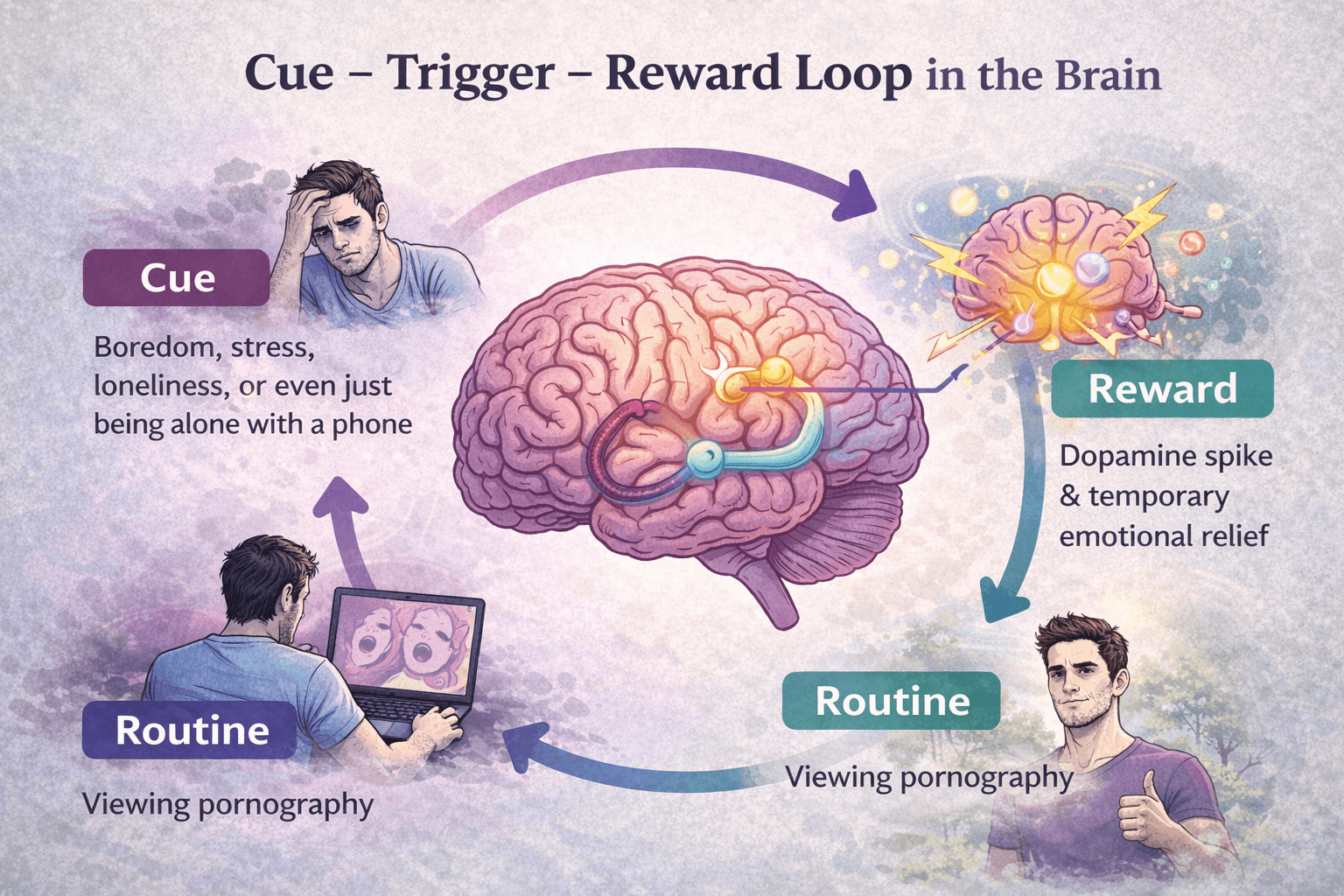
Over time, repeated exposure to highly stimulating content can strengthen what neuroscientists call the cue–trigger–reward loop:
-
Cue – boredom, stress, loneliness, or even just being alone with a phone
-
Reward – dopamine spike and temporary emotional relief
The more this loop repeats, the more efficiently your brain wires it. The basal ganglia (habit circuitry) begins to automate the behavior, while the prefrontal cortex — the area responsible for impulse control and long-term decision-making — becomes less active in the moment of temptation.
When you quit cold turkey, two things happen:
1. Reward expectations begin to adjust
Without repeated high-intensity stimulation, the brain gradually adapts to a lower level of artificial reward intensity. Cravings early on are not proof that something is “wrong” — they’re often the brain expecting a reward it has learned to anticipate.
This adjustment period can feel uncomfortable because your brain temporarily experiences:
-
Reduced motivation
-
Irritability
-
Restlessness
-
Mood fluctuations
These are commonly described as “withdrawal-like” symptoms in behavioral addictions.
2. Habit circuits weaken
Neural pathways strengthen through repetition. They weaken through disuse.
By stopping completely, you interrupt the reinforcement cycle. Over time, triggers that once felt overwhelming lose intensity because the brain is no longer pairing them with immediate reward.
This is one reason some people prefer cold turkey — it creates a clear neurological break in the pattern.
However, the early phase can feel intense precisely because the brain is adjusting to the absence of a previously reliable dopamine spike.
Importantly, this process is gradual. The brain does not “reset overnight,” but it is highly adaptable. Consistency — not perfection — is what drives long-term change.
Recovery Guides
Quitting porn cold turkey vs quitting porn by tapering off: Which is better?
Cold turkey creates a clean break. It removes negotiation and forces a full interruption of the habit loop. This approach may work best for people who:
-
Struggle with binge patterns
-
Find that “cutting back” quickly turns into relapse
-
Prefer decisive, structured commitments
Gradual reduction lowers the intensity of early discomfort but carries a risk of rationalization. It may work better for people who:
-
Use porn less frequently
-
Primarily use it as a stress-coping mechanism
-
Respond better to incremental change
There is no universally superior method. The right approach depends on your pattern of use, emotional triggers, and past attempts to quit.
Further reading: I Can't Quit Masturbating—What Do I Do?
Is cold turkey right for you?
Deciding to quit porn cold turkey is a personal choice. For some people, a clean break creates clarity and momentum. For others, the sudden absence of a familiar coping mechanism can feel overwhelming.
Cold turkey tends to work best for people who struggle with binge patterns or who find that “just cutting back” quickly turns into rationalization. If you’ve tried moderating your use without success, a full stop may create the psychological interruption needed to reset the habit loop.
At the same time, slips do not equal failure. Behavior change is rarely linear. What matters most is consistency over time, not perfection in the first week.
Why it's been so hard to quit porn in the past
The concept of “porn addiction” remains debated in research, but many people experience compulsive patterns that feel difficult to control.
As explained earlier, repeated exposure strengthens cue-reward pathways. When you attempt to quit, your brain expects the familiar stimulus, which can produce cravings, irritability, or restlessness.
Accessibility also plays a major role. Unlike many habits that require effort or social exposure, pornography is available instantly and privately, lowering friction and increasing repetition.
Can you actually quit porn cold turkey?
In principle, yes. In practice, success depends on usage patterns, emotional drivers, and consistency.
Some people benefit from a decisive break, while others require structured support. The key variable is not willpower alone, but strategy and environment.
The benefits of quitting porn cold turkey
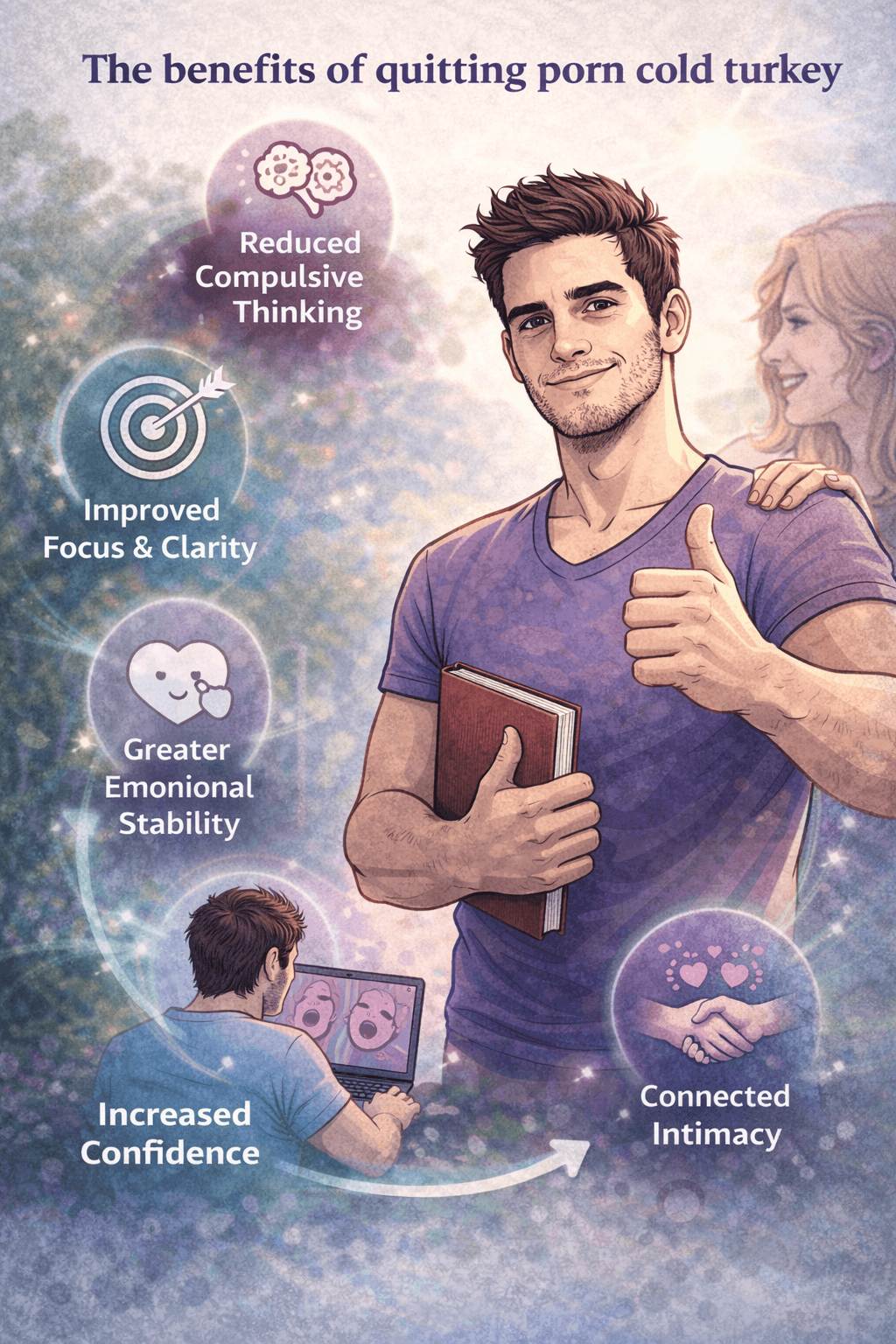
When successful, quitting cold turkey can lead to:
-
Reduced compulsive thinking. Mental energy previously spent anticipating or planning porn use often decreases, freeing attention for other priorities.
-
Improved focus and mental clarity. Without repeated high-stimulation interruptions, many people report improved concentration and greater tolerance for less intense tasks.
-
Greater emotional stability. As the cue–reward cycle weakens, emotional reactions to stress or boredom may become less extreme and more manageable.
-
Increased confidence during triggers. Each resisted urge reinforces self-efficacy, gradually strengthening your ability to tolerate discomfort without acting on it.
-
More present, connected intimacy. When attention is no longer divided by compulsive or hidden habits…, relational engagement often becomes more direct and intentional.
These changes do not occur instantly. They tend to develop gradually as repeated patterns weaken and self-regulation strengthens over time.
The Challenges of Quitting Porn Cold Turkey
The early phase can feel uncomfortable. Cravings may spike, mood may fluctuate, and motivation may dip temporarily. Because the behavior is often tied to stress relief, boredom, or emotional escape, removing it can initially make those underlying feelings more noticeable.
Many people also experience what feels like internal negotiation. Thoughts such as “just once won’t hurt” or “I’ll start again tomorrow” are common. This is not a sign of weakness — it reflects how strongly habits are reinforced through repetition.
There can also be social friction. Some people may dismiss pornography as harmless, making it harder to explain why quitting matters to you. When a behavior is culturally normalized, resisting it can feel isolating.
Recovery is rarely linear. Short-term setbacks do not erase neurological or behavioral progress, but repeated reinforcement of the old pattern can strengthen the habit loop again. The challenge is less about eliminating urges entirely and more about learning to tolerate them without acting on them.
The intensity of discomfort typically decreases over time. What feels overwhelming in the first week often becomes manageable with consistency and environmental adjustments.
Further reading: Porn relapse: What to do next (Without Spiraling)
Practical tips for stopping porn completely
If you choose to quit porn cold turkey, there are several psychological strategies that can help you manage cravings and stay on the path to recovery.
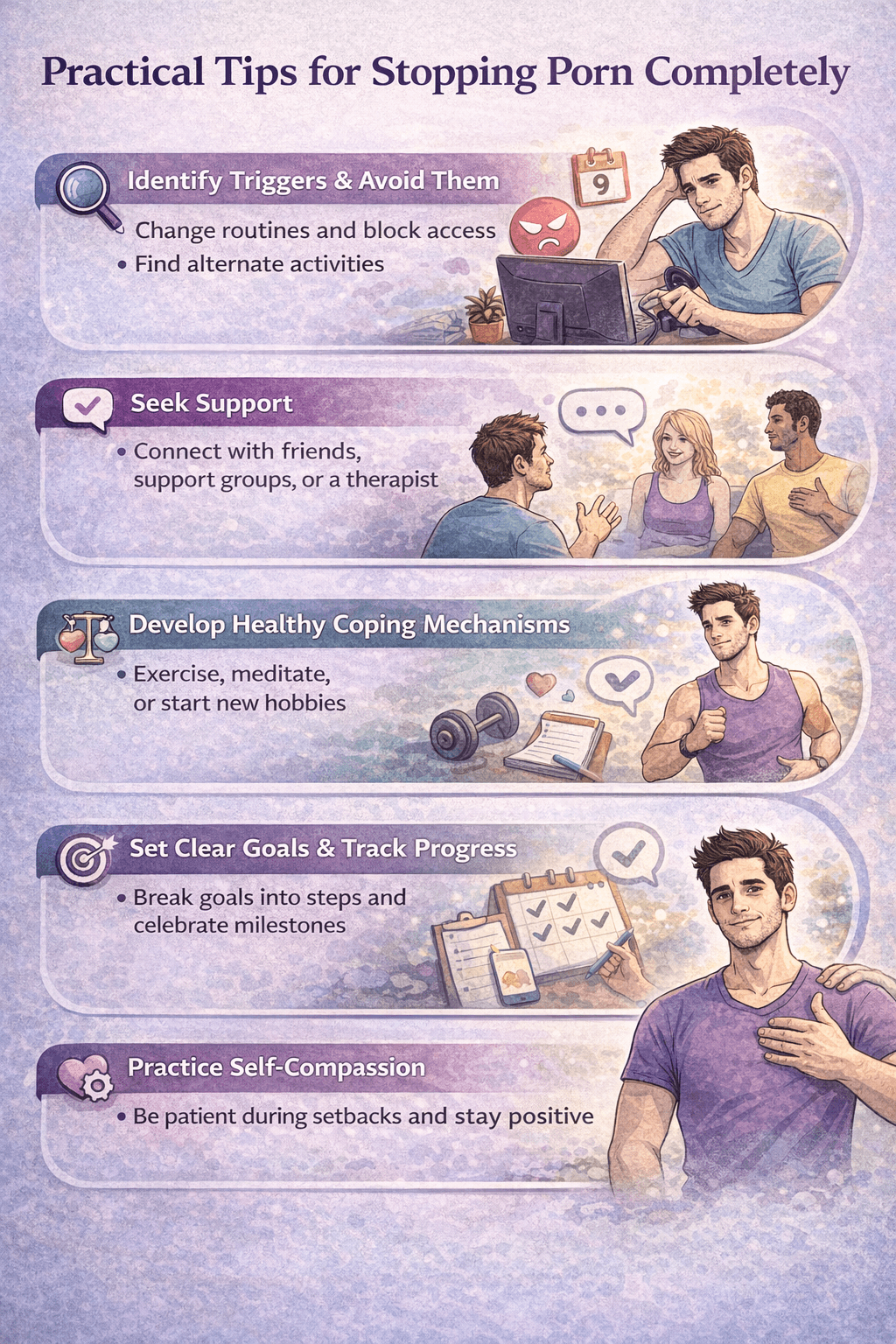
One is cognitive-behavioral therapy (CBT), which helps you identify and manage triggers that lead to porn use. But if therapy isn’t currently in the budget for you, here are a list of tips and tricks to help you limit your porn use—or even quit it altogether!
-
Identify Triggers and Avoid Them: Recognize situations, emotions, or environments that trigger the urge to consume porn. Once identified, make a conscious effort to avoid or minimize exposure to these triggers. This might involve changing daily routines, setting up internet filters, or finding alternative activities to occupy your time.
-
Seek Support: Don't hesitate to reach out to supportive friends, family members, or professionals who can offer understanding and encouragement. Joining support groups or seeking therapy can provide valuable guidance and accountability on your journey to quitting porn.
-
Develop Healthy Coping Mechanisms: Find healthier ways to cope with stress, boredom, or negative emotions that may have previously led you to turn to porn. Engage in activities such as exercise, mindfulness, hobbies, or creative outlets that promote well-being and provide a sense of fulfillment.
-
Set Clear Goals and Track Progress: Establish realistic goals for reducing or eliminating porn consumption and track your progress over time. Breaking down larger goals into smaller, manageable steps can make the process more achievable and help you stay motivated. Celebrate milestones along the way to acknowledge your accomplishments.
-
Practice Self-Compassion: Be kind to yourself throughout the quitting process. Understand that setbacks are a normal part of change and don't define your progress. Instead of being overly critical, practice self-compassion and focus on learning from mistakes, adjusting strategies, and moving forward with renewed determination. Remember, every step you take towards quitting porn is a step towards a healthier and more fulfilling life.
An effective, top-rated resource for anyone who is ready to quit porn
Therapy is wonderful, but if you don’t feel ready to commit to therapy, there are many alternative routes to recovery that you can try out as you try to quit porn cold turkey. One of the best is Relay, a group-based recovery program.
Combining the benefits of a support group with a guided addiction recovery curriculum developed by behavioral psychologists, Relay has helped all its users to make meaningful progress towards the good habits they want to incorporate into their lives, and leave their bad habits and addictions behind. You can find more information about Relay here!
Conclusion
Quitting porn cold turkey is not the easiest strategy, but for many people it creates the decisive interruption needed to weaken compulsive patterns. The brain adapts gradually, not instantly, and progress depends more on consistency than perfection.
If one approach does not work, adjustment is not failure — it is strategy refinement.