

Key takeaways about hentai addiction
-
Hentai addiction is compulsive use of animated pornography that continues despite negative effects on mental health, relationships, or daily life.
-
Hentai can be more addictive than regular porn because it combines unlimited fantasy, extreme novelty, and emotional escapism.
-
The brain becomes addicted to the anticipation and novelty of hentai, not just the act of watching it.
-
Hentai addiction often develops through escalating content, loss of control, and using it as a coping mechanism for stress or loneliness.
-
There are two main types of hentai users: fantasy-driven users and novelty-driven users, each with different addiction patterns.
-
Hentai can distort expectations of real relationships by replacing emotional intimacy with idealized fantasy experiences.
-
Signs of hentai addiction include binge watching, escalation, secrecy, guilt, low motivation, and reduced interest in real relationships.
-
Recovery from hentai addiction requires reducing triggers, replacing the habit, building real-world engagement, and addressing underlying emotions.
Frequently asked questions about hentai addiction
What is hentai addiction?
Hentai addiction is compulsive use of animated pornography that continues despite negative consequences. It is commonly understood as a form of problematic pornography use.
Why is hentai more addictive than regular porn?
Hentai allows for unlimited fantasy, exaggerated scenarios, and constant novelty, which can overstimulate dopamine and lead to faster escalation than live-action porn.
What are the signs of hentai addiction?
Signs include loss of control, escalating content, failed attempts to quit, excessive time spent watching, and using hentai to cope with stress or emotions.
Is hentai addiction a real condition?
Yes. While not formally listed in the DSM-5, it is widely recognized as a form of compulsive sexual behavior or behavioral addiction.
How can you stop watching hentai?
You can stop by removing triggers, adding friction (blockers), replacing the habit, improving real-world engagement, and addressing underlying emotional triggers.
Relay is a therapist-backed group recovery program for pornography and unwanted sexual behavior, combining daily accountability, real-time urge support, and a private peer community.
Hentai Addiction is More Common Than You Think
If you’re worried that you may be suffering from a hentai addiction, take a deep breath. You’re not crazy, and you’re not alone.
Hentai has quietly become one of the most consumed forms of pornography in the world. In fact, according to Pornhub’s annual Year-in-Review report, “Hentai” has ranked as the platform’s #1 or #2 most-searched category from 2017-2024.
Pornhub did not release its 2020 data, but the trend is clear: Hentai is popular enough to dominate searches on the streaming porn site that receives the most traffic in the world.
You have to go all the way back to 2016 to see “Hentai” not ranked as the 1st or 2nd most-searched-for terms on their site—and even then, it was ranked in the top 10.
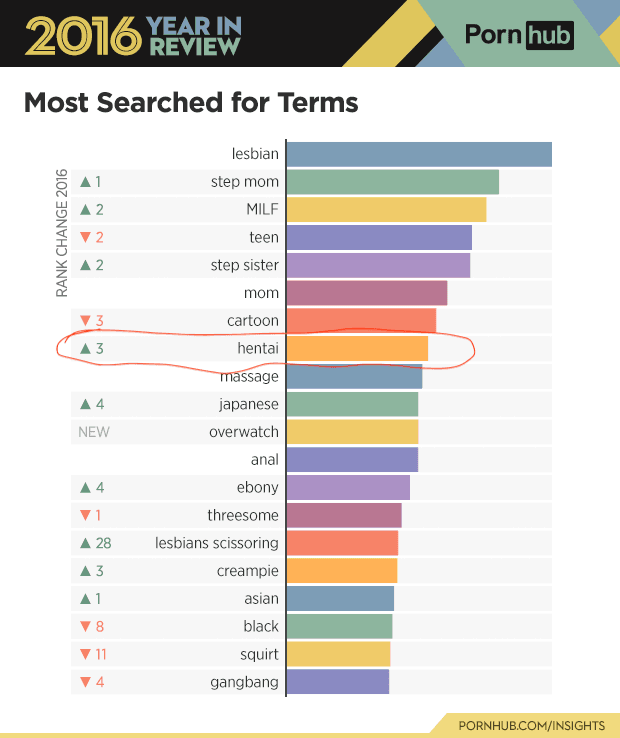
That means more people search for animated sexual content than they do for most forms of live-action porn. And if this many people are searching for “hentai,” then it stands to reason that many of them suffer from an addiction to it.
And that raises a question most people don’t want to ask out loud:
Why are so many men—smart, normal, otherwise well-adjusted men—turning to cartoons for sexual release?
It’s easy for people to shrug hentai off as a niche or a joke, but the numbers don’t lie. If you’ve ever found yourself losing hours to it, escalating to more extreme categories, or feeling ashamed about what you’re watching, you already know that the issue is real.
Hentai isn’t “just animated porn.”
It taps into a different set of uniquely powerful psychological mechanisms:
-
Escapism, for people who feel overwhelmed, lonely, anxious, or disconnected from real intimacy
-
Fantasy, where anything can happen and nothing is off-limits
-
Novelty, which the brain interprets as excitement and reward
-
Parasocial attachment, where fictional characters feel emotionally safer than real people
-
Distinct cultural aesthetics, especially the exaggerated femininity and emotional tone of Japanese animation
Put those together, and you get a form of porn that hits harder, sticks longer, and escalates faster than most people realize.
I’m not here to judge you or shame you. I’m here to explain the mechanics behind hentai addiction—why it develops, why it feels so powerful, and why quitting can be harder than quitting regular porn.
I’m also here to separate myth from reality, especially around taboo content and legal risks, because misinformation in this space only makes people feel worse about their situation.
Most importantly, I’ll give you a clear, realistic plan to break free. Not a plan that relies on willpower alone, but one that rewires the habit loops and emotional patterns that make hentai so appealing in the first place.
If you’ve ever wondered “What’s happening to me?” or “Why can’t I stop watching this?” then this guide is going to give you the clarity and direction you’ve been missing.
Let’s get into it.
What Is Hentai? (And How It Differs From Ecchi, Anime, and Regular Porn)
Before we can talk about hentai addiction, we need to be clear about what hentai actually is—and what it isn’t.
People use the word loosely, but hentai has a specific meaning, a specific history, and a specific psychological appeal that separates it from every other form of pornography.
When the average person uses the word “hentai,” they can mean anything from a pornographic cartoon drawing or animation to live-action pornography from Japan.
That last meaning sounds far-fetched to anyone who knows anything about hentai, but there’s a reason that “hentai” and “Japan” or “Japanese” showed up so close to “hentai” in the Pornhub “Most Search Terms” reports earlier.
Hentai is a category all its own, and we need to strictly define it before we can talk about why guys get addicted to it and how to break that addiction.
Hentai Is More Than “Animated Porn”
Hentai is strictly defined as:
A genre of Japanese manga/anime characterized by overtly sexualized characters, sexually explicit actions and images, and sexually explicit plots.
Generally speaking, hentai is applied only to manga and anime. However, when it’s involved in a video game, it’s referred to as “eroge.”
Hentai is fundamentally different from live-action porn. It is a pure fantasy engine where actions that would be considered illegal (like sexual assault, CSAM, and even bestiality) can be viewed. Well, in most places. More on that shortly.
Animation removes every limit that exists in real life:
-
No physical constraints
-
No laws of biology
-
No production budget
-
No moral boundaries
-
No camera angles or lighting limitations
Whatever can be drawn can be depicted. And that makes hentai fundamentally different from live-action porn, not just visually, but psychologically.
Before we go any further, we need to make an addendum to the definition of “hentai,” and it requires its own section to make sure there is no confusion.
Ecchi vs. Hentai: The Line Between Suggestive and Explicit
Many anime fans have never heard the term “ecchi” before, but they know it when they see it. Much like the way many anime fans know hentai when they see it, ecchi is instantly recognizable once you know what to look for. The difference is that there is a much greater awareness of hentai than there is of ecchi.
However, a lot of casual fans or people who are watching anime for the first time might confuse the two, not because they know or don’t know the names, but because of the similar substance of the two.
But the two are different, and it’s important to understand that difference if we want to know how we got addicted and how to get clean.
What is the difference between ecchi and hentai?
Ecchi (from the Japanese word for “naughty” or “pervy”) is suggestive, playful, and teasing. Think:
-
cleavage shots
-
comedic sexual situations
-
bathhouse scenes
-
revealing outfits
-
“accidental” nudity
Ecchi stops short of explicit nudity and sex. While you probably wouldn’t show ecchi to any kids, no one would ever see you watching it and think you are watching explicit material.
Hentai, on the other hand, is fully explicit. It shows:
-
graphic sex
-
intercourse
-
fetish content
-
orgasm imagery
-
exaggerated anatomy
Ecchi content ranges from PG-13 to a very soft, debatable R. The most innocent hentai, if such a thing exists, is rated R or NSFW, and it goes all the way up to things that are morally repugnant and psychologically depraved.
Ecchi is built around a concept called “fan service”—scenes in non-hentai anime/manga with revealing outfits, accidental nudity, exaggerated curves, and playful sexual tension that stop short of explicit sex.
For a lot of viewers, this becomes their first introduction to sexualized 2D imagery, easing them into the aesthetic and fantasy style that hentai later takes to explicit extremes.
For some men, ecchi is the gateway. Playful fan service becomes explicit fantasy.
Two Types of Hentai Users And What That Means For Addiction
One thing people consistently misunderstand about hentai is the assumption that all viewers are the same. They’re not.
Research across multiple sources—including:
-
Japanese otaku-behavior studies and sexuality analyses (Galbraith, 2011)
-
Western anime-fandom surveys such as the Anime News Network reader studies, large-scale behavioral datasets like Pornhub Insights (Pornhub, 2019),
-
Community-survey research from Reddit fandom groups
-
Psychological studies of hentai users show a consistent pattern:
Hentai users fall into two psychologically distinct groups.
Those groups watch for different reasons and develop different compulsive patterns as well.
Understanding which group you fall into is one of the most powerful insights you can have, because the strategies that help one group quit or regain control rarely work for the other.
Let’s break them down.
Group 1 — Dual Consumers (Anime/Manga Fans Who Also Watch Hentai)
This is the majority group, comprising roughly 60–75% of hentai users across multiple survey datasets. These are people who were already consuming anime and manga long before they discovered hentai, so their connection to 2D fantasy existed first. For them, hentai isn’t “just porn.” It’s part of a larger emotional and cultural ecosystem.
What drives this group:
-
Fantasy immersion
-
Narrative context
-
Parasocial attachment to characters
-
Appreciation for 2D aesthetics and design
-
“Moe” desire—affection for idealized or cute characters
-
Strong imagination and fantasy orientation
Galbraith’s work on moe explores mediated intimacy with fictional characters. Azuma describes otaku “database consumption,” where characters and tropes blend with desire in a unique way (Azuma, 2009).
Psychological profile of the dual anime and hentai consumer:
Dual consumers often lean toward being imaginative, introverted, emotionally invested in anime culture, aesthetically driven, and deeply immersed in fictional worlds.
For this group, hentai is:
-
an extension of the stories and worlds they already love
-
a way to explore fantasy safely
-
tied to narrative, character, and emotion
-
less about shock value and more about immersion and escapism
This helps explain why dual consumers often escalate slower than others. Their arousal isn’t about novelty alone but about connection, context, and emotional fulfillment. This psychological profile is in stark contrast to the second group.
Group 2 — Hentai-Only Consumers (Porn-Driven Users)
This group represents roughly 25–40% of hentai viewers in Western datasets. Unlike dual consumers, these individuals do not watch anime, read manga, or identify with anime culture.
They come to hentai the same way someone discovers a new porn genre—out of curiosity, novelty, or an interest in more intense stimulation.
For them, hentai is a high-intensity upgrade from traditional pornography.
What drives this group:
-
Novelty-seeking
-
Escalation into extreme or taboo content
-
Curiosity about scenarios impossible in real life
-
Hyper-stimulation from exaggerated visuals
-
Desire for stronger sexual intensity
-
Thrill of the forbidden
These motivations align closely with the I-PACE model of addictive sexual behavior (Brand et al., 2019), which predicts higher cue-reactivity, compulsive loops, stronger cravings, and faster escalation.
Psychological profile of the “hentai-only” consumer:
Hentai-only users are typically sensation-seeking, stimulation-driven, quick to boredom, and more susceptible to compulsive viewing patterns. They are less interested in narrative or character and more motivated by intensity.
For this group, hentai is:
-
a more extreme, more novel form of pornography
-
a place where the impossible becomes sexually accessible
-
free from the physical limits of real bodies
-
a rapid path to dopamine
Because they are not tied to the anime culture, manga stories, or emotionally invested in characters, they tend to jump between videos quickly, consume more categories, and escalate at a faster rate.
If you’re quitting, it helps to know what to expect at each stage of the recovery timeline.
Why This Distinction Matters for Addiction and Recovery
The reason hentai feels so addictive—and the reason quitting is hard—depends heavily on which group you most identify with. If you don’t understand this, you’ll end up trying to fix the wrong problem, and that can often cause even more problems.
Dual anime/hentai consumer challenges
-
emotional dependence on fantasy worlds
-
parasocial attachment
-
using 2D intimacy as a substitute for real intimacy
-
escapism tied to loneliness, anxiety, or depression
You don’t just need to stop watching hentai. You need to strengthen your real-world emotional life and reduce dependence on fantasy. The overarching theme with the dual anime/hentai user is escape from reality because hentai is part of an artificial world that fulfills everything without any challenges.
Hentai-only consumer challenges
-
high novelty-seeking
-
compulsive reward loops
-
binge-like behavior
-
escalation into extreme content
-
difficulty regulating impulses
You need strategies that break the loop, reduce stimulation, and rebuild your dopamine baseline. If you’re a hentai-only consumer, you got into hentai because it’s the next level for stimulation and gratification after boredom with the “ordinary” stuff.
Why Is Hentai So Addictive?
Most people assume addiction to hentai works the same way as addiction to regular pornography. But the psychology is different. Standard pornography is simulated reality. There are real bodies, real limits, and real-world scenarios.
But hentai is a different beast.
The bodies in hentai are two-dimensional, unrealistic exaggerations and the only limits are the imagination of the producer. All of this means that it can tap into deeper emotional patterns, stronger novelty-seeking urges, and more powerful fantasy loops than anything live-action pornography can produce.
This is why so many men report that hentai became addictive faster, escalated more quickly, or felt “stickier” than traditional pornography. Hentai typically contains more novel, fantastical, and transgressive content than conventional porn. Those elements are known to increase arousal intensity and accelerate escalation in compulsive sexual behaviors (Galbraith, 2011).
Psychological studies also find that many hentai users score higher on escapism, fantasy dependency, and loneliness. These traits are linked to faster progression toward problematic or compulsive porn-use patterns. Together, these mechanisms explain why hentai can feel more gripping or habit-forming for certain individuals.
There are four key neurological mechanisms that drive the addictive nature of hentai.
1. The Dopamine Anticipation Loop (Search > Reward)
Many people believe dopamine spikes at the moment of orgasm or pleasure, but dopamine actually fires most intensely during the anticipation phase.
This is the phase when you are searching, scrolling, and expecting a reward (Schultz, 2016). This anticipation-driven dopamine loop is where hentai becomes uniquely compelling.
In this way, hentai is similar to the patterns we see in conventional porn. For example, someone browsing a streaming porn site for hentai will:
-
Scroll through endless thumbnails
-
Jump between categories and tags
-
Bounce between loops, GIFs, and short clips
-
Spend hours in search of a “perfect” scene
Each action spikes dopamine as you anticipate reward. And once the reward is satisfied, dopamine tells your brain that this leads to a favorable, enjoyable outcome, and you are now primed to do it whenever your dopamine dips even slightly from stress or loneliness.
Your brain becomes hooked on “one more video,” “one more clip,” or “one more extreme category.” With hentai, the search never ends. There is always something new, shocking, or visually different one click away.
The brain becomes addicted to the search, not the satisfaction. And because hentai offers infinite variety, the dopamine loop can continue ad infinitum.
2. Extreme Novelty Escalation (Escapism → Extremity)
Novelty-seeking is a major driver of human sexual motivation.
Across species, sexual arousal reliably increases in response to new or varied partners—an effect known as the Coolidge Effect, which has been well-documented in mammals and supported by human sexual-response research (Banca et al., 2018).
In humans, exposure to novel sexual stimuli produces stronger arousal patterns, greater dopamine release, and faster habituation to familiar stimuli, which helps explain why some forms of pornography escalate more rapidly than others (Pornpakakul et al., 2020; Prause et al., 2015).
When taken to extremes, it becomes an uncontrollable compulsion that leads to destructive sexual expression (Brand et al., 2019).
Human brains naturally release dopamine when exposed to new or intensified stimuli. This doesn’t mean you’re pathological. It means your nervous system is functioning normally under abnormal stimulation.
Hentai accelerates novelty-seeking in ways regular porn simply cannot. And trying to quit hentai can bring it's own host of challenges.
Why novelty escalates faster with hentai:
-
Animation has no physical or biological limits
-
Artists can exaggerate bodies, expressions, and scenarios
-
Extreme categories exist that would be illegal or impossible in real life
-
Visual styles can shift dramatically between scenes
-
The variety is virtually unlimited
Escalation in hentai does not mean you’re developing dangerous or criminal desires. Research on CSAM offenders shows that offending behavior stems from pre-existing traits—not from porn escalation (Seto, 2019).
Your escalation is a novelty-response pattern, not a moral failure.
3. Fantasy > Reality Mismatch
One of the most psychologically powerful aspects of hentai is the fantasy-realism gap.
Live-action porn still deals with the limits of the human body. Hentai does not. It offers idealized or impossible sexual dynamics, perfect emotional availability, and characters who exist solely to satisfy your desires.
How this mismatch develops:
-
Hentai characters never reject you
-
There is no awkwardness, insecurity, or miscommunication
-
Characters are drawn to maximize aesthetic and sexual appeal
-
Emotional tone is always idealized—submissive, adoring, receptive
-
Sexual enthusiasm is exaggerated beyond human behavior
Over time, this can produce unintended consequences:
-
Guilt for preferring 2D fantasies over real intimacy
-
Shame about what you watch or escalate to
-
Avoidance of dating or emotional vulnerability
-
Performance anxiety, because real women cannot match fantasy perfection
None of this means you're abnormal.
It means hentai provided a shortcut to the feelings you wanted without requiring the emotional work of real connection. The same way that drugs allow you to feel good without doing anything to earn that feeling, hentai does the same thing for your sexual and emotional needs.
The destruction just looks different because it’s not obvious, but it can be just as devastating.
4. The Hentai-Specific Escapism Loop
Hentai is uniquely positioned to serve as an emotional escape, especially for individuals who score higher on traits like neuroticism, fantasy proneness, and avoidance coping.
Research consistently shows that hentai consumers—particularly dual consumers—exhibit stronger escapist tendencies than users of live-action porn (Galbraith, 2019).
How the escapism loop works:
-
You feel stressed, lonely, anxious, or overwhelmed
-
Hentai provides immediate escape, fantasy immersion, and comfort
-
Your brain learns: “This fixes how I feel right now”
-
Real-world problems remain unresolved
-
Emotional discomfort increases
-
You return to hentai again
At this point, hentai stops being a sexual choice and becomes an emotional coping mechanism. Regular porn is also an escape mechanism, but this is stronger with hentai because live-action pornography does not typically provide
-
immersive fantasy worlds
-
character intimacy
-
narrative continuity
-
emotionally soothing parasocial attachments
-
complete freedom from social stakes
The addiction to hentai isn’t even sexual. It’s mainly emotional.
Many men use hentai not to get off, but to get away.
Understanding how hentai captures your attention and emotions is the first step toward breaking the pattern. Once you understand how the trap works, you can start building your way out of it.
And this trap is particularly insidious because it’s the one form of porn addiction that can actually cost you your freedom.
Legal Risks: When Hentai Crosses Into Criminal Territory
Most people think hentai is “just drawings,” and that drawings are automatically protected as free expression. That is not true everywhere.
In many countries, certain forms of hentai—especially material involving characters who appear to be under 18—are treated the same as real child sexual abuse material (CSAM), even when no real children were involved in its creation.
Understanding the legal landscape is crucial because hentai is a global medium, but the laws that govern it are not.
You may be watching from the United States—where drawn content is generally protected—but traveling or downloading content while visiting another country could put you in legal danger without you even realizing it.
The laws are real, they vary widely, and you should know how your country treats fictional content. You may live in a country that can use these laws to prosecute you, and many have done this before.
Here is a handy Wikipedia entry on the legality of hentai in countries around the world. The Wiki also references cases, just so you know that the government in those countries takes hentai seriously.
In these countries, possessing hentai, manga, doujinshi, or AI-generated art can lead to criminal prosecution if authorities believe the characters depicted appear to be underage.
It’s important to emphasize: these laws are not theoretical. They have been enforced.
Why Some Hentai Is Illegal Even If “No Real Child Was Harmed”
There’s a natural instinct to say, “But this is just fictional drawings.” However, many of these laws were written specifically to challenge that assumption.
How the laws generally define illegal content:
-
“Pseudo-photographs” (UK) — images that are not real but look like real minors
-
“Prohibited images of a child” (UK) — includes cartoons and digitally created content
-
“Representations of minors” (Australia) — covers animated and fictional imagery
-
“Visual depictions of a minor for sexual purposes” (Canada) — includes comics and art
The wording may vary slightly, but they all express the same point. Whether the content is drawn, animated, or digitally rendered is irrelevant in these jurisdictions. If it appears to show a minor in a sexual context, it can be ruled illegal.
While doing research for this article, I was surprised to find that the United States appears to be a notable English-speaking country where hentai is legal. The UK, Canada, Australia, and New Zealand all have serious laws against hentai. There have been notable instances where these laws have been invoked. For example:
-
In 2014, a 39-year-old anime fan from South Bank, Middlesbrough named Robul Hoque was convicted in a UK court for possessing illegal manga and anime images that depicted fictional children in sexualised situations.
Police seized hundreds of still and moving images during a search of his home computer; none showed real people, but the drawings were judged to depict children engaging in sexual acts and to fall under UK child-pornography laws as “prohibited images of a child.” Hoque was sentenced to a nine-month prison term, suspended for two years and was forced to register in a sex offender program.
-
In May 2024, a 30-year-old man from West Ulverstone, Tasmania was charged by the Australian Federal Police (AFP) for allegedly accessing a large volume of computer-generated animated child abuse material — described in the release as thousands of pages of Japanese hentai depicting minors in sexually explicit acts.
-
In August 2015, an Adelaide, South Australia man was given a suspended jail sentence after police found more than 300 anime images on his laptop that were legally classed as child pornography, even though they were animated rather than real photos.
-
In the Ryan Matheson case, an 18-year-old Canadian manga fan was arrested at the U.S.–Canada border in 2010 after customs agents found hentai and manga on his laptop depicting fictional characters—some appearing underage—in sexual situations. He was charged under Section 163.1 of the Canadian Criminal Code, which defines child pornography to include drawings and cartoons, even when no real children exist.
Matheson faced severe penalties, including possible prison time and sex-offender registration, before prosecutors ultimately dropped all charges after forensic analysis showed the images were clearly fictional and did not meet the legal threshold.
Even if your own country does not criminalize drawn content, downloading, possessing, or viewing certain hentai while traveling abroad can put you at legal risk in countries that do.
Myth vs Fact: Does Watching Hentai Lead to Contact Offenses?
Because some hentai depicts taboo or extreme scenarios, people often assume that consuming this content leads to dangerous behavior. This assumption is not supported by evidence.
MYTH: Watching hentai causes people to develop interest in CSAM.
FACT: No credible research supports this.
Studies on CSAM offenders consistently show:
Offenders have specific psychological and developmental risk factors, and these traits typically precede any pornography use. Porn consumption does not predict who will commit real-world offenses (Seto, 2019; Seto & Lalumière, 2010).
While hentai consumption alone is not a risk factor for real-world offending, legal risk still exists depending on the country you’re in.
Signs You May Have a Hentai Addiction
You don’t need every symptom on a checklist to know something in your life is getting out of control.
Addiction—whether it’s porn, hentai, alcohol, or anything else—is ultimately about loss of control and negative consequences. If you’ve ever told yourself “I’ll stop after this one” and then watched for another hour, you already understand the feeling.
Hentai addiction has its own unique signature because it hooks into fantasy, escapism, and novelty more deeply than regular porn.
These signs are drawn from clinical models of compulsive sexual behavior (Brand et al., 2019), parasocial attachment research (Zsila et al., 2020), and thousands of real user reports from Reddit, NoFap, Discord recovery communities, and anime fandom surveys.
Below are the clearest indicators that your hentai use might be crossing into addictive territory. If you have any, consider using a porn blocker to help you start to break free.
1. Behavioral Signs
These are the patterns you can see from the outside—your actions, your habits, and the way hentai is shaping your daily life.
You watch longer than intended
You tell yourself it’ll just be five minutes. But an hour passes. Then two. You lose track of time because hentai pulls you into an endless loop of tabs, clips, GIFs, and escalating categories.
You keep escalating to more extreme content
This doesn’t mean you’re broken. It means your brain has adapted to your current level of stimulation. Escalation is a hallmark of stimulus addiction:
-
new genres
-
more exaggerated visuals
-
more taboo themes
-
more shocking or intense content
If mild content no longer “works,” that’s a red flag your dopamine system is being overstimulated.
You struggle to stop once you start.
You try to close the window…then reopen it You delete your history… then go back You quit for a day… then binge
Loss of control is one of the clearest signs of compulsion.
You’re returning to hentai even when you don’t want to
You minimize tabs, clear history, use private browsing, or stash files in multiple folders. Secrecy is a major indicator that your behavior doesn’t align with your values.
2. Emotional Signs
These are the internal consequences. The way hentai affects your self-esteem, mental health, and emotional world.
You feel guilt or shame after watching hentai
Especially if you’re watching content you morally disagree with or find embarrassing. Many men report feeling a deep sense of conflict between what they watch and who they want to be.
You feel numb or detached after watching
Hentai’s intensity can drain your dopamine system. After overstimulation comes the crash:
-
emotional flatness
-
emptiness
-
irritability
-
lack of motivation
This is not weakness. It’s your neurochemistry trying to rebalance.
You feel anxious when you try to quit
Withdrawal from behavioral addictions isn’t physical—it’s psychological. You may feel:
-
restlessness
-
irritability
-
intrusive fantasies
-
difficulty focusing
-
heightened urges
The anxiety isn’t about hentai—it’s about removing your primary coping tool.
You’re using hentai to escape uncomfortable emotions
This is the real heart of the issue for many people. If you find yourself watching when you’re:
-
lonely
-
bored
-
stressed
-
sad
-
overwhelmed
-
avoiding responsibility
…then hentai is functioning as emotional anesthesia.
3. Life Impact Signs
These are the consequences that show hentai is affecting your real life—not just your screen time.
Declining motivation
Excessive hentai use drains dopamine. When your brain is overstimulated, everyday tasks feel dull:
-
studying
-
working
-
cleaning
-
pursuing goals
-
exercising
Your baseline motivation drops because you’ve trained your brain to expect hyper-stimulation.
Reduced interest in real relationships
This is one of the strongest signs specific to hentai users. Because hentai exaggerates bodies, emotions, and sexual enthusiasm, real intimacy can feel:
-
awkward
-
slow
-
less exciting
-
emotionally demanding
If your standards shift toward fantasy, real dating starts to feel harder.
Avoidance of social connection
Many men who rely on hentai also struggle with:
-
loneliness
-
anxiety
-
avoidance
-
low confidence
-
limited social experience
Hentai becomes a safer world—one where you don’t have to risk vulnerability or rejection.
Sleep problems and late-night binges
Hentai binges often happen at night because:
-
you’re alone
-
you’re tired
-
inhibitions are lower
-
you want to escape
Chronic late-night use leads to:
-
poor sleep
-
exhaustion
-
emotional volatility
-
decreased productivity
All of this, ironically, makes you more susceptible to watching hentai.
4. Signs Specific to Hentai (Not Regular Porn)
Because hentai involves fantasy, art, and escapism, some addiction signs are unique to this medium.
You start to prefer 2D characters over real intimacy, not because real women are bad—but because fantasy is easier and emotionally safer.
So you start falling in love with animated characters. Characters start feeling comforting, idealized, or emotionally safe compared to real relationships.
If hentai helps you escape who you are—or who you fear you are—that’s a sign the habit is psychological, not purely sexual.
How Many of These Signs Apply to You?
You don’t need all of them. Even two or three of these signs can indicate a compulsive relationship forming. The point isn’t to diagnose yourself—it’s to understand the pattern so you can break it.
Once you learn the mechanics behind the loop, you can start building a better one.
How to Stop Watching Hentai (Tailored Plan)
You don’t quit hentai addiction by trying to “be stronger.”
You quit by changing the systems, habits, and emotional patterns that make hentai your default escape.
It’s like they teach us in Alcoholics Anonymous: you change people, places, and things. When you change all the nouns, all of the verbs will change in due time.
Below is a plan built specifically for hentai users, based on behavior change psychology, real-world recovery patterns, and what thousands of men report works for them.
1. Remove Triggering Environments
Hentai addiction often begins with the environments you spend time in. Anime communities, fanart pages, meme accounts, Reddit threads, algorithmic content—these all serve as constant micro-triggers.
If you don’t remove these environmental cues, your brain will keep anticipating hentai.
If you're a dual consumer (anime + hentai):
-
Take breaks from anime communities
-
Unfollow cosplay and fanart accounts
-
Reduce manga reading temporarily
-
Avoid ecchi-heavy shows and subreddits
If you're a hentai-only consumer:
-
Avoid explicit meme pages
-
Block NSFW subreddits
-
Remove bookmarks leading to hentai sites
-
Install porn blockers on your computer
Both dual and hentai-only users will need to retrain their social media algorithms. Right now, your explore page on TikTok, IG, and YouTube shows you content it thinks you want to see.
Even if you can’t access hentai on those apps, you are almost certainly looking up things related to it that serve as triggers. This means you’ll have to start looking up new things and retraining the algorithm on your new tastes.
Along with that, every time something comes up that reminds you of hentai, mark it as something you’re not interested in seeing.
Algorithms repeat what you reward and show you what you want to see. This action alone will allow you to make massive progress.
2. Build Real-World Interaction (Counter-Escapism Protocol)
If hentai is your escape from loneliness, anxiety, or feeling misunderstood, then you don’t just have a porn problem—you have an escapism problem. This is extremely common among hentai users, especially those high in fantasy-proneness or neuroticism.
To break the cycle, you need grounding experiences.
Real-world activities that weaken hentai’s grip:
-
join a gym or martial arts class
-
attend local meetups
-
join a hobby club
-
volunteer
-
take on social or team-based work
-
start dating casually or practicing social skills
The point isn’t to become an extrovert. The point is to break out of the hentai loop and remind your brain that real-world engagement feels good, too.
When your actual life gets heavier and richer, your fantasy life stops being the only place you feel alive.
3. Replace the Habit Instead of White-Knuckling
If your entire plan is “just don’t watch hentai,” you will fail. The brain hates a vacuum. When you remove a compulsive behavior without replacing the underlying reward, your motivation system pushes you back toward the habit you’re trying to quit (Brand et al., 2019; Schultz, 2016).
You need to replace the urge with something that targets the real need—comfort, stimulation, escape, or emotional regulation.
Effective replacement habits include:
-
writing in a journal
-
taking a walk
-
deep breathing
-
an ice-cold face splash or cold shower
-
10 push-ups or a quick workout
-
texting a friend
-
playing a short game for 5 minutes
-
reading fiction
These are more than just distractions. Behavioral research consistently shows that substituting an old reward loop with a new, healthier behavior is one of the most reliable ways to break an entrenched habit (Brand et al., 2019).
This is where a habit-support tool becomes powerful.
Instead of relying on willpower, Relay helps you:
-
track urges
-
log triggers
-
follow a structured recovery plan
-
get accountability
-
build new habits that compete with your old ones
-
help you get back on track if you relapse
Relay gives you a playbook so you’re not trying to fight an emotional-porn habit with raw effort. It turns recovery into a process you can measure.
You’re not meant to do this alone. Tools help.
Give Relay a try today for 7 days free.
4. Block and Create Friction
Ease of access fuels addiction. If watching hentai requires only two taps, you’re already halfway into relapse before you can even think.
Create friction. Make the wrong decision harder.
Add friction with:
-
website blockers
-
app blockers
-
DNS-level filters
-
deleting saved folders
-
removing hentai bookmarks
-
logging out of devices before bed
-
keeping your phone across the room at night
You’re not trying to imprison yourself. You’re trying to interrupt automatic behaviors long enough to make conscious decisions.
Here is a list of the best porn blockers we've found in our research.
5. Address Underlying Emotions
This is where the real battle is. Hentai isn’t just about arousal—it’s about comfort, escape, and self-soothing.
Ask yourself:
-
What am I avoiding?
-
What emotion sends me running to hentai?
-
What would I have to face if I couldn’t escape into fantasy?
If you don’t address the underlying emotion, you’ll simply replace hentai with another escape. When you address it, urges lose their power.
Final Thoughts on Kicking a Hentai Addiction
Hentai isn’t inherently evil, but depending on where you live, it is illegal.
It’s a form of animated fantasy that taps into imagination, novelty, and emotional escape. But those exact qualities make it uniquely addictive—because it fulfills needs that real life isn’t fulfilling yet.
And there’s no reason to let it continue to control your life—or ruin it.
If you’ve struggled to quit, it’s because hentai was filling a psychological gap you didn’t know how to fill any other way.
With structure, accountability, replacement habits, environment design, and real-world grounding, recovery is possible. You can retrain your brain and rebuild a life where hentai isn’t your escape route.
Quitting hentai isn’t just removing a behavior.
It’s reclaiming control—over your attention, your emotions, and your future.
References
Banca, P., Morris, L. S., Mitchell, S., Harrison, N. A., Potenza, M. N., & Voon, V. (2018). Novelty, conditioning and attentional bias to sexual rewards. Behavioural Brain Research, 323, 18–25. https://doi.org/10.1016/j.bbr.2017.01.046
Brand, M., Wegmann, E., Stark, R., Müller, A., Wölfling, K., Robbins, T. W., & Potenza, M. N. (2019). The Interaction of Person–Affect–Cognition–Execution (I-PACE) model of addictive behaviors. Neuroscience & Biobehavioral Reviews, 104, 1–10. https://doi.org/10.1016/j.neubiorev.2019.06.032
Pornpakakul, K., et al. (2020). Novel sexual stimuli induce stronger reward-related brain activation than familiar stimuli. Frontiers in Human Neuroscience, 14, Article 220. https://doi.org/10.3389/fnhum.2020.00220
Prause, N., Staley, C., & Roberts, V. (2015). Sexual arousal habituates differently to novel versus repeated erotic images. Psychophysiology, 52(7), 933–942. https://pubmed.ncbi.nlm.nih.gov/26185674/
Schultz, W. (2016). Dopamine reward prediction error coding. Current Opinion in Neurobiology, 17(2), 145–156. https://pmc.ncbi.nlm.nih.gov/articles/PMC4826767/
Seto, M. C. (2019). The motivation–facilitation model of sexual offending. Sexual Abuse, 31(1), 3–24. https://pubmed.ncbi.nlm.nih.gov/28715948/
Seto, M. C., & Lalumière, M. L. (2010). What is so special about male adolescent sexual offending? A review and test of explanations through meta-analysis. Psychological Bulletin, 136(4), 526–575. https://pubmed.ncbi.nlm.nih.gov/20565168/
Azuma, H. (2009). Otaku: Japan’s Database Animals. University of Minnesota Press.
Galbraith, P. W. (2011). Bishōjo games, “techno-intimacy,” and the virtually human in Japan. Mechademia, 6(1), 135–172. https://doi.org/10.1353/mec.2011.0011
Galbraith, P. W. (2019). Otaku and the Struggle for Imagination in Japan. Duke University Press.
Anime News Network. (2015). ANN Reader Survey: Streaming, Manga, Piracy & Fandom Consumption Patterns. https://www.animenewsnetwork.com/survey/
Pornhub Insights. (2024). 2024 Year in Review – Top Searches.
Pornhub Insights. (2023). 2023 Year in Review – Top Searches.
Pornhub Insights. (2022). 2022 Year in Review – Top Searches.
Pornhub Insights. (2021). 2021 Year in Review – Most Searched For Terms.
Pornhub Insights. (2019). 2019 Year in Review – Search Trends.
Pornhub Insights. (2018). 2018 Year in Review – Search Trends.
Pornhub Insights. (2017). 2017 Year in Review.
Legal references
Canada. Criminal Code, R.S.C. 1985, c. C-46, sec. 163.1.
United Kingdom. Coroners and Justice Act 2009.