

Key takeaways about the sinfulness of exploring your body
-
“Exploring your body” is commonly used as a softer term for masturbation or sexual self-stimulation.
-
The Bible does not explicitly mention masturbation, so Christians evaluate it using principles like lust, self-control, and God’s design for sexuality.
-
Many Christians conclude sexual self-exploration is sinful because it is typically tied to lust and self-focused gratification.
-
Scripture teaches that sexuality is intended for marriage and relational intimacy, not private self-stimulation.
-
The Bible distinguishes between temptation and sin, meaning sexual desire itself is not sinful unless acted upon.
-
Repeated sexual self-stimulation can form habits that weaken self-control and shape desire away from biblical ideals.
-
Christians evaluate this issue based on heart, intention, and long-term spiritual effects rather than a single rule.
-
Scripture emphasizes repentance, grace, and growth, meaning struggle does not remove the possibility of change.
Frequently asked questions about the sinfulness of exploring your body
What does “exploring your body” usually mean?
In most modern contexts, it refers to masturbation or sexual self-stimulation, often phrased in a less direct or less stigmatized way.
Does the Bible directly address exploring your body?
No. The Bible does not explicitly mention masturbation, but it provides principles about lust, self-control, and sexuality that guide how it is evaluated.
Is exploring your body always sinful?
Christians generally distinguish between learning about the body (which is not sinful) and sexual self-stimulation for pleasure, which many believe falls outside God’s design.
Is temptation the same as sin?
No. Experiencing sexual desire or curiosity is not sin—sin involves how those desires are acted upon.
What if this has become a habit I can’t break?
You may need more than willpower—accountability, structured support, and addressing emotional triggers are often necessary for lasting change.
If you want help with living in accordance to God's plan, try Relay for free for 7 days. Relay offers a faith-based porn recovery option, paired with sound psychological guidance, licensed counselors, and peer recovery specialists who know what it's like.
Is It a Sin to Explore Your Body? What the Bible Actually Teaches
It’s good to explore new ideas, information, and experiences—but not all forms of exploration are safe, wise, or honoring to God. In today’s culture, the phrase “exploring your body” is often presented as something healthy, empowering, and even necessary for self-care.
Many Christians encounter this language and feel unsure how to respond. Is it harmless curiosity? Is it part of learning how the body works? Or is it something Scripture warns against?
Before answering whether exploring your body is a sin, it’s important to clarify what people usually mean by the phrase. In most modern conversations, “exploring your body” does not refer to learning your physical limits, discovering which foods help you feel your best, or understanding how to care for your health. Instead, it is commonly used as a softer, less explicit way of referring to masturbation—sexual self-stimulation done for personal pleasure.
For a deeper explanation of the theology around this question, see our full guide to whether masturbation is a sin.
Many people choose this phrasing intentionally. Saying “exploring your body” feels less graphic, less shameful, and less morally loaded than saying “masturbation.” That hesitation often reflects an underlying conscience at work. Even when culture insists the behavior is normal, people still sense that sexuality carries moral and spiritual weight.
Christians have long wrestled with this question, and it’s worth acknowledging that Scripture does not mention masturbation by name. As a result, believers sometimes disagree on how to approach the topic.
Some ask whether an action can be sinful if it is not explicitly condemned. Others look to the broader biblical framework—God’s design for sexuality, purity, self-control, and the body's purpose—to figure things out.
The Bible consistently teaches that God gives boundaries not to deprive His people of joy, but to protect them from harm. These boundaries are not arbitrary rules meant to withhold pleasure; they are expressions of God’s love and wisdom.
Further reading: What Does The Bible Say About Pornography? Scripture, Sin, and Hope
Throughout Scripture, we see examples of people who crossed boundaries and suffered serious consequences, but we also see countless examples of repentance, restoration, and grace.
God’s response to sin is never abandonment, but an invitation to return.
When discussing masturbation and sexual self-exploration, the question is not simply, “Does this feel good?” or “Does culture approve?” The deeper question is whether this behavior aligns with God’s design for sexuality and honors Him with the body He has given us.
While Christians may approach the issue from slightly different angles, Scripture provides clear principles that guide our understanding. When we examine what the Bible teaches about the body, desire, self-denial, marriage, and holiness, a consistent picture begins to emerge—one that helps us evaluate whether sexual self-exploration belongs within God’s will for our lives.
In the sections that follow, we’ll look at those biblical principles and explain why many Christians believe that exploring the body sexually falls outside God’s design, while also offering hope and guidance for anyone who struggles in this area.
Bible translations used: Scripture quotations in this article are primarily taken from the King James Version (KJV) for consistency. In select cases, the New International Version (NIV) is referenced for clarity or comparison of wording.
What the Bible Says (and Doesn’t Say) About Exploring Your Body
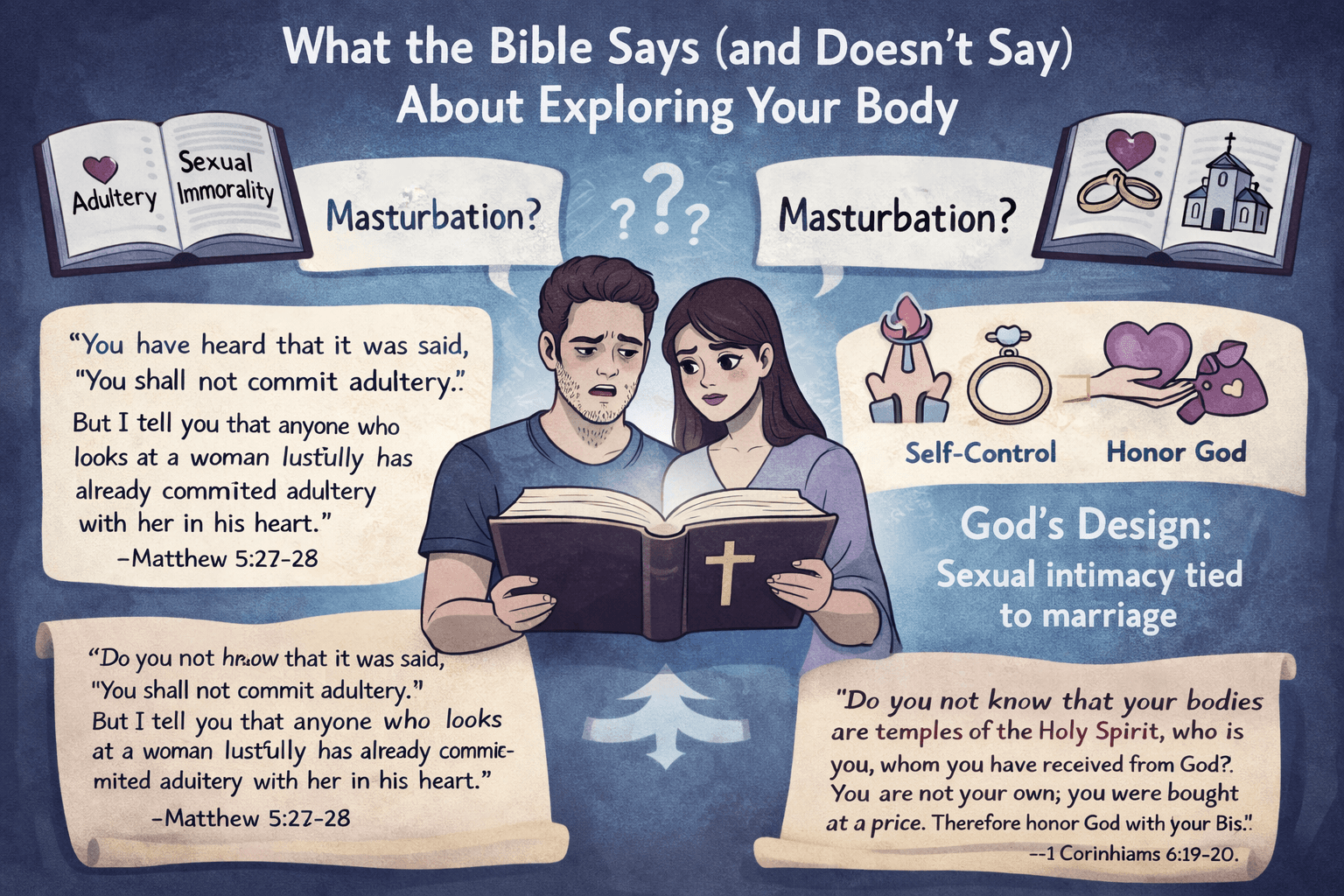
One of the first objections Christians raise when discussing masturbation is that the Bible never mentions it directly.
Unlike adultery, fornication, or sexual immorality more broadly, Scripture does not contain a verse that explicitly names sexual self-stimulation. For some, this absence creates uncertainty: if the Bible doesn’t clearly prohibit something, can it really be considered a sin?
However, the absence of explicit mention does not mean that it is permissible.
The Bible often teaches through principles rather than exhaustive lists of behaviors. Scripture does not attempt to catalog every possible action a person might take; instead, it lays out God’s design for human life and provides moral guidance to help believers evaluate their choices within that design.
Christians regularly apply biblical principles to modern issues that didn’t exist in biblical times, such as technology, media consumption, and many medical practices, without needing explicit verse-by-verse prohibitions.
When it comes to sexuality, the Bible is remarkably consistent. Sexual desire is presented as a powerful gift from God, but one that is meant to be expressed within a specific context.
From Genesis to the New Testament, sexual intimacy is repeatedly tied to marriage—a covenantal union between a man and a woman. Outside of that context, sexual expression is treated as something that can easily become disordered, harmful, or self-focused.
Scripture also places strong emphasis on the condition of the heart and mind, not just outward actions. Jesus teaches that sin is not limited to physical behavior alone, but includes desires, thoughts, and intentions that run contrary to God’s will.
“You have heard that it was said, ‘You shall not commit adultery.’ But I tell you that anyone who looks at a woman lustfully has already committed adultery with her in his heart.”
-Matthew 5:27-28
Further reading: Is It A Sin To Look At A Woman's Body? The Biblical Line Between Attraction and Lust
Because masturbation is typically accompanied by sexual fantasy and lustful imagery, many Christians see it as inseparable from the internal sins Scripture warns against.
At the same time, the Bible recognizes that temptation itself is not the same as sin. Feeling desire, experiencing sexual urges, or noticing attraction does not make a person morally corrupt. These are part of being human in a fallen world. The issue arises in how those desires are handled—whether they are disciplined and directed toward holiness, or indulged in ways that reinforce self-gratification.
This is where Christians often distinguish between curiosity and action. Learning about the body’s biology or seeking medical understanding is not the same as engaging in sexual self-stimulation for pleasure.
But the Christian concern is not knowledge, but behavior that trains the mind and body toward private sexual fulfillment outside of God’s intended design.
Although faithful believers may wrestle with these questions, the broader biblical framework points toward self-control, purity, and honoring God with both body and mind. These principles form the foundation for why many Christians conclude that exploring the body sexually—through masturbation—does not align with Scripture’s vision for human sexuality.
“Do you not know that your bodies are temples of the Holy Spirit, who is in you, whom you have received from God? You are not your own; you were bought at a price. Therefore honor God with your bodies.”
-1 Corinthians 6:19-20
Your Body, Desire, and God’s Design
One of the clearest biblical teachings related to sexuality is that the human body is not morally neutral.
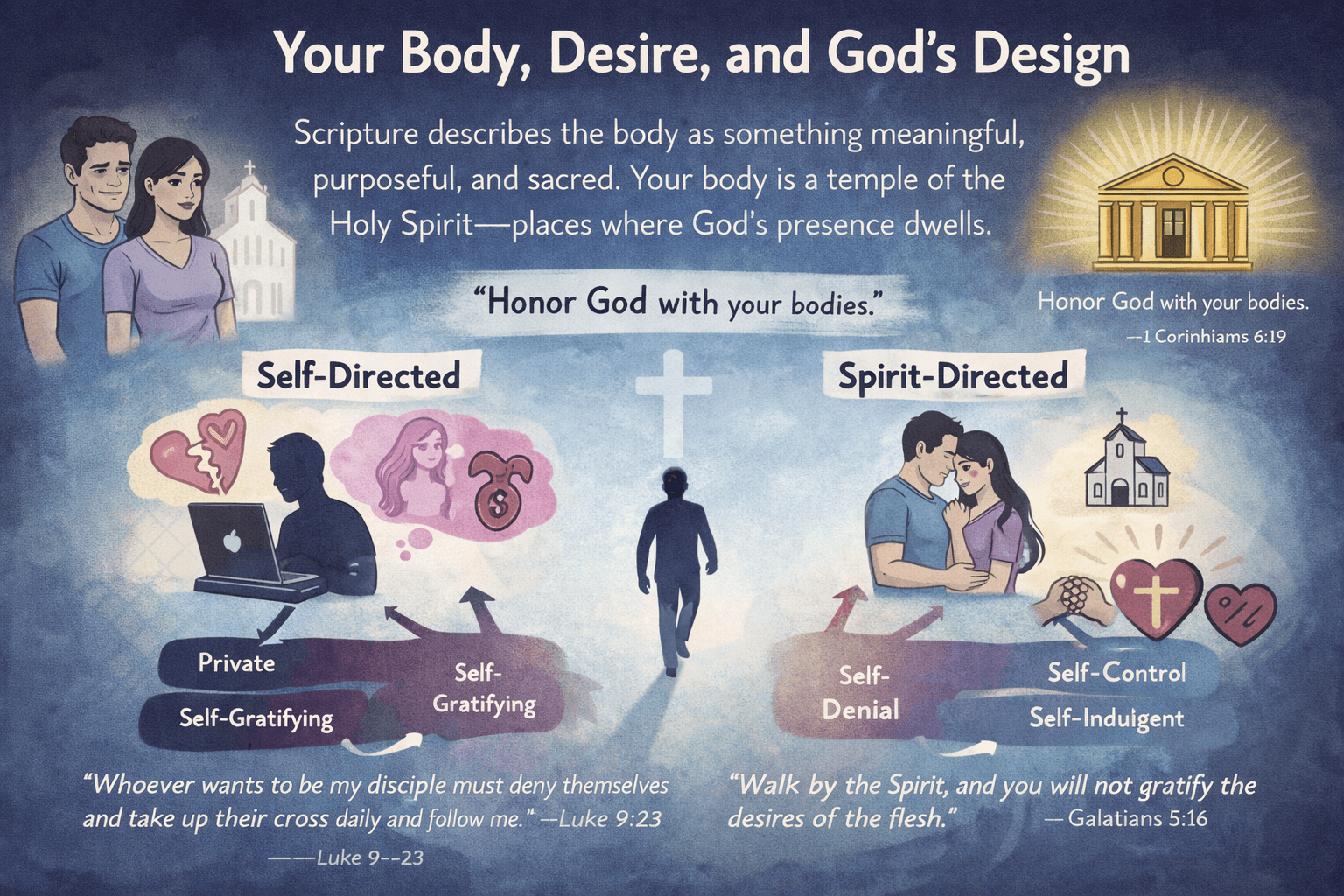
Scripture describes the body as something meaningful, purposeful, and sacred. In 1 Corinthians 6:19, believers are reminded that their bodies are temples of the Holy Spirit—places where God’s presence dwells. This language carries weight.
This passage is important because it suggests that what we do with our bodies matters not only physically, but spiritually.
For many Christians, this teaching shapes how they think about sexual behavior. Sexuality is not treated as a purely private experience or a personal release valve, but as a powerful force meant to serve a higher purpose.
When sexual desire is turned inward—focused primarily on self-stimulation—it can move away from the relational and covenantal context God intended. Sexuality moves away from its unitive purpose and instead becomes self-directed, self-serving, and potentially harmful in what it focuses on.
The Bible consistently calls believers to honor God with both body and mind. Sexual self-exploration often involves mental imagery, fantasy, or habitual patterns that train the heart toward private gratification rather than toward love, commitment, and self-giving.
Even when no one else is involved physically, the inner life is being shaped in a particular direction. Over time, repeated indulgence can dull sensitivity to conviction and weaken the discipline Scripture encourages.
Scripture also warns against allowing desires to rule over us.
“Then he said to them all: ‘Whoever wants to be my disciple must deny themselves and take up their cross daily and follow me.’”
-Luke 9:23
In Luke 9:23, Jesus calls His followers to deny themselves, take up their cross, and follow Him.
This call to self-denial is not about suppressing humanity or rejecting pleasure altogether; it’s about ordering desires rightly. When sexual desire becomes something we immediately satisfy whenever it appears, it begins to exercise authority over us rather than the other way around.
“So I say, walk by the Spirit, and you will not gratify the desires of the flesh. For the flesh desires what is contrary to the Spirit, and the Spirit what is contrary to the flesh. They are in conflict with each other, so that you are not to do whatever you want.”
-Galatians 5:16–17
Galatians 5:16–17 describes a tension every believer experiences—the conflict between the flesh and the Spirit. This passage is a prime example of the Scripture guiding us with principles rather than exact words, and it applies to any time period or situation.
Walking by the Spirit does not eliminate desire. Rather, it demands emotional restraint, mental discernment, and spiritual obedience.
Masturbation, especially when it becomes habitual, can train the body to expect release without effort, commitment, or sacrifice. That pattern works against the formation of self-control, a fruit of the Spirit Scripture repeatedly emphasizes.
None of this implies that believers achieve perfect holiness. No human is perfect, and that’s why we follow Jesus. Scripture is clear that sanctification is a process.
“It is God’s will that you should be sanctified: that you should avoid sexual immorality.”
-1 Thessalonians 4:3
Christians stumble, repent, and grow over time. A single failure does not place someone beyond grace, but unchecked habits can quietly reshape priorities and weaken spiritual resolve. As the old saying goes, “The chains of habit are too light to be felt until they are too heavy to be broken.”
Understanding sexuality through the lens of God’s design helps explain why many Christians view sexual self-exploration as incompatible with holiness.
The issue is not the existence of desire, but how that desire is directed—and whether it is surrendered to God’s will or allowed to rule the body, heart, and mind.
Sexuality, Marriage, and Habit Formation
Throughout Scripture, sexual intimacy is consistently connected to marriage. From the creation account in Genesis to Jesus’ teaching in the Gospels and the instruction of the apostles, sexuality is presented as something designed for covenantal union.
”That is why a man leaves his father and mother and is united to his wife, and they become one flesh.”
-Genesis 2:24
“‘Haven’t you read,’ he replied, “that at the beginning the Creator ‘made them male and female,’ and said, ‘For this reason a man will leave his father and mother and be united to his wife, and the two will become one flesh’?”
-Matthew 19:4–5
“But since sexual immorality is occurring, each man should have sexual relations with his own wife, and each woman with her own husband.”
-1 Corinthians 7:2
Marriage is not simply a social arrangement or legal contract; it is a sacred bond meant to reflect commitment, mutual self-giving, and faithfulness.
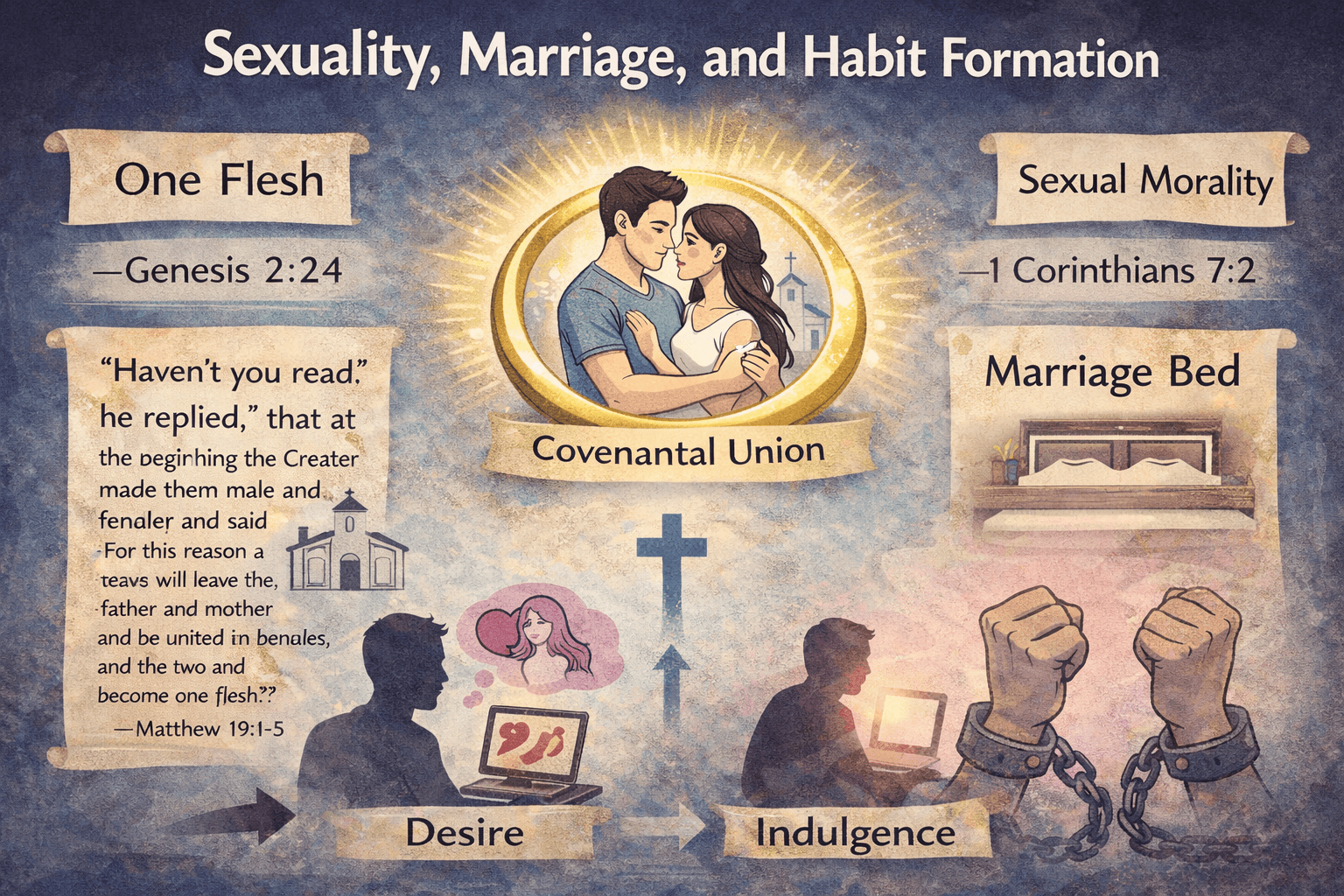
Because of this, many Christians believe that sexual expression outside of marriage—even when done privately—falls outside God’s intended context. Hebrews 13:4 affirms the honor of marriage and calls believers to keep the marriage bed undefiled.
“Marriage should be honored by all, and the marriage bed kept pure, for God will judge the adulterer and all the sexually immoral.”
-Hebrews 13:4
While masturbation does not involve another person physically, it still directs sexual energy away from the relational purpose God designed and inward toward the self.
A common argument in favor of sexual self-exploration is that it harms no one. From a biblical perspective, however, moral evaluation is not limited to immediate external consequences. Scripture frequently addresses the long-term formation of the heart. Private behaviors shape desires, expectations, and habits in ways that are not always obvious at first.
Masturbation, particularly when practiced repeatedly, can become habit-forming. Scripture warns against allowing anything to master us (1 Corinthians 6:12).
Further Reading: What Does The Bible Say About Masturbating?
What begins as an occasional indulgence can slowly develop into a reflexive response to stress, boredom, loneliness, or temptation. Over time, this pattern can reduce sexual desire to a coping mechanism rather than an expression of intimacy.
These habits do not stay isolated. They influence how individuals view sex, relationships, and even their future spouses. Sexual self-gratification trains the body to expect pleasure without vulnerability, patience, or mutual responsibility.
That conditioning can make it harder to approach marital intimacy with selflessness and emotional presence.
The Bible repeatedly encourages believers to pursue freedom, not bondage. Romans 6:12–14 urges Christians not to let sin reign in their bodies, but to offer themselves to God as instruments of righteousness. This call is not about rigid rule-keeping; it’s about cultivating a life that is ordered, disciplined, and directed toward God’s purposes.
None of this suggests that marriage is a reward for sexual restraint or that sexual desire disappears until a wedding day. Desire remains a reality for believers because believers are human and humans have a sex drive.
The question is whether that desire is trained toward self-control and patience, or toward immediate personal release.
By placing sexuality within the context of marriage and covenant, Scripture offers a vision of sex that is meaningful, unifying, and life-giving. From this perspective, exploring the body sexually through masturbation is seen not as harmless experimentation, but as a habit that subtly pulls sexuality away from its God-given purpose.
Repentance, Grace, and Moving Forward
Recognizing the biblical perspective on exploring the body sexually is not meant to leave anyone trapped in shame or condemnation. Scripture is clear that conviction is meant to lead to repentance, and repentance is meant to lead to restoration.
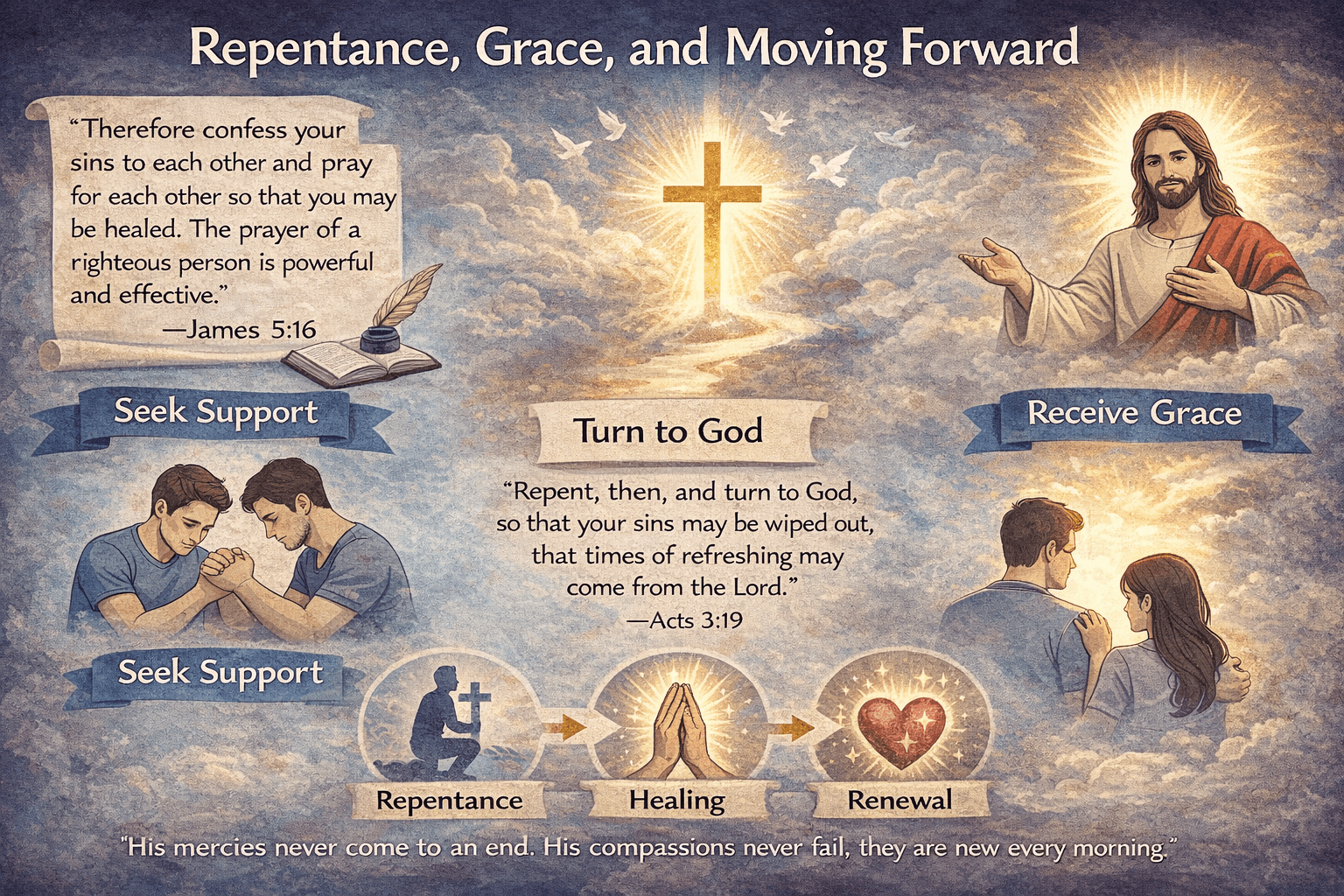
“Repent, then, and turn to God, so that your sins may be wiped out, that times of refreshing may come from the Lord.”
-Acts 3:19
Acts 3:19 calls believers to turn back to God so that times of refreshing may come. No matter how long someone has struggled, God’s invitation to return is always open.
Further reading: Is Touching Yourself A Mortal Sin?
Repentance is more than feeling regret; it involves a willingness to change direction.
For some, this may be a shift in behavior. For others, especially those who have developed habitual or compulsive patterns of masturbation, change can be more difficult.
Sexual habits are often tied to stress, loneliness, anxiety, or emotional pain, which means they cannot always be overcome by willpower alone.
“Therefore confess your sins to each other and pray for each other so that you may be healed. The prayer of a righteous person is powerful and effective.”
-James 5:16
The Bible encourages believers to walk in the light and seek support rather than struggling in isolation. James 5:16 speaks to the healing power of confession and prayer within the body of Christ.
Reaching out to a pastor, mentor, or a trusted friend in the Christian community is an important step toward freedom. These are the individuals who provide the necessary accountability, encouragement, and prayer to help replace secrecy and shame with truth and growth.
It’s also important to remember that sanctification is a process. Growth in holiness does not happen overnight, and mistakes will happen.
Christians stumble and learn as they come to rely on God’s grace rather than their own strength. A temporary setback is not a failure and does not mean defeat. If you struggle, that’s ok because you aren’t perfect.
Neither struggle nor setback disqualifies you from God’s grace and patience.
For those who feel stuck in patterns they can’t seem to break, structured support can be especially helpful. Programs designed for Christians dealing with sexual habits provide guidance, accountability, and community in ways that private resolve often cannot. Having others who understand the struggle can make the path forward feel less overwhelming and more hopeful.
Turing away from sexual self-exploration is not about suppressing desire or rejecting sexuality.
It is about trusting God’s design, honoring Him with both body and mind, and pursuing a kind of freedom that leads to deeper peace and integrity.
Through repentance, support, and reliance on Christ, lasting change is possible—and no one has to walk that path alone.
A Practical Path Forward
If sexual self-exploration has become a habit you can’t seem to break, you’re not alone—and you’re not expected to overcome it through willpower alone. Many Christians struggle quietly, not because they lack faith, but because deeply ingrained habits are shaped by psychology, environment, and emotional patterns as much as spiritual conviction.
Relay is designed with that reality in mind. It uses sound, research-backed psychological methods—such as habit tracking, behavioral awareness, and structured accountability—to help people change patterns that feel automatic or compulsive.
At the same time, Relay recognizes that for many believers, lasting change is strengthened when those tools are grounded in faith. That’s why the program offers an option to integrate biblical principles, prayer, and Christian community alongside its evidence-based approach.
This isn’t a “faith-only” solution, and it isn’t a cold, clinical system either. Relay combines practical behavioral tools with meaningful spiritual support, giving users both structure and purpose as they work toward freedom.
You don’t have to share more than you’re comfortable with, and you don’t need to have everything figured out before you begin. The goal isn’t perfection—it’s steady progress, honesty, and building habits that align with the life you want to live.
If you’re ready to stop fighting this battle alone and want a clear, grounded path forward, Relay can help you take that next step.
👉 Learn more about Relay and get started here.