

Key takeaways of God's forgiveness of lust
-
God forgives lust, even after repeated failure, because forgiveness is based on His mercy, not perfect behavior.
-
The Bible does not limit how many times someone can be forgiven when they genuinely repent.
-
Repeated struggle with lust does not mean someone is rejected by God, but often reflects habit patterns and emotional triggers.
-
Temptation itself is not sin; sin occurs when desire is intentionally entertained and acted upon.
-
Feeling guilt or remorse is a sign of an active conscience, not evidence that grace has run out.
-
The cycle of temptation, relapse, and shame is often reinforced by isolation and lack of structure, not lack of faith.
-
Lasting change requires combining repentance with practical steps like accountability, habit change, and reducing triggers.
-
Christianity teaches transformation over time, with grace supporting growth rather than excusing ongoing patterns.
Frequently asked questions about God's forgiveness of lust
Will God forgive me for watching bad things?
Yes. Scripture teaches that God forgives those who confess and repent, regardless of how many times they have failed.
What if I keep failing over and over again?
Repeated failure does not cancel forgiveness. What matters is continued repentance and a genuine desire to change.
Is being tempted the same as sin?
No. Temptation itself is not sin—sin occurs when temptation is entertained and acted on.
Why does pornography feel spiritually serious?
Because it involves intentional lust, shapes desire, and can create patterns of secrecy and disconnection from God and others.
How can I stop repeating this cycle?
By combining repentance with practical steps like accountability, habit changes, reducing triggers, and building supportive structures for change.
Relay is a therapist-backed group recovery program for pornography and unwanted sexual behavior, combining daily accountability, real-time urge support, and a private peer community.
Does God Forgive Lust? Yes — Even When You’ve Failed Repeatedly
If you're on this page, you’re probably worried that despite your best efforts, you may have exhausted God’s grace and put yourself beyond forgiveness.
On the one hand, you know you’re imperfect, and God expects you to repent of your sins. But you also know that you keep making mistakes, and you feel like it’s impossible to escape lust in this modern world.
Last night, you were frustrated and lonely. Although you exercised your willpower and tried to remain vigilant and disciplined, you failed to keep your mind clear, your heart pure, and you misdirected your sexual energy and felt like you violated your temple.
You feel like you messed up.
And then you promised yourself it would be the last time, but you said that the last time—and the time before that.
You’ve prayed for forgiveness so many times that you’re afraid to pray again because you wonder—despite everything you’ve learned about God—that maybe he’s tired of forgiving you.
You worry that you’ve somehow managed to run out of forgiveness. But is such a thing even possible?
The Bible does not put a number on how many times you can be forgiven.
It does not say forgiveness runs out after the tenth failure, the hundredth relapse, or the moment you feel exhausted and discouraged.
Scripture grounds forgiveness in God’s divine character—“merciful and gracious, slow to anger, and abounding in steadfast love” (Psalm 103:8–12)—not in an artificial limit based on human perspective.
So the clear answer, before we move on to anything else, is simple, beautiful, and reassuring:
Yes. God forgives lust — even when you’ve failed repeatedly.
Further reading: Will God Forgive Me For Watching Bad Things?
God’s infinite forgiveness does not mean lust is harmless, repentance doesn’t matter, or that grace is permission to keep sinning.
But it does mean this: forgiveness is not something you “use up,” run out of, or exhaust.
This confusion is at the heart of many questions that Christians struggle with. For example, you may also be trying to understand whether masturbation itself is considered a sin.
For a deeper explanation of the theology around this question, see our full guide to whether masturbation is a sin.
If you’re a Christian who struggles with lust, it’s tempting to think you’re rebelling against God’s plan and that you’re a failure, but that’s simply not true. The reality is that you’re flawed and human, and you make mistakes.
But when you’re trying to live life as God intended, those flaws and mistakes can leave you feeling trapped, exhausted, and in a cycle you don’t fully understand but so desperately want to escape.
This is true for all sins, but lust feels different from all the other sins, because it’s the one sin that appears to be beyond your control.
People don’t usually count how many times God forgives their pride, impatience, or anger, because society also reinforces the control of those misgivings and sins. Also, perhaps most importantly, lust involves not just the heart and mind, but the body as well.
There are real physiological reactions that are not just normal but have become normalized, not just in their expression but also in their representation in media and cultural norms. And so you almost automatically give in to temptation without a second thought.
And then the cycle starts.
Relief follows temptation. Shame follows relief. And soon, forgiveness begins to feel like a limited resource rather than a promise.
If that’s where you are right now, pause for a moment and take a breath.
The fact that you are afraid—and even thinking about this—itself is not proof you’re beyond forgiveness. Feeling remorse is proof that you are not beyond grace, not evidence that grace has run out.
Wondering about the limits of forgiveness for repeated transgressions is not a sign of spiritual failure. It’s the exact opposite. It’s a sign that your conscience is still very much alive.
Before talking about how to change, it’s important to settle this first:
God is not counting how many times you’ve asked for forgiveness.
The danger is not that God will stop forgiving you. That is impossible. The real danger is believing that you are already beyond redemption, so you give up hope and stop trying to live in God’s image.
This article will dive into why this happens and how to step out of it without minimizing sin or living in constant fear.
Popular Recovery Guides
The Short Answer: Yes. God Forgives Lust — Again and Again
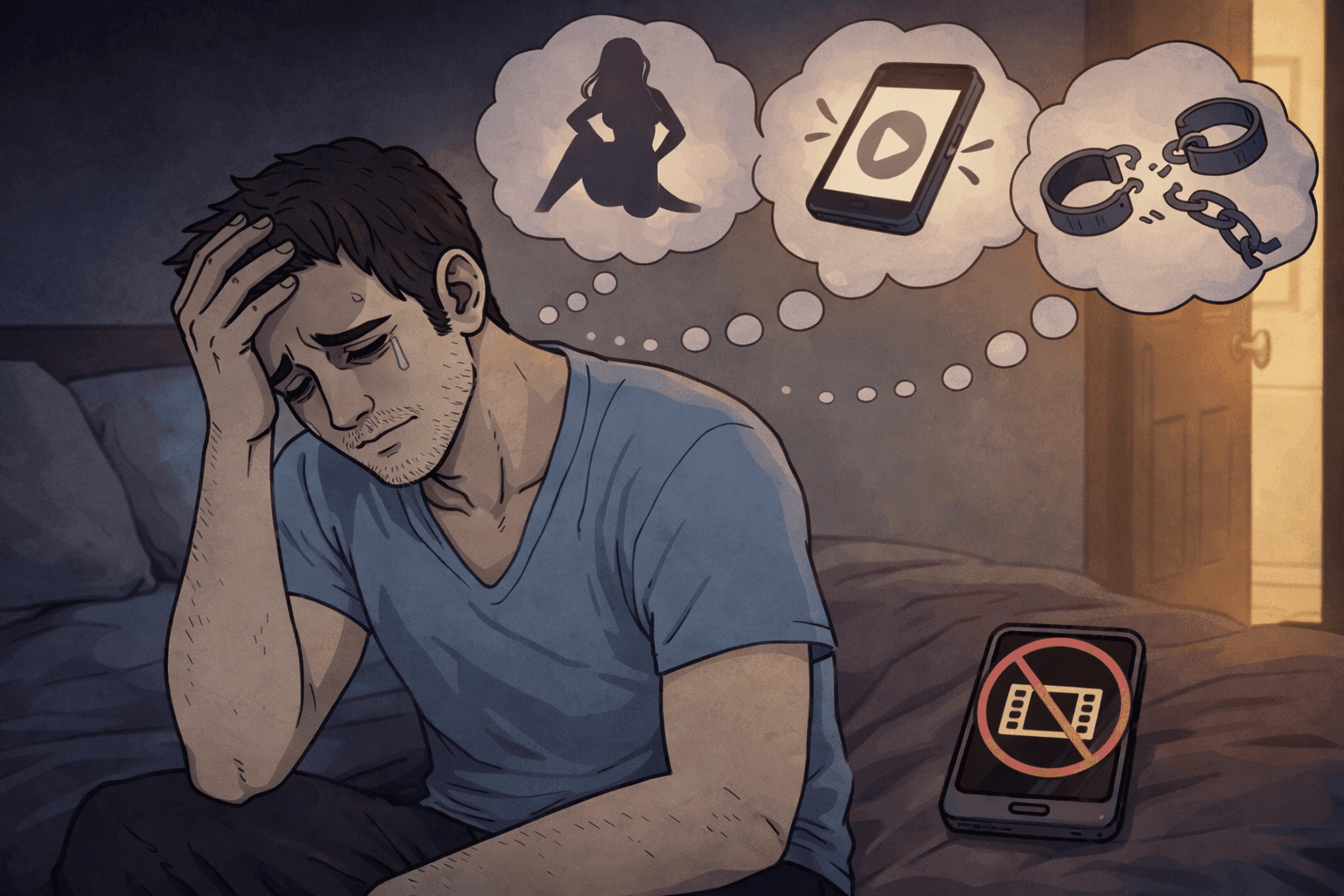
Scripture anchors forgiveness in God’s character, not in a quota system tied to your performance.
He is “merciful and gracious, slow to anger, and abounding in steadfast love,” and that steadfast love does not diminish with repeated failure.
When the Bible speaks of forgiveness, it never assigns a number, a cap, or a final warning label for sincere repentance; it consistently points back to a God whose grace is deeper than our weakness and whose faithfulness does not run out when we stumble.
Forgiveness is not tallied, rationed, or depleted—it flows from who God is, not how many times you’ve asked.
If you want to see how Scripture consistently addresses lust, repentance, and mercy together, you may find these biblical passages on masturbation and lust helpful.
Why Lust Feels Different Than Other Sins
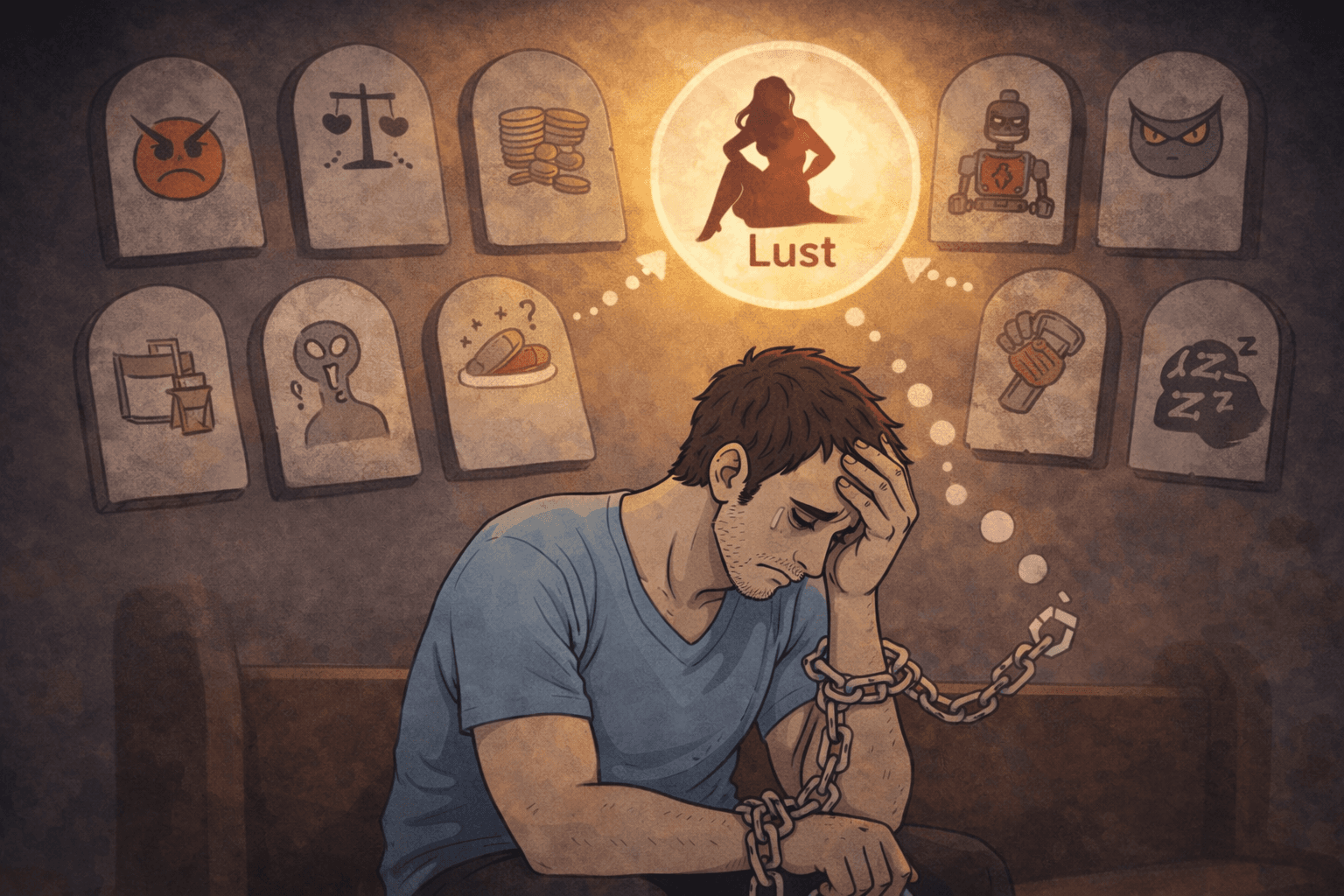
Lust often carries a weight that other sins don’t, and that difference is real—even though the doctrine of sin itself doesn’t change.
Sexual sin uniquely involves both the mind and the body, which means it doesn’t stay abstract. A thought becomes physical arousal, arousal seeks release, and release brings temporary relief. That embodied sequence sets lust apart from sins that remain largely internal or situational.
What makes this struggle even harder is that lust is not merely tolerated in modern culture—it is normalized, rewarded, and often celebrated. For many Christians, especially younger ones, daily life places invisible expectations directly at odds with their faith. Sexual imagery is constant. Pornography is ubiquitous. Temptation is no longer occasional; it’s ambient.
Giving in, however briefly—and however normalized it feels in the moment—is quickly followed by guilt and shame. The pattern becomes predictable: thought → body → relief → guilt. Over time, this loop trains the brain to repeat the behavior even while the conscience remains fully aware that something is wrong. The result is not indifference to sin, but a painful inner conflict where environment, desire, and conviction collide again and again.
This is why lust produces such intense shame. It feels personal. It feels secretive. And it creates a visible clash between culture and conscience, biology and belief, desire and devotion. Because the body is involved, repeated failure is often interpreted not as weakness or misdirected desire, but as evidence of moral corruption.
This tension also drives more granular questions about bodily awareness and intent, such as whether exploring your own body is sinful in itself.
Further reading: Is It A Sin To Look At Woman's Body?
Pride, anger, or envy rarely create the same immediate cycle of bodily reinforcement, so we don’t tend to count how many times we’ve been forgiven for them. Society also reinforces control over those sins. Lust works differently. It is culturally accepted, biologically reinforced, and spiritually resisted.
Each failure creates a visible “reset moment,” which tempts people to start counting: How many times have I asked? How many times is too many? Is the priest—or God—finally going to get tired of hearing this confession?
Keeping count is not a sign of weak faith. It’s a sign that lust behaves differently from other sins. And without understanding how this reinforcement loop works, people end up measuring their worth by how often they fall, rather than learning to step out of the pattern entirely.
Repeated Failure Does Not Mean You’re Rebellious or Rejected
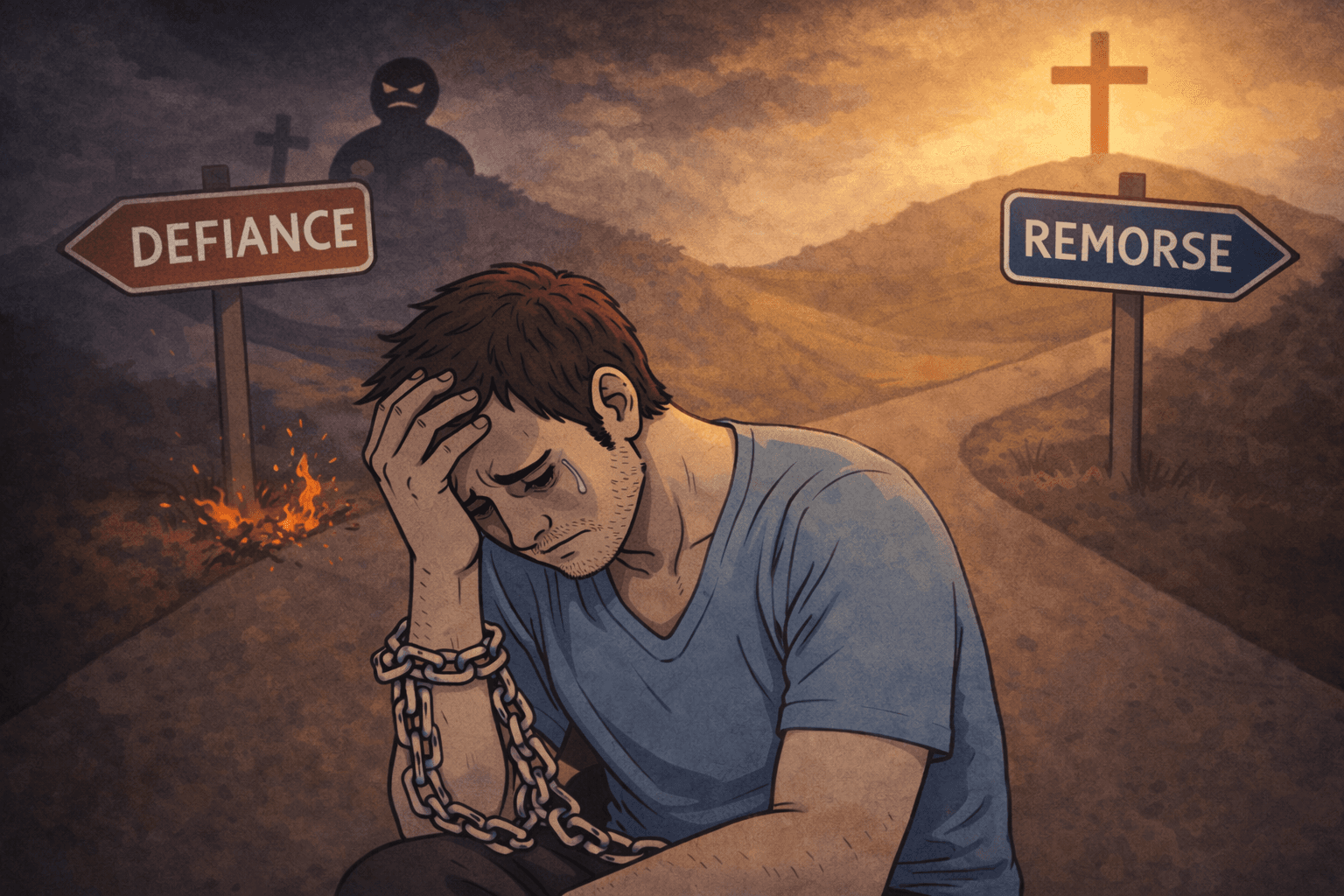
One of the most damaging conclusions people draw from repeated lust is that failure itself equals defiance—that if the sin keeps happening, it must mean they’ve stopped caring or are deliberately abusing grace.
Scripture warns against hard-hearted rebellion, but it also draws an important distinction between presumption and ongoing struggle.
Presumption is not falling and repenting; it is sinning with the settled attitude that repentance doesn’t really matter because forgiveness can be assumed in advance. It treats grace as a safety net rather than a gift.
By contrast, ongoing struggle is marked by resistance, remorse, and a genuine desire to change—even when a person keeps falling short. Defiance shrugs at sin. Presumption plans around it. Struggle grieves it.
Those states are not the same, and confusing them causes unnecessary fear. Many believers who are terrified that they are “taking advantage of grace” are not presuming at all—they are fighting, failing, and returning to God with honesty rather than indifference.
Read more about how to overcome lustful thoughts.
This is why remorse is the clearest signal that you are not beyond forgiveness and grace. Guilt, grief, and even fear are not signs that God has abandoned you; they are signs that you still want God in your heart, and that desire matters more than anything—but only when paired with the resolve to make space for him by living in His image.
People who have turned their backs on Christ do not care whether they are forgiven. They just make excuses, minimize the sin, or assume that all will be well because they will ask for forgiveness later—or they stop trying altogether.
The very fact that lust troubles you, that you regret it, and that you are searching for clarity is strong evidence that you are not sinning under presumption. It means sin has not become your identity or your allegiance.
Scripture describes God’s mercy not as fragile or exhaustible, but renewing—“his compassions never fail; they are new every morning” (Lamentations 3:22–23)—which is precisely why fear is not the same thing as rejection.
Passages like Hebrews 10 are often read as warnings against repeated failure, but in context they address deliberate rejection of Christ, not believers who grieve their sin and keep turning back to God. But those warnings are aimed at deliberate rejection of Christ, not believers who hate their sin yet struggle to overcome it.
The danger Scripture describes is not failing again; it is deciding that repentance no longer matters.
If you are still turning toward God—even weakly, even exhausted, even afraid—you have not crossed the line those warnings address. Fear may feel unbearable, but it is not proof of rejection. In many cases, it is proof that your heart has not gone numb.
The Forgiveness–Relapse–Counting Trap (And How It Forms)
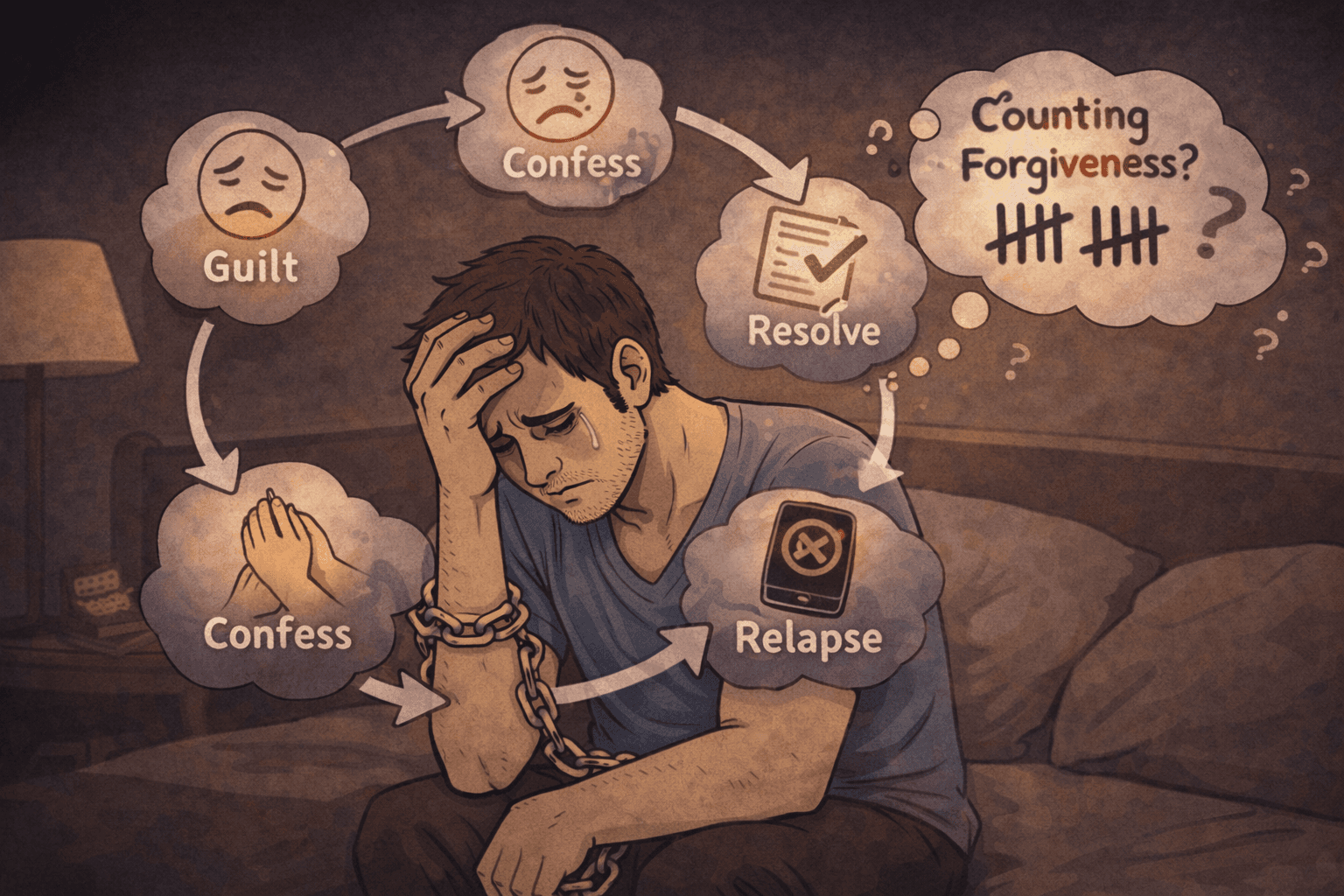
The struggle with lust follows a predictable cycle that quietly turns faith into fear. It usually begins with sin, followed almost immediately by guilt—the sharp awareness that you’ve done something wrong.
Confession comes next, and with it a real sense of relief. For a moment, the burden lifts from your shoulders, and you develop a sincere resolve: This time will be different. But then a familiar trigger rears its ugly head—stress, loneliness, boredom, fatigue—and the cycle repeats.
Relapse follows, often faster than expected, and the relief that once came from confession is replaced by deeper shame.
At that point, you look for certainty. You start ruminating on how many times you’ve asked to be forgiven for your sin:
Oh no, not again. How many times is this now? How many times can God forgive this? Am I still sincere—or am I just taking advantage? Did I plan this knowing that I’d be absolved?
And then you become afraid—not because forgiveness has limits, but because the cycle itself feels endless, and you feel like God is at his wits’ end with your soul. The focus shifts away from repentance and toward tallying failures, as if forgiveness were a finite resource.
Here’s something you have to keep in mind: counting forgiveness is not repentance—it’s anxiety disguised as remorse.
Repentance turns toward God with honesty and trust. Anxiety turns inward, measuring your worthiness, sincerity, and how many chances you have left.
Until you understand that difference, you will stay trapped—confessing faithfully, fearing constantly, and mistaking your fear for spiritual discernment.
What Actually Helps You Move Forward (Without Minimizing Sin)

Lasting change rarely comes from trying harder; it comes from changing the conditions around the struggle.
Lust thrives in familiar, predictable environments—privacy, fatigue, unstructured time—so removing triggers matters more than willpower. Changing your environment will change your behavior more than changing your behavior will change your environment.
And the change doesn’t have to be complicated or extensive.
It can be as simple as using different devices, following a different routine, going to bed an hour earlier so you’re well rested, or switching up the media you consume.
Scripture treats temptation as something to flee, not something to stare down and prove strength against.
Accountability also matters, but only when it is supportive rather than shaming. Groups or partners that rehearse failure without offering structure tend to reinforce the very cycle they’re trying to stop.
Healthy accountability focuses on honesty, encouragement, and forward movement—not public confession as punishment. Avoid shame, because shame isolates, but support stabilizes. When someone knows they can speak freely, they are far more likely to interrupt the cycle before it escalates.
You also need an after-slip protocol—a clear plan for what to do immediately after failure. That means refusing to spiral into self-condemnation, confessing without dramatizing, and re-engaging with normal life instead of hiding.
The goal is to shorten the distance between failure and restoration, not to pretend the failure didn’t matter. Lingering in shame gives lust more power, not less.
Isolation is what ultimately strengthens lust the most. Secrecy amplifies desire, distorts perspective, and convinces people they are uniquely broken.
Struggle grows in the dark and dies when it’s brought to light.
Moving forward doesn’t require minimizing sin—but it does require refusing to let sin define the entire story.
When You Need More Than Willpower

Willpower works in short bursts, but lust is rarely a single-moment temptation. It’s reinforced by habits, isolation, emotional regulation, and long-standing patterns that don’t disappear just because someone prayed harder.
For many people, the problem isn’t a lack of sincerity or willpower—it’s a lack of structure.
What’s needed isn’t more intensity or a stronger resolve, but a supportive community, a new lifestyle structure, and sincere guidance. When these elements are combined, it’s easy to interrupt the cycle before it reaches critical mass.
Community matters because struggle weakens in the presence of consistency and honesty.
Not public shaming or performative confession—rather knowing that you’re not fighting alone, and that someone will notice if you stop trying or disappear into isolation.
Structure matters because vague intentions don’t survive stress, fatigue, or loneliness.
Clear rhythms, check-ins, and expectations reduce the mental load of “figuring it out again” every time you slip. Guidance matters because many people have never been taught how lust actually works psychologically and spiritually—they’ve only been told to stop.
None of this replaces repentance, and none of it substitutes for faith.
Confession, humility, and turning toward God remain central. But tools like community and structure make the beast of lust so much easier to tame.
Remember that grace and help are not mutually exclusive. Sometimes, the most faithful move is to admit that willpower alone was never meant to carry the weight.
If You’re Reading This After Failing Again
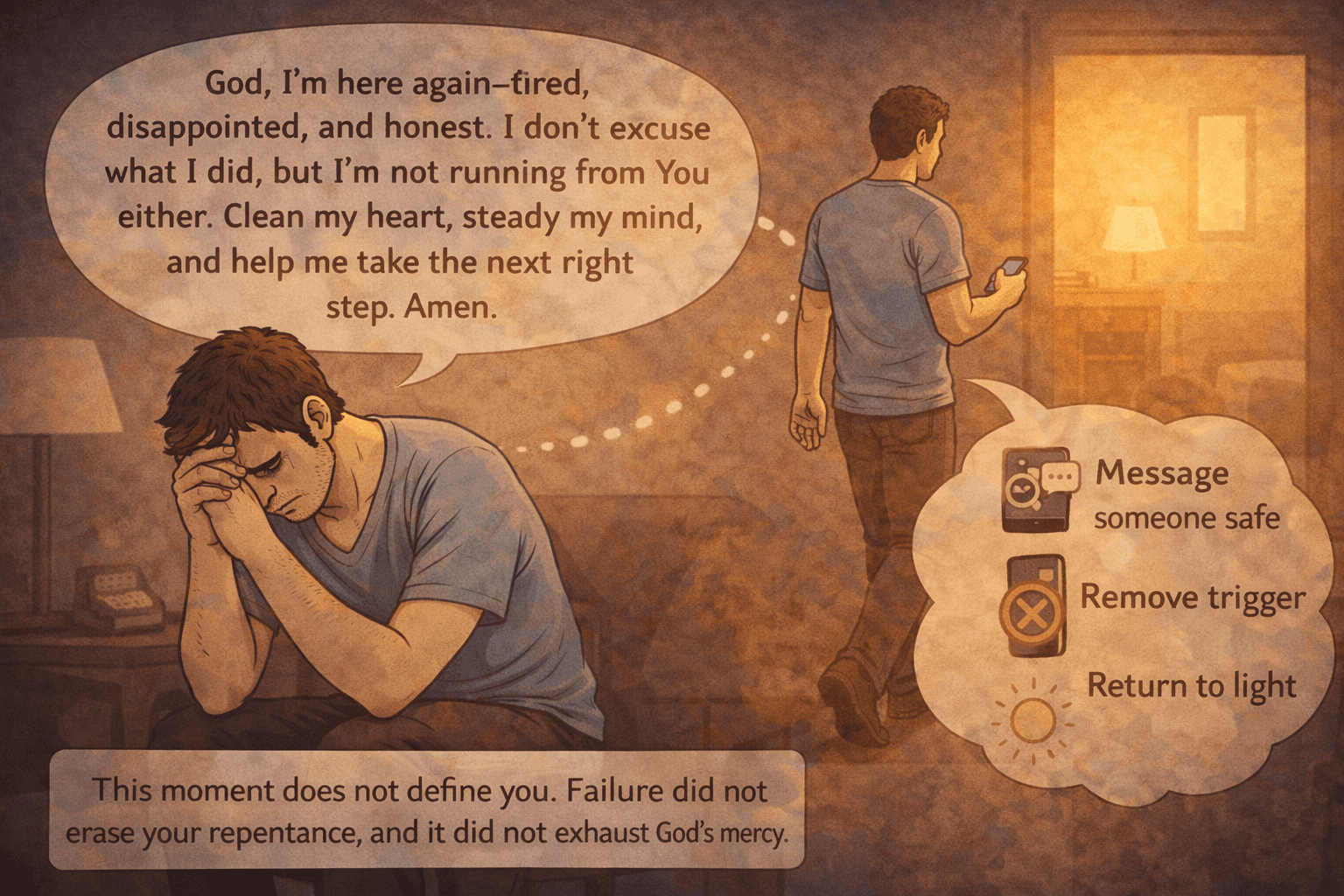
A short prayer against lust:
God, I’m here again—tired, disappointed, and honest. I don’t excuse what I did, but I’m not running from You either. Clean my heart, steady my mind, and help me take the next right step. Amen.
A short reassurance:
This moment does not define you. Failure did not erase your repentance, and it did not exhaust God’s mercy. Shame is loud right now, but it is not the voice of truth.
The clear next step:
Don’t spiral. Don’t start counting. Don’t hide. Confess simply, stand up, and re-enter the light—message someone safe, remove the trigger you just fell to, and return to your normal rhythm. The goal isn’t to punish yourself; it’s to shorten the distance between falling and getting back up.
And read this article about what to do after a relapse to help you keep from spiraling.
God Can Forgive Lust, Grace Is Not Running Out, and You Don’t Have to Fight Alone
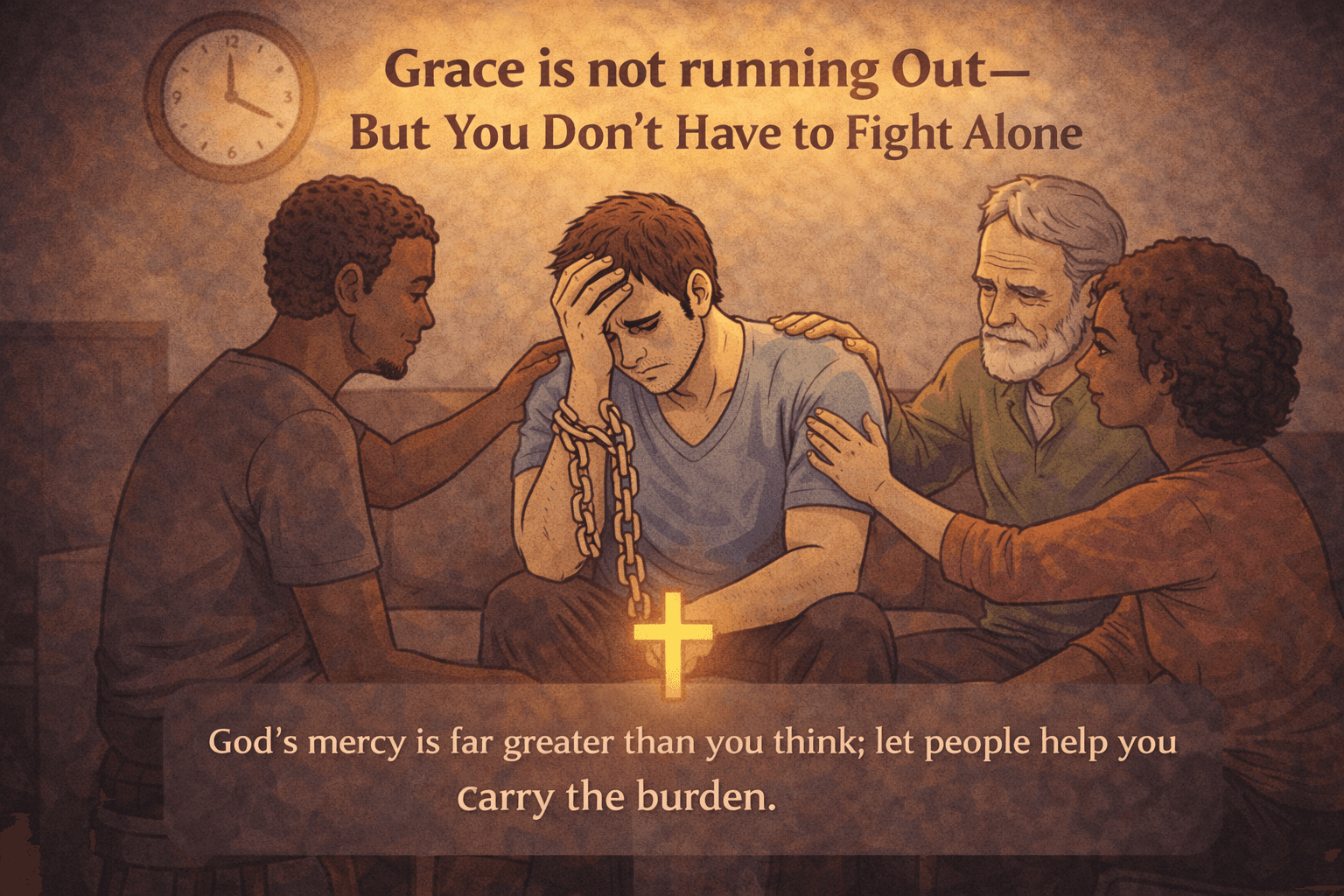
Grace is not a countdown clock, and forgiveness is not slowly being depleted by your weakness.
God’s mercy does not shrink because you’re tired, inconsistent, or still learning how to change. But grace was never meant to be carried alone in silence.
Struggle grows heavier in isolation and lighter when it’s shared with the right kind of support—people and structures that tell the truth, reduce shame, and help you keep moving forward without pretending sin doesn’t matter.
If your fear is framed in terms of “mortal sin” or spiritual finality, this question about whether touching yourself is a mortal sin may address that concern directly.
Further reading: Is Touching Yourself A Mortal Sin? Does God Forgive This Struggle?
If you’ve realized that willpower by itself keeps breaking under the same pressure, that’s not failure—it’s clarity.
You don’t need theatrics or vows you can’t keep. You need honesty, rhythm, and support that works with repentance, not against it. Grace is still there. And you don’t have to fight this by yourself anymore.
If you find that willpower alone keeps breaking under the same pressure, support and structure can help. Relay exists to provide that kind of guidance and community.